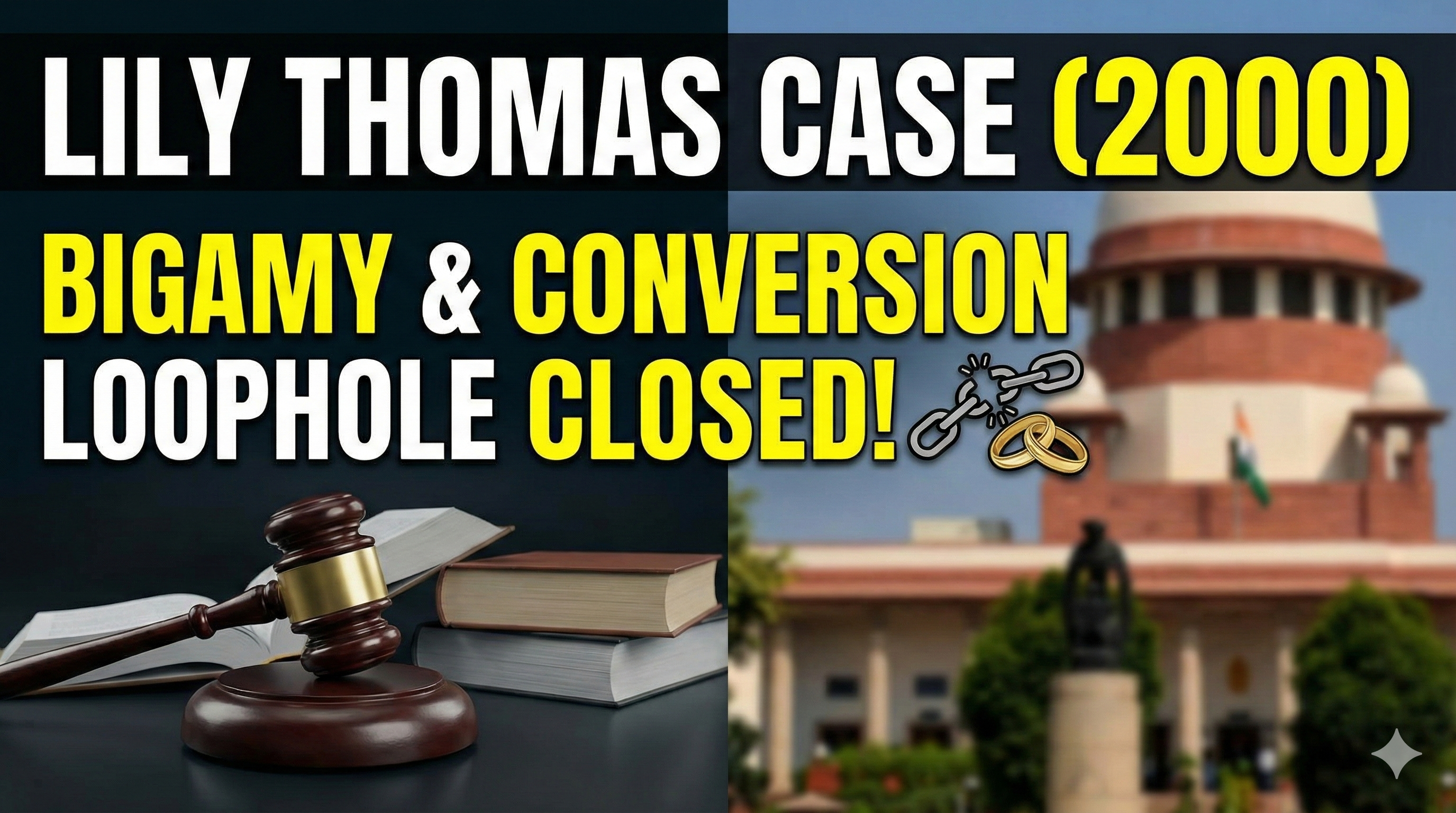
Ever heard of a legal loophole so problematic it had to be slammed shut by the Supreme Court? The 2000 case of Lily Thomas v. Union of India is a perfect example.This judgment was a crucial moment in Indian family law, clarifying the intersection of religious freedom, marriage laws, and the Indian Penal Code.
The Facts of the Case
This case didn’t happen in a vacuum. It was a set of review petitions filed against the Supreme Court’s own 1995 judgment in Sarla Mudgal v. Union of India.
The Original Problem (The Sarla Mudgal Facts): The court, in 1995, was addressing several writ petitions. The common story was this: a Hindu man, already married under the Hindu Marriage Act, 1955, would convert to Islam. He would then marry a second woman, claiming that as a Muslim, he was now permitted to have up to four wives. His first Hindu wife was left in a legal and social lurch, as he claimed his conversion ended their marriage.
The 1995 (Sarla Mudgal) Ruling: The Supreme Court held that such a second marriage was void and the husband was liable for bigamy under Section 494 of the IPC.
The 2000 (Lily Thomas) Petitions: The petitioners in this case (Lily Thomas & others) filed petitions asking the court to review and overturn the Sarla Mudgal decision, arguing it was legally incorrect.
Issues Before the Court
The court was essentially re-examining its own logic. The core issues were:
1. Was the 1995 Sarla Mudgal judgment legally incorrect and did it deserve to be overturned?
2. If a Hindu man converts to Islam while his first (Hindu) marriage is still subsisting, can he contract a valid second marriage?
3. Does such a second marriage make him guilty of bigamy under Section 494 of the Indian Penal Code (IPC)?
Arguments of the Parties
Petitioners (Challenging the Sarla Mudgal judgment)
Infringement of Religious Freedom: The primary argument was that the Sarla Mudgal judgment infringed on the fundamental right to practice and profess any religion (Article 25).
Application of Personal Law: They argued that once a person converts to Islam, they are governed by Muslim Personal Law, which permits polygamy (up to four wives).
IPC 494 Doesn’t Apply: They contended that for bigamy under Section 494 of the IPC to apply, the second marriage must be “void.” They argued that under Muslim law, this second marriage was not void, and therefore the husband could not be prosecuted.
Respondents (Defending the Sarla Mudgal judgment)
First Marriage is Statutory: The first marriage was solemnized under the Hindu Marriage Act, 1955. This Act is a statute that enforces monogamy.
Conversion Doesn’t Dissolve Marriage: A marriage under the Hindu Marriage Act can only be dissolved by one of the methods prescribed in the Act itself (i.e., a decree of divorce). A party’s conversion to another religion does not, by itself (ipso facto), dissolve the marriage.
Sham Conversions: It was argued that these conversions were not genuine acts of faith but “fraudulent” shams, done for the sole purpose of escaping the legal obligations of the first marriage.
Article 25 is Not Absolute: The right to religious freedom (Article 25) does not give anyone the right to commit a crime or to infringe on the legal rights, dignity, and life (Article 21) of the first wife.
The Judgment
The Supreme Court, in a powerful and unambiguous ruling, dismissed the review petitions and emphatically upheld the Sarla Mudgal judgment.
Review Dismissed: The court found no error in its 1995 decision.
Second Marriage is VOID: It confirmed that a second marriage contracted by a Hindu husband after converting to Islam (without dissolving the first marriage) is null and void.
Bigamy Charge Stands: Such a husband is unequivocally liable for prosecution under Section 494 of the IPC for bigamy.
The Court’s Core Logic:
- The first marriage, solemnized under the Hindu Marriage Act, is a valid, subsisting, monogamous marriage.
2. That marriage can only be dissolved as per the procedures laid down in the Hindu Marriage Act.
3. Conversion to Islam is not a procedure for dissolving the marriage.
4. Therefore, even after conversion, the man is still the legal “husband” of his first wife.
5. When he marries a second time, he does so while his first wife is living and the first marriage is still in force.
6. This action perfectly fits the definition of bigamy under Section 494 IPC, which applies to “whoever… having a husband or wife living, marries in any case in which such marriage is void by reason of its taking place during the life of such husband or wife.”
- Honor Killing After Independence

- Navtej Singh Johar v. Union of India : Landmark case that decriminalised Homosexuality in India
- Kerala High Court : Mandatory Injunction Claim Does Not Bar Arbitration

- AI-Hallucinated Case Citations: Landmark NCLAT Review in Pooja Ramesh Singh v. Jammu and Kashmir Bank
- Juvenile Justice (Care and Protection of Children) Act, 2015