
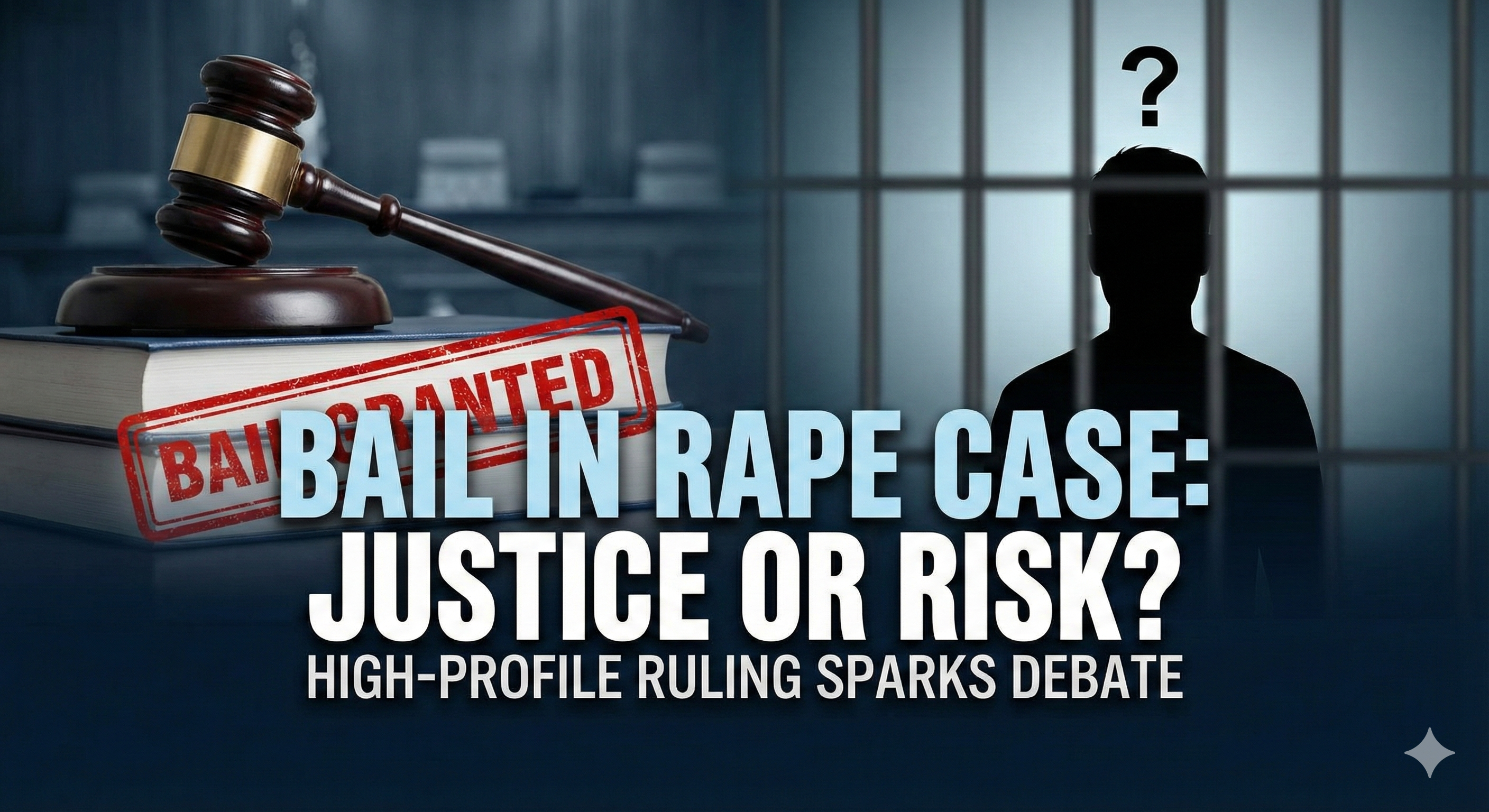
The legal landscape regarding bail in sensitive cases has been a subject of intense debate in 2025. The most significant recent development involves the Delhi High Court’s decision to grant bail to Kuldeep Singh Sengar, the former BJP MLA convicted in the 2017 Unnao rape case.
This case has reignited discussions on the interpretation of the POCSO Act, the definition of a “public servant,” and the balance between an accused person’s right to liberty during appeal versus the safety of the victim.
The High-Profile Ruling: Bail for Kuldeep Singh Sengar
On December 23, 2025, a division bench of the Delhi High Court suspended the life sentence of Kuldeep Singh Sengar and granted him bail. Sengar had been in custody since 2018 and was serving a life term awarded by a trial court in December 2019 for the kidnapping and rape of a minor.
Why was Bail Granted?
The High Court’s reasoning was centered on two primary factors:
Duration of Incarceration: The court noted that Sengar had already served over seven years and five months in prison. It held that continued incarceration during the pendency of a long-drawn appeal could violate his rights under Article 21 of the Constitution.
Interpretation of “Public Servant”: In a controversial legal turn, the bench prima facie observed that an MLA might not fall under the strict definition of a “public servant” for the purpose of Section 5(c) of the POCSO Act (Aggravated Penetrative Sexual Assault). By diluting this classification, the court found grounds to suspend the maximum sentence.
Strict Conditions Imposed
The bail was not absolute. The High Court imposed several stringent conditions to ensure the safety of the survivor and the integrity of the judicial process:
Financial Bond: A personal bond of ₹15 lakh with three sureties of the same amount.
Geographic Restrictions: Sengar is strictly prohibited from entering a 5-kilometer radius of the survivor’s residence.
Residence Limit: He is directed to stay within the limits of Delhi during the pendency of his appeal and cannot leave without permission.
No Contact: A complete ban on contacting or threatening the survivor or her family members.
Note: Despite this bail order, Sengar remains in jail as he is also serving a 10-year sentence in a separate case related to the custodial death of the survivor’s father.
The CBI’s Challenge in the Supreme Court
The decision sparked immediate backlash from the survivor’s family and the Central Bureau of Investigation (CBI). On December 26, 2025, the CBI filed a Special Leave Petition (SLP) in the Supreme Court, seeking an immediate stay on the bail order.
The CBI’s Core Arguments:
Advani Judgment Precedent: The CBI cited the landmark L.K. Advani v. CBI case, arguing that MPs and MLAs are indeed “public servants” under the Prevention of Corruption Act and should be treated as such under POCSO.
Gravity of Offense: The agency argued that the heinous nature of the crime—rape of a minor by a person in power—overshadows the duration of time spent in jail.
Threat Perception: The survivor has publicly called the bail order a “Kaal” (death sentence) for her family, expressing deep fears for their safety.
Broader Legal Implications in 2025
The Sengar case is part of a broader trend in 2025 where Indian courts are “walking the tightrope” of bail. Other notable rulings this year include:
- J&K Court (June 2025): Denied bail in a rape case involving a 70-year-old tourist, citing a “moral collapse” of the accused.
- Punjab & Haryana High Court (June 2025): Granted bail in a “rape on pretext of marriage” case, suggesting that the possibility of a “no strings attached” relationship should be considered during the trial.
Key Takeaways for Legal Professionals
| Issue | Judicial Trend in 2025 |
|---|---|
| Incarceration Period | Increasing weight given to the length of time spent in jail during appeals. |
| POCSO Interpretations | Debates over the definition of “Authority” and “Public Servant” are intensifying. |
| Victim Safety | Courts are using “Geographic Restrictions” as a middle ground for granting bail. |
What’s Next?
The Supreme Court, led by a vacation bench, is scheduled to hear the CBI’s appeal on December 29, 2025. This hearing will be a landmark moment, potentially clarifying whether the status of a lawmaker as a “public servant” triggers harsher penalties and stricter bail conditions under the POCSO Act.
- Honor Killing After Independence
- Navtej Singh Johar v. Union of India : Landmark case that decriminalised Homosexuality in India
- Kerala High Court : Mandatory Injunction Claim Does Not Bar Arbitration
- AI-Hallucinated Case Citations: Landmark NCLAT Review in Pooja Ramesh Singh v. Jammu and Kashmir Bank
- Juvenile Justice (Care and Protection of Children) Act, 2015


1 thought on “Justice or Risk? The Shocking Bail of Kuldeep Singh Sengar”
Ooh, Phtayavip, sounds fancy! Is it as VIP as it sounds? Anyone know? Thinking about checking it out. Here’s the link for anyone else who’s curious: phtayavip.