
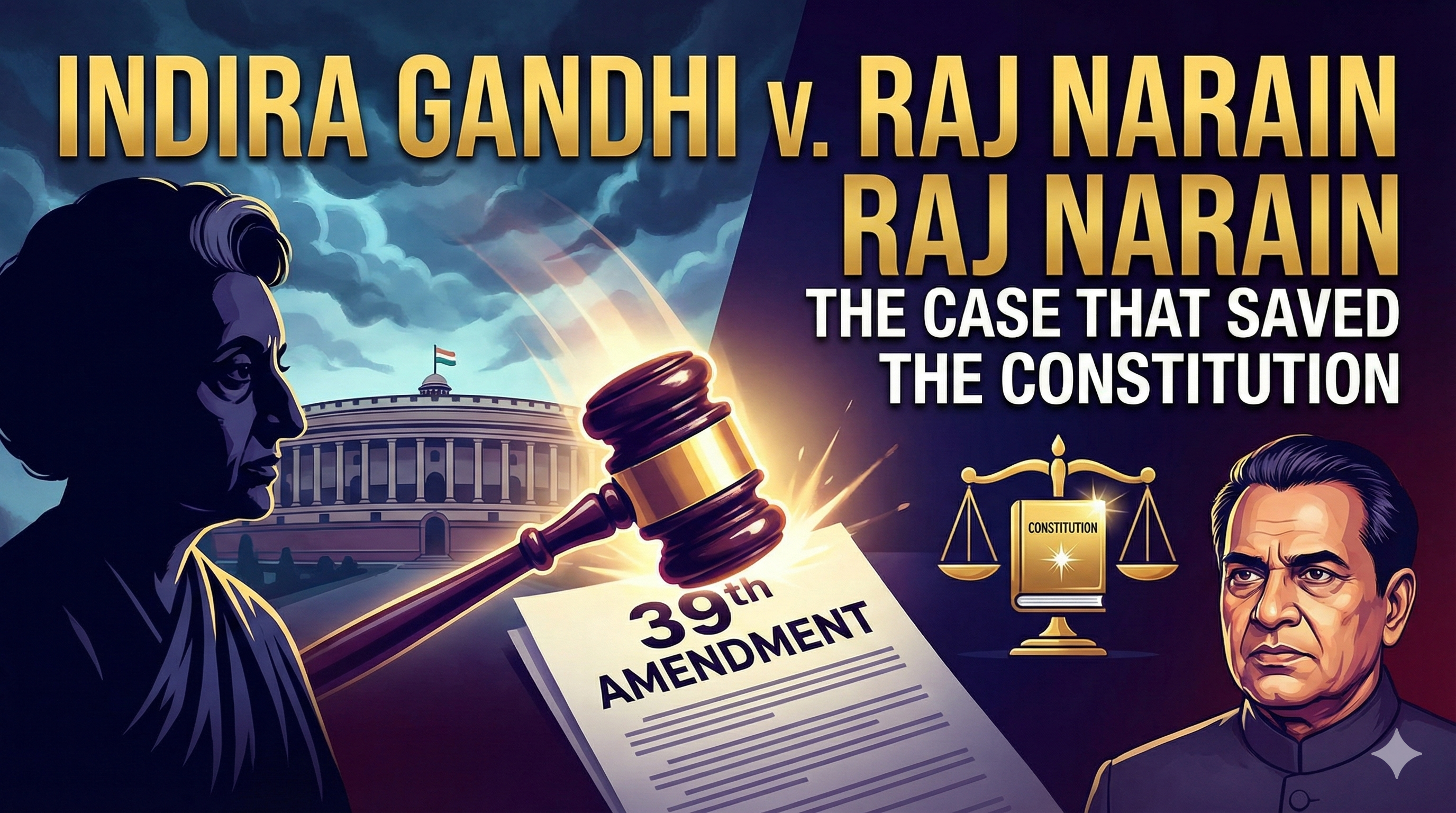
The case of Indira Nehru Gandhi v. Raj Narain (AIR 1975 SC 2299) is one of the most significant and politically charged judgments in Indian history. It directly led to the imposition of the National Emergency in 1975 and was the first major case to apply the Basic Structure Doctrine (established in Kesavananda Bharati) to strike down a constitutional amendment.
Facts of the Case
The case began not in the Supreme Court, but in the Allahabad High Court.
- The Election: In the 1971 Indian general elections, Indira Gandhi (the incumbent Prime Minister) defeated her opponent, Raj Narain, in the Rae Bareli constituency.
- The Petition: Raj Narain filed an election petition in the Allahabad High Court, accusing Indira Gandhi of committing electoral “corrupt practices” under the Representation of the People Act, 1951. The main allegations were:
- Using a government official (Yashpal Kapoor) as her election agent.
- Using government machinery (like state police and officials) to build rostrums for her campaign rallies.
- The High Court Verdict: On June 12, 1975, Justice Jagmohanlal Sinha of the Allahabad High Court found Indira Gandhi guilty of corrupt practices. The court declared her election null and void and disqualified her from holding public office for six years.
- The Political Response: This judgment created a constitutional crisis, as it meant the Prime Minister would have to resign.
- Indira Gandhi appealed to the Supreme Court.
- On June 25, 1975, a state of National Emergency was declared.
- While the case was pending, Parliament, under the Emergency, passed the 39th Constitutional Amendment Act, 1975.
- The 39th Amendment: This amendment introduced a new Article 329A into the Constitution. Clause (4) of this new article was the main point of contention. It stated that:
- No court had the jurisdiction to hear any dispute regarding the election of the Prime Minister or Speaker.
- Any pending case or judgment regarding such an election (i.e., the Allahabad HC judgment) was void.
- This amendment was applied retrospectively, meaning it legally validated Indira Gandhi’s 1971 election, regardless of the High Court’s findings.
The Supreme Court case, therefore, was no longer just about the election malpractices; it became a direct challenge to the constitutional validity of the 39th Amendment itself.
Issues Before the Court
The primary legal questions before the five-judge Supreme Court bench were:
Was the 39th Constitutional Amendment Act, 1975 (specifically Article 329A, Clause 4) constitutionally valid?
Did the 39th Amendment violate the “Basic Structure” of the Constitution?
Could Parliament, using its constituent (amending) power, take away the Supreme Court’s power of judicial review in election disputes?
Was Parliament “adjudicating” (passing a judgment) rather than “legislating” (making a law), thereby violating the Separation of Powers?
Arguments by Both Parties
Arguments of the Petitioner (Raj Narain)
The 39th Amendment destroys the very essence of the Constitution.
It violates the Basic Structure by attacking several fundamental features at once:
Separation of Powers: Parliament took on the role of the judiciary by “deciding” a specific case.
Judicial Review: It completely removed the court’s jurisdiction, which is a basic feature.
Rule of Law: It replaced a legal judgment with an arbitrary political declaration, creating a situation where the law was not applied equally.
Free and Fair Elections: It implied that a person, if they become Prime Minister, is above the electoral laws of the land.
Arguments of the Respondent (Indira Nehru Gandhi / Union of India)
Parliament has supreme power to amend any part of the Constitution under Article 368.
The concept of “Basic Structure” (from the Kesavananda case) is too vague and should not be used to strike down an amendment.
The Constitution (in Article 329) already states that Parliament can make laws regarding election disputes. The 39th Amendment was just an exercise of that power.
Elections are a political matter, and Parliament (the political branch) should have the final say.
The Judgment
On November 7, 1975, the five-judge bench delivered a unanimous verdict that was a complex mix of victory and defeat for both sides.
Part 1: The 39th Amendment (The Constitutional Question)
- The Supreme Court unanimously struck down Clause (4) of Article 329A as unconstitutional.
- The Court held that the amendment violated the Basic Structure of the Constitution.
- The judges provided converging reasons:
- Justice Khanna held it violated the norm of free and fair elections, which is fundamental to democracy.
- Justice Mathew called it an “act of despotic power” and not a law, as it destroyed the principle of judicial review and the rule of law.
- Justices Chandrachud and Beg found it to be a clear violation of the Separation of Powers, as the legislature was performing a judicial function.
Part 2: The Election Appeal (The Original Dispute)
- This is the twist. While the 39th Amendment was struck down, Parliament had also passed retroactive amendments to the Representation of the People Act (the election law itself).
- These new amendments changed the very definition of “corrupt practice.” For example, they clarified that the work of a government officer (like Yashpal Kapoor) before a candidate formally filed their nomination did not count as a corrupt practice.
- The Supreme Court upheld these amendments to the election law.
- Therefore, the original grounds on which the Allahabad High Court had disqualified Indira Gandhi were no longer illegal. The Supreme Court overturned the High Court’s judgment and upheld Indira Gandhi’s 1971 election.
In essence, Indira Gandhi won her case and kept her seat, but the Supreme Court firmly established that even a constitutional amendment cannot destroy the Basic Structure of the Constitution, particularly judicial review and the separation of powers
- Honor Killing After Independence
- Navtej Singh Johar v. Union of India : Landmark case that decriminalised Homosexuality in India

- Kerala High Court : Mandatory Injunction Claim Does Not Bar Arbitration

- AI-Hallucinated Case Citations: Landmark NCLAT Review in Pooja Ramesh Singh v. Jammu and Kashmir Bank
- Juvenile Justice (Care and Protection of Children) Act, 2015