

In criminal law, the concept of bail plays an essential role in protecting personal liberty. However, there are situations where a person fears arrest even before the police take them into custody. To address such situations, the law provides a special remedy known as anticipatory bail.
Anticipatory bail is an important safeguard against unnecessary arrest and misuse of criminal law. Understanding this concept is particularly important for law students, judiciary aspirants, and individuals who want to be aware of their legal rights.
This article explains the meaning, legal provisions, procedure, and important judicial interpretations of anticipatory bail in India.
Meaning of Anticipatory Bail
Anticipatory bail refers to a pre-arrest legal protection granted by a court to a person who anticipates arrest for a non-bailable offence.
In simple terms, it is a direction from the court stating that if the person is arrested in the future, they shall be released on bail immediately.
This provision protects individuals from unjustified arrest, harassment, or false criminal allegations.
Legal Provision for Anticipatory Bail
Anticipatory bail is provided under Section 438 of the Code of Criminal Procedure, 1973 (CrPC).
The section empowers:
- High Courts
- Courts of Sessions
to grant bail to a person before arrest when they believe that the person may be arrested on accusation of a non-bailable offence.
The court may impose certain conditions while granting anticipatory bail to ensure that the accused cooperates with the investigation.
When Can Anticipatory Bail Be Applied For?
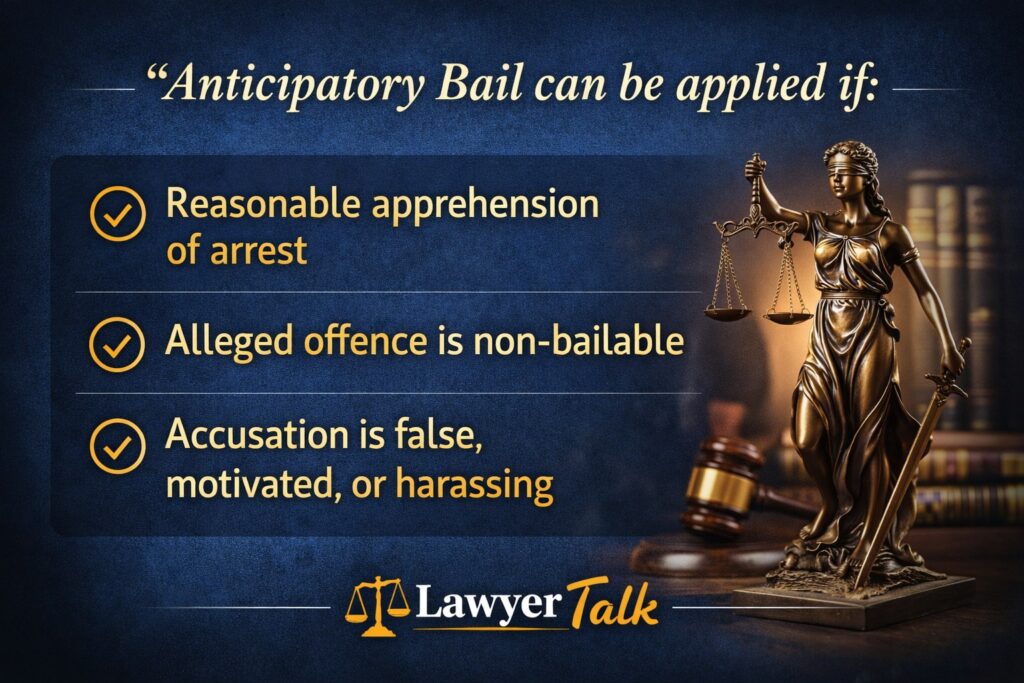
A person can apply for anticipatory bail when:
- They have reasonable apprehension of arrest.
- The offence alleged is non-bailable.
- They believe the accusation is false, motivated, or intended to harass.
However, anticipatory bail cannot be granted in every situation. Courts consider several factors before granting such protection.
Factors Considered by Courts
While deciding an anticipatory bail application, courts usually consider:
1. Nature and gravity of the offence
Serious offences such as murder or terrorism may reduce the chances of anticipatory bail.
2. Role of the accused
The court evaluates whether the accused had a significant role in the alleged offence.
3. Possibility of fleeing from justice
If the court believes the accused may abscond, bail may be denied.
4. Likelihood of tampering with evidence or influencing witnesses
5. Previous criminal record of the accused
The court balances individual liberty and the need for a fair investigation before granting relief.
Conditions That Courts May Impose
Courts often impose conditions while granting anticipatory bail to ensure cooperation with the investigation. These conditions may include:
- The accused must cooperate with the police investigation.
- They must not threaten or influence witnesses.
- They must not leave the country without permission of the court.
- They must appear before the investigating officer when required.
Violation of these conditions may lead to cancellation of anticipatory bail.
Important Supreme Court Judgment
One of the most significant cases on anticipatory bail is:
Gurbaksh Singh Sibbia v. State of Punjab (1980)
In this landmark judgment, the Supreme Court clarified that:
- Anticipatory bail should not be granted mechanically.
- Courts must consider the facts of each case.
- There should not be unnecessary restrictions on granting anticipatory bail.
The judgment emphasized that personal liberty under Article 21 of the Constitution must be protected.
Duration of Anticipatory Bail
Earlier, there was confusion regarding the duration of anticipatory bail. However, the Supreme Court clarified in Sushila Aggarwal v. State (2020) that:
- Anticipatory bail does not automatically expire after a limited period.
- It can continue till the end of the trial, unless cancelled by the court.
This ruling strengthened the protection available under anticipatory bail.
Difference Between Anticipatory Bail and Regular Bail
Anticipatory bail and regular bail are often confused, but they are different.
Anticipatory Bail
- Granted before arrest
- Protection against possible arrest
- Applied under Section 438 CrPC
Regular Bail
- Granted after arrest
- Release from police custody or judicial custody
- Applied under Sections 437 or 439 CrPC
Importance of Anticipatory Bail in Criminal Justice
Anticipatory bail serves several important purposes in the criminal justice system:
- Protects individuals from arbitrary arrest
- Prevents misuse of criminal law
- Safeguards personal liberty
- Ensures fair investigation without harassment
In many cases, this provision acts as a shield against false accusations and malicious prosecutions.
Conclusion
Anticipatory bail is a crucial legal remedy that balances the power of the police with the protection of individual liberty. It allows courts to prevent unjustified arrests while ensuring that the accused cooperates with the investigation.
For law students and judiciary aspirants, understanding anticipatory bail is essential because it reflects the broader principle that liberty should not be curtailed unnecessarily without due process of law.
A proper understanding of this concept helps in appreciating how the legal system attempts to maintain a balance between justice, investigation, and fundamental rights.
– Team Lawyer Talks