
The Constitution of India provides several powerful legal remedies to protect the fundamental rights of citizens. One of the most important among them is the concept of writs. These writs act as tools through which courts can control the actions of authorities and ensure justice when rights are violated.
For law students, judiciary aspirants, and anyone interested in constitutional law, understanding writs is essential. This guide explains writs in a simple and practical manner.
What is a Writ?
A writ is a formal written order issued by a court directing a person, authority, or government body to perform or refrain from performing a specific act.
In India, writs are issued primarily by:
- Article 32 of the Constitution of India – empowers the Supreme Court to enforce Fundamental Rights.
- Article 226 of the Constitution of India – empowers High Courts to issue writs for Fundamental Rights and other legal rights.
These provisions make the judiciary a strong protector of citizens against arbitrary actions of the state.
Why Are Writs Important?
Writs play a crucial role in maintaining the rule of law in a democratic country. They help in:
- Protecting Fundamental Rights
- Controlling misuse of power by public authorities
- Ensuring that government bodies act within their legal limits
- Providing a quick remedy when rights are violated
Because of these powers, writ jurisdiction is considered one of the most significant safeguards in the Indian legal system.
Types of Writs in the Indian Constitution
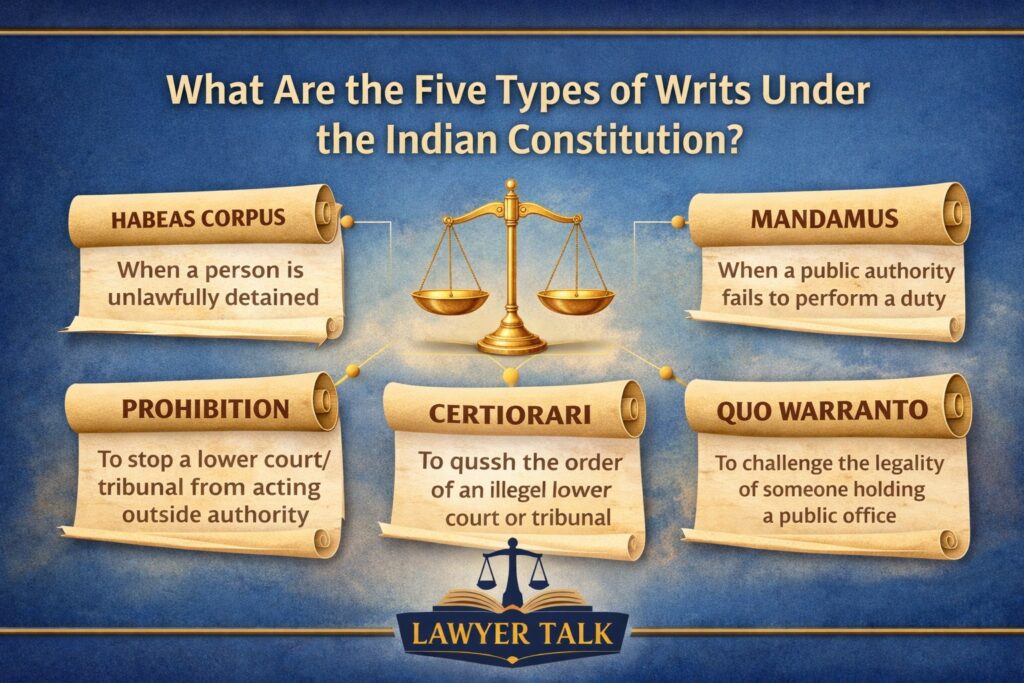
The Constitution recognizes five types of writs, originally derived from English law. Each writ serves a different purpose.
1. Habeas Corpus
The term Habeas Corpus literally means “to produce the body.”
This writ is issued when a person is illegally detained or imprisoned. The court orders the authority holding the person to bring them before the court and justify the detention.
If the detention is found unlawful, the court immediately orders the person’s release.
Example:
If a person is arrested without legal justification and kept in custody without being produced before a magistrate, a Habeas Corpus petition can be filed.
2. Mandamus
The word Mandamus means “we command.”
This writ is issued by a court directing a public authority, government officer, or public body to perform a duty that they are legally obligated to perform but have failed or refused to do.
Important Point:
Mandamus cannot be issued against a private individual or for duties that are discretionary.
Example:
If a government department refuses to grant a license despite fulfilling all legal requirements, the court may issue a Mandamus directing the authority to perform its duty.
3. Prohibition
The writ of Prohibition is issued by a higher court to a lower court or tribunal, preventing it from continuing proceedings that exceed its jurisdiction.
In simple terms, it stops a lower authority from acting beyond its legal powers.
Example:
If a tribunal begins hearing a matter that legally belongs to a civil court, the High Court or Supreme Court may issue a writ of Prohibition.
4. Certiorari
The writ of Certiorari is issued by a higher court to review and quash the decision of a lower court or tribunal if it has acted beyond its jurisdiction or violated principles of natural justice.
This writ not only prevents misuse of power but can also invalidate an already passed order.
Example:
If a tribunal passes an order without giving the affected party an opportunity to be heard, the High Court may quash the order using Certiorari.
5. Quo Warranto
The term Quo Warranto means “by what authority.”
This writ is issued to challenge the legal validity of a person holding a public office.
The court asks the person to show under what authority they are occupying the office. If the appointment is unlawful, the court can remove the person from the position.
Example:
If someone is appointed to a public post without meeting the required qualifications, a Quo Warranto petition may be filed.
Supreme Court vs High Court Writ Powers
There is an important difference between the powers of the Supreme Court and High Courts.
The Supreme Court can issue writs only for the enforcement of Fundamental Rights under Article 32 of the Constitution of India.
However, High Courts under Article 226 of the Constitution of India have wider powers. They can issue writs not only for Fundamental Rights but also for other legal rights.
Because of this broader scope, High Courts often become the first forum where writ petitions are filed.
Writs and the Protection of Fundamental Rights
Dr. B.R. Ambedkar famously described the right to constitutional remedies as the “heart and soul of the Constitution.”
Through writ jurisdiction, courts ensure that citizens have a direct remedy when their rights are violated by the state or public authorities. Without writs, the protection of fundamental rights would remain incomplete.
Conclusion
Writs are one of the most powerful legal tools available under the Indian Constitution. They ensure accountability of authorities, prevent misuse of power, and protect the fundamental rights of individuals.
For law students and judiciary aspirants, understanding writs is essential because they form a core part of constitutional law and judicial remedies. In practice, writ petitions also play a crucial role in protecting civil liberties and maintaining constitutional governance.
In a democracy governed by the rule of law, writs act as a bridge between citizens and justice, ensuring that no authority is above the law.
– Team Lawyer Talks