
In many civil disputes, waiting for the final judgment can sometimes cause serious harm to one of the parties. For example, imagine a property dispute where one party may sell the property before the case is decided. If that happens, the court’s final decision might lose its practical value.
To prevent such situations, courts have the power to grant temporary injunctions. These are short-term orders issued during the pendency of a case to protect the rights of the parties until the court gives its final judgment.
Understanding temporary injunctions is important not only for lawyers but also for law students and judiciary aspirants, as this concept frequently appears in exams and legal practice.
What is a Temporary Injunction?
A temporary injunction is a court order that temporarily restrains a party from performing a particular act until the court decides the case.
In India, temporary injunctions are governed by Order XXXIX Rules 1 and 2 of the Code of Civil Procedure, 1908 (CPC).
The purpose of such injunctions is simple: to maintain the status quo and ensure that justice is not defeated while the case is still pending.
For instance, the court may order a person not to sell, transfer, damage, or alter disputed property until the dispute is resolved.
Legal Provisions Under the CPC
Temporary injunctions are mainly covered under:
- Order 39 Rule 1 CPC – Cases where a temporary injunction may be granted
- Order 39 Rule 2 CPC – Injunction to restrain breach of contract or other injury
These provisions empower courts to intervene when there is a risk of injustice if immediate protection is not provided.
When Can a Court Grant a Temporary Injunction?
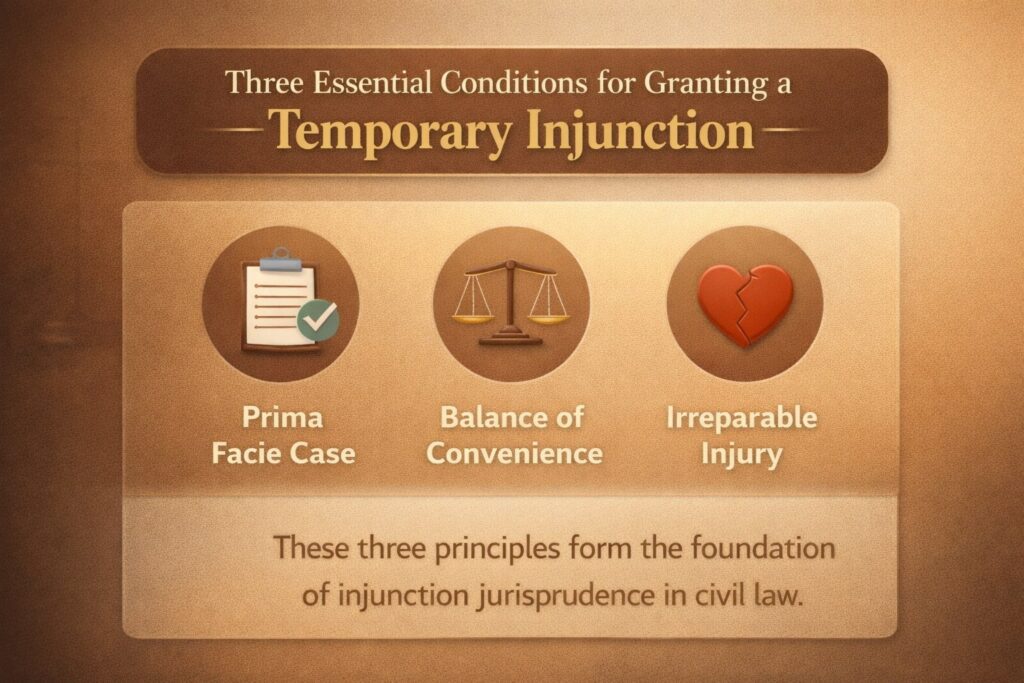
Courts do not grant injunctions automatically. Before granting one, the court generally considers three essential legal principles.
1. Prima Facie Case
The applicant must show that there is a genuine issue that deserves to be tried in court.
It does not mean that the case is already proven, but it must appear that the claim is not frivolous or baseless.
2. Balance of Convenience
The court examines which party would suffer greater hardship if the injunction is granted or refused.
If denying the injunction would cause more harm to the applicant than granting it would cause to the opposite party, the court may grant the injunction.
3. Irreparable Injury
The applicant must demonstrate that the damage cannot be adequately compensated by money.
For example:
- destruction of property
- violation of intellectual rights
- unlawful construction on disputed land
If such harm occurs, it may be impossible to reverse later.
Situations Where Temporary Injunctions Are Granted
Courts commonly grant temporary injunctions in cases such as:
- Property disputes where ownership is contested
- Cases involving illegal construction or land encroachment
- Breach of contractual obligations
- Intellectual property violations such as trademarks or copyrights
- Preventing damage or misuse of disputed property
The main objective is always to preserve the subject matter of the dispute.
Types of Temporary Injunctions
Temporary injunctions may take different forms depending on the situation.
1. Prohibitory Injunction
This is the most common type of temporary injunction. It prevents a party from doing a particular act.
For example, the court may restrain someone from selling a disputed property.
2. Mandatory Injunction (Interim)
In certain circumstances, the court may order a party to perform a specific act, such as removing an illegal structure or restoring a property to its original condition.
However, courts grant such injunctions very cautiously.
Importance of Temporary Injunctions in Civil Justice
Temporary injunctions play a crucial role in ensuring fairness during litigation.
Without such remedies, a party could alter the situation irreversibly before the court decides the case.
These orders help in:
- Protecting legal rights
- Preventing misuse of property
- Maintaining fairness during the trial
- Preserving the subject matter of the dispute
In simple terms, temporary injunctions ensure that the final judgment remains meaningful and enforceable.
Key Takeaway for Law Aspirants
For judiciary exams and law entrance tests, remember these three essential conditions for granting a temporary injunction:
- Prima Facie Case
- Balance of Convenience
- Irreparable Injury
These three principles form the foundation of injunction jurisprudence in civil law.
Conclusion
Temporary injunctions are an important protective remedy in civil law. They allow courts to prevent injustice before the final judgment is delivered. By maintaining the status quo and protecting the rights of parties, these orders ensure that the legal process remains fair and effective.
For law students and judiciary aspirants, understanding the concept of temporary injunctions under the Code of Civil Procedure is essential, as it forms a key part of civil procedural law and practical litigation.
For more simple and aspirant-friendly legal explanations, stay connected with Lawyer Talk.
– Team Lawyer Talks

1 thought on “Temporary Injunction in Civil Cases: Meaning, Types, and Legal Principles (CPC Explained)”
Very elaborate explanation. The three essential conditions of injunction must be read well and understood, to prove it in order to seek an injunction orders.