
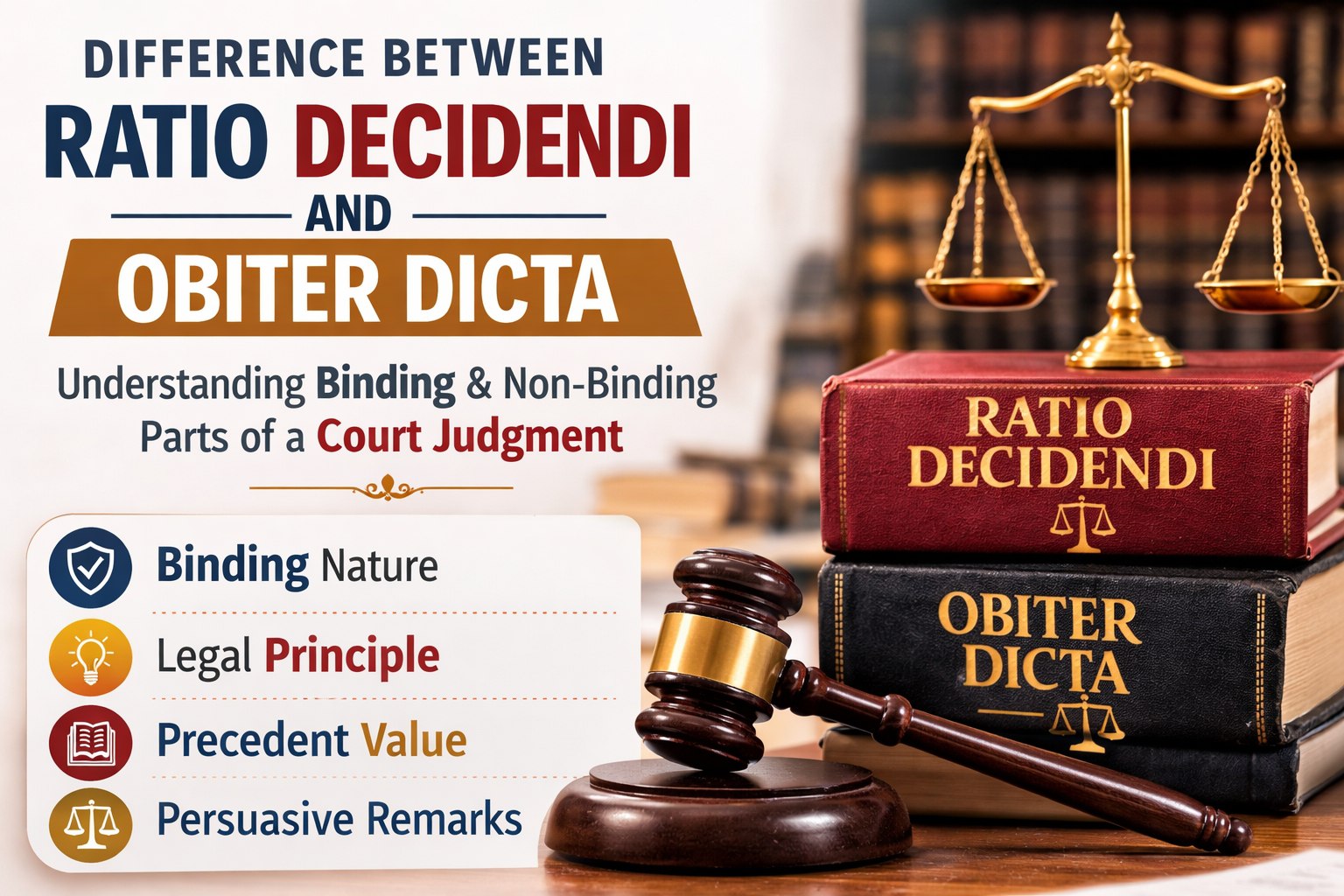
When reading court judgments, especially for judiciary exams or law school, two important terms frequently appear: Ratio Decidendi and Obiter Dicta. These concepts are fundamental in understanding how judicial precedents work in the legal system.
Every judgment delivered by a court contains reasoning, analysis, and observations. However, not all parts of a judgment carry the same legal authority. Some parts are binding, while others are merely persuasive. This is where the distinction between Ratio Decidendi and Obiter Dicta becomes important.
Understanding this difference helps law students, judiciary aspirants, and legal professionals interpret case law more accurately.
What is Ratio Decidendi?
The term Ratio Decidendi is a Latin phrase which means “the reason for deciding.”
It refers to the legal principle or rule of law on which the court’s decision is based. This part of the judgment forms the foundation of the decision and becomes a binding precedent for future cases in similar circumstances.
In simple words, Ratio Decidendi is the core legal reasoning that directly leads to the final judgment.
Key Features of Ratio Decidendi
- It is the binding part of a judgment.
- It establishes a legal principle applicable in future cases.
- Lower courts are required to follow the ratio of higher courts.
- It forms the basis of the doctrine of precedent.
For example, if a court decides a case based on a specific interpretation of a law, that interpretation becomes the ratio decidendi and must be followed by lower courts when similar issues arise.
What is Obiter Dicta?
The term Obiter Dicta means “things said by the way.”
It refers to remarks, observations, or opinions made by the judge that are not essential to the final decision of the case. These statements may provide additional insights or explanations but are not necessary for resolving the dispute before the court.
Although Obiter Dicta does not have binding authority, it can still carry persuasive value, especially when expressed by higher courts.
Key Features of Obiter Dicta
- It is not binding on future courts.
- It consists of incidental remarks or observations.
- It may help clarify legal principles or provide guidance.
- It has persuasive value, particularly if given by higher courts.
For instance, while deciding a case, a judge may discuss how the law should apply in hypothetical situations. These discussions are usually considered obiter dicta.
Key Differences Between Ratio Decidendi and Obiter Dicta
Meaning
Ratio Decidendi refers to the legal principle that forms the basis of the court’s decision.
Obiter Dicta refers to incidental observations made by the judge that are not necessary for deciding the case.
Binding Nature
Ratio Decidendi is binding on lower courts under the doctrine of precedent.
Obiter Dicta is not binding, but it may be persuasive.
Importance in Judgment
Ratio Decidendi is the essential part of the judgment.
Obiter Dicta is supplementary commentary.
Role in Future Cases
Ratio Decidendi must be followed in similar cases by lower courts.
Obiter Dicta may influence judicial reasoning, but courts are not obligated to follow it.
Why This Distinction Matters in Law
Understanding the difference between Ratio Decidendi and Obiter Dicta is crucial for several reasons:
- It helps lawyers and judges identify the binding legal principle in a case.
- It ensures proper application of the doctrine of precedent.
- It assists law students and judiciary aspirants in case law analysis.
- It prevents confusion between binding rules and mere judicial observations.
When reading judgments, legal professionals must carefully determine which part of the reasoning forms the ratio and which part is merely obiter.
Simple Example to Understand
Imagine a court decides a case about negligence in a road accident.
The court states that drivers have a duty to maintain reasonable speed in crowded areas, and based on this principle, the defendant is held liable.
This legal rule becomes the Ratio Decidendi.
The judge also comments that cities should install more traffic cameras to prevent accidents.
This statement is Obiter Dicta, because it is not necessary for deciding the case.
Conclusion
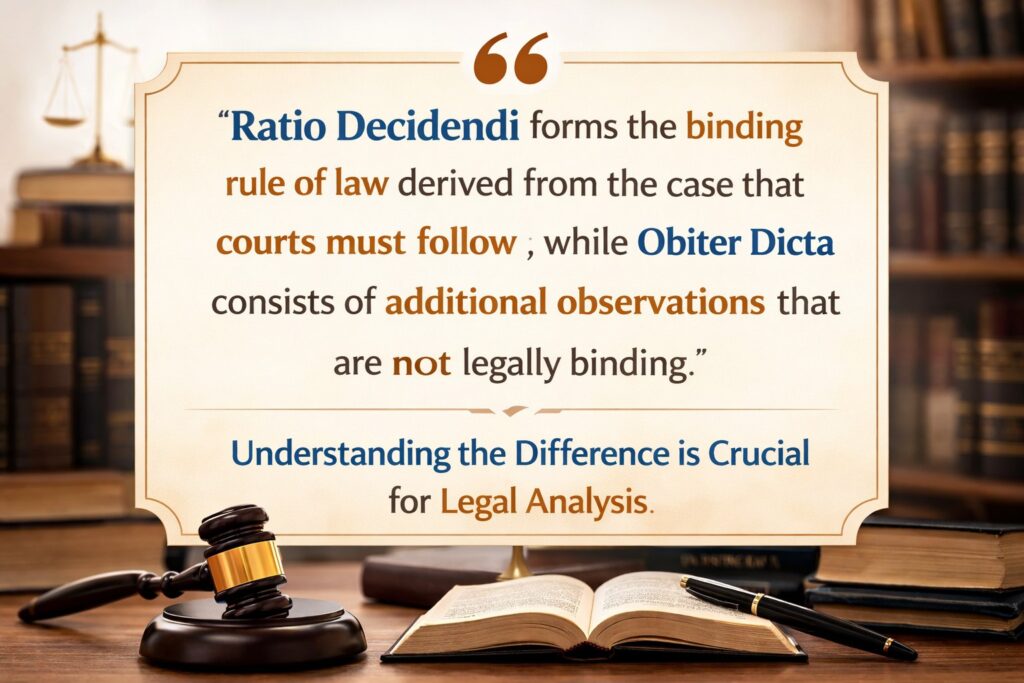
Ratio Decidendi and Obiter Dicta are essential concepts in understanding judicial reasoning and the doctrine of precedent. While Ratio Decidendi forms the binding rule of law derived from a case, Obiter Dicta consists of additional observations that may guide future decisions but are not legally binding.
For law students, judiciary aspirants, and legal professionals, the ability to distinguish between these two elements is crucial for correctly interpreting court judgments and applying legal principles in practice.
– Team Lawyer Talks