
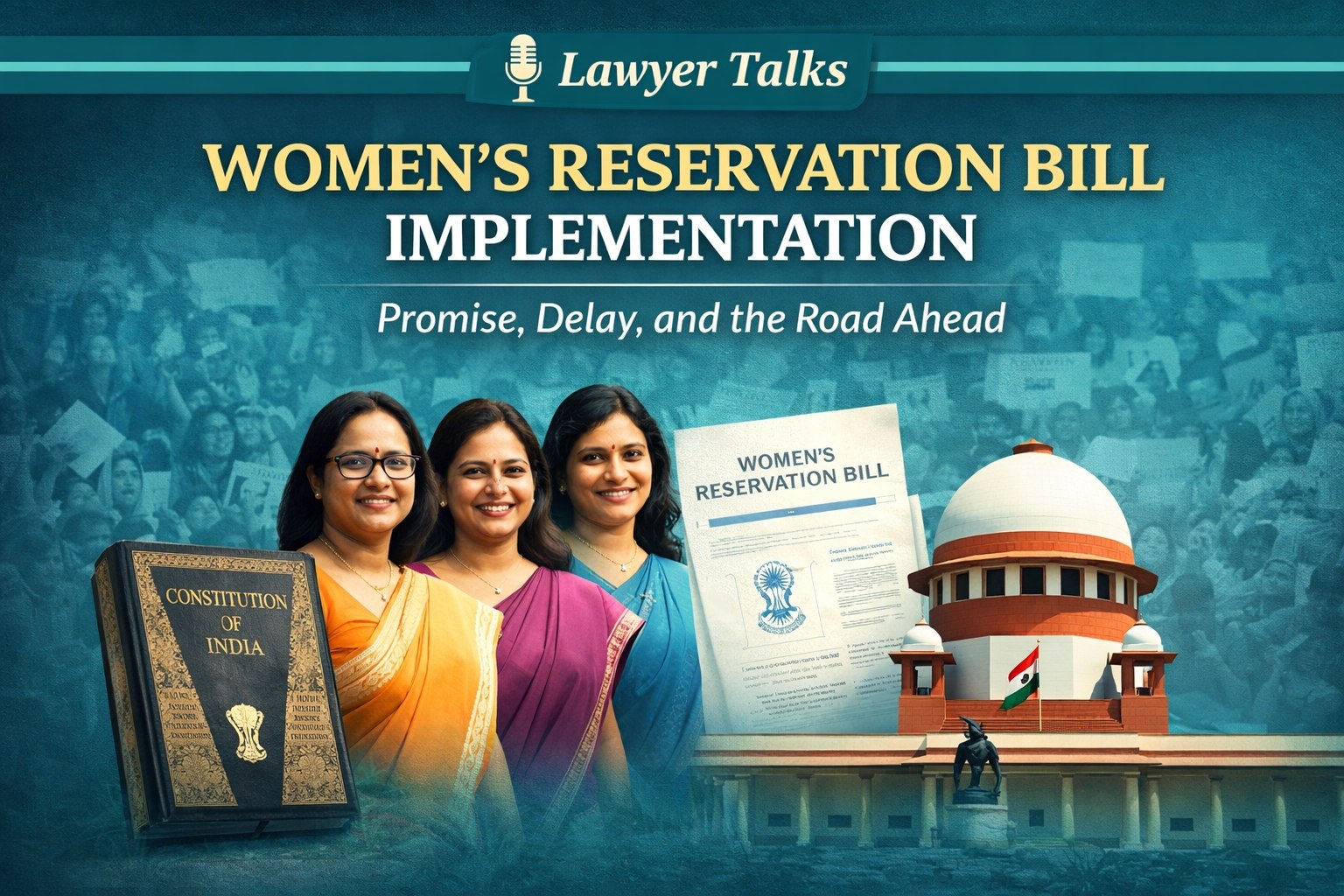
Gender equality in Indian politics is a significant step toward gender equality, especially where the Women Reservation Bill is now a constitutional amendment. It promises to hold 33 percent of the seats in the Lok Saba and state legislative assemblies by women.
The bill has been passed but there is uncertainty and delay in its implementation, which poses serious legal and constitutional concerns.
Let us examine this question in a practical manner.
Table of Contents
ToggleWhat does the Women Reservation Bill entail?
It aims at making sure that more women are represented in law-making institutions.
The distinctive characteristics are:
- 33 percent of seats in the Lok Sabha and state legislature assemblies will be filled by women and 33% of this will also be filled by SC/ST;
- the seats will be rotated after every delimitation exercise.
- It is a significant step of inclusion of governance.
Legal background:
The bill was enacted in 2023 and is a constitutional amendment (usually referred to as Nari Shakti Vandan Adhiniyam). Its application, though, has two conditions, a census has to be done, and delimitation exercise has to be done.
It is only upon these steps that the reservation can be effective.
Why does implementation take so long?
The controversy starts here. The census itself has been delayed, and this has a direct impact of postponing implementation.
The redrawing of constituencies also known as the delimitation has not yet been done.
The government has not given any specific deadline.
This therefore leaves one wondering when women will ever enjoy the law.
Critical legal and constitutional problems:
Representation vs. delay:
Although the law offers the representation, such a delay makes one wonder whether the advantage is being put on hold forever.
Equality in practice:
Article 14 of the Constitution grants equality, but the promise is not yet fulfilled, without it being put into effect.
Federal and political implications:
Delimitation can change the balance of political power between states and therefore it is a politically sensitive process.
Criticism and concerns:
The bill is seen by some as being symbolic, but not transformative.
The absence of an effective timeline makes it less effective.
Women may be deterred in developing politically in the long run by rotation of seats.
Nevertheless, the motive of the law is highly valued.
Why this is important:
The female population in India is almost half of the total population but still they cannot have a significant representation in parliament.
This bill can:
- empower women to be more active in politics;
- introduce diversity in the law-making process; and
- enhance an inclusive democracy.
Conclusion:
The Women Reservation bill is no doubt historic in nature yet its success will be faced by the level of its execution.
A paper law can not make any tangible transformation. The government should fully complete the census and delimitation without wasting time to make a meaningful progress.
Representation in a democracy is not a promise but is a necessity.
Final Thought
“Empowering women in law-making is not just about equality, it is about strengthening democracy itself.”
– Team Lawyer Talks