
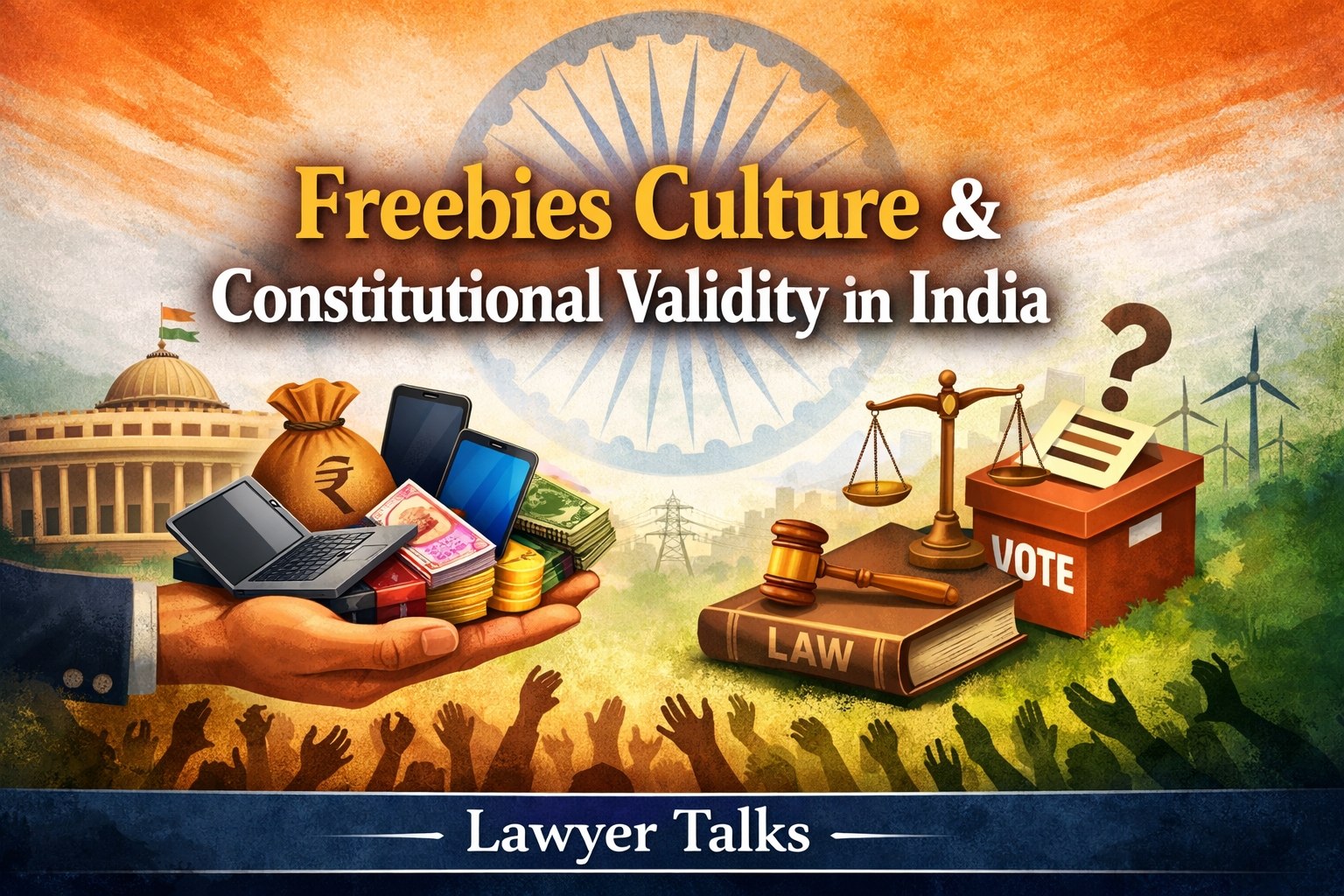
The culture of freebies has become the center stage of politics in India in recent years. Free electricity and water, laptops, smartphones and cash transfers-political parties tend to offer such gifts in the course of elections. Although such schemes might seem to favor the people, there is a pertinent constitutional issue of whether such freebies are constitutional or whether they erode the governance principles.
We need to appreciate this problem in the simple and practical form.
Table of Contents
ToggleWhat is “Freebies Culture”?
Freebies are goods or services given by the government to the citizens at minimal or none cost, commonly as a form of welfare or in election campaigns.
Examples of some of them include:
- Complimentary electricity or water.
- The distribution of laptops, bicycle or smartphones.
- Loan waivers for farmers
Complimentary transportation of some categories
These measures are meant to be relief giving, however, they create issues of financial discipline and electoral fairness.
Constitutional Perspective
The term of freebies is not mentioned in the Indian Constitution directly. Their validity is however looked at based on general constitutional principles.
Directive Principles of State Policy (DPSP)
Part IV of the Constitution gives the government an incentive to facilitate social and economic welfare. Some of the freebies that are justified according to these principles include:
Reducing inequality
- Educating and promoting public health.
- Helping the weaker members of the society.
- This implies that welfare schemes are not necessarily unconstitutional.
Public Finance and Accountability
Freebies are subsidized by the tax payers. Business overspending in the absence of planning can:
Burden the state’s financesIncrease public debtInfluence the long-term development.
Therefore, although the Constitution does not prohibit welfare practices, it anticipates responsible governance.
Free and Fair Elections
One of the biggest questions is whether freebies have the undue influence on voters. In case promises are made with a view of acquiring votes, it can:
- Pervert the democratic procedures.
- Bring about a level of inequality between political parties.
- Nevertheless, there is no chance to always differentiate true welfare and bribery in elections.
Judicial ViewIn S. Subramaniam Balaji v., this issue has been raised by the Supreme Court. State of Tamil Nadu (2013).
Key observations:
- Freebies are not illegal in nature.
- The welfare schemes are those which are policies of the government.
- Courts are not allowed to intervene where there is obvious breach of law.
- The Court also indicated that rules should be formulated which would govern such promises particularly during elections.
Propositions in Support of Freebies
Proponents say that they need freebies in an emerging nation such as India:
- Assistance to boost the poor.
- Enhance education and technology.
- Give instant solace when suffering.
Promote inclusive growth
These schemes are necessities rather than luxuries to many citizens.
Arguments Against Freebies
Opponents have the view that freebies are not always good in the long term:
- Promote dependence and not empowerment.
- Strain government finances
- Frauds money allocated to infrastructure and development.
- Make elections a bidding war of the political parties.
- This brings about serious issues of sustainability and governance.
The Way Forward
There should be a middle ground instead of total rejection or blind support of freebies:
- Target welfare and not universalism.
- Make the spending transparent and accountable.
- Separate the critical welfare and populist actions.
- Enhance the rules of organizations such as the Election Commission.
Conclusion
The problem of freebies is at the border of welfare and politics. Even though the Constitution favors social welfare, it also requires governments to be fiscally responsible and hold fair elections. Freebies are not unconstitutional as such, then, but their abuse can subject democratic ideals to test.
Finally, this should not be aimed at eradicating welfare schemes, but it must be justified, sustainable and in the real interest of the people.
– Team Lawyer Talks