
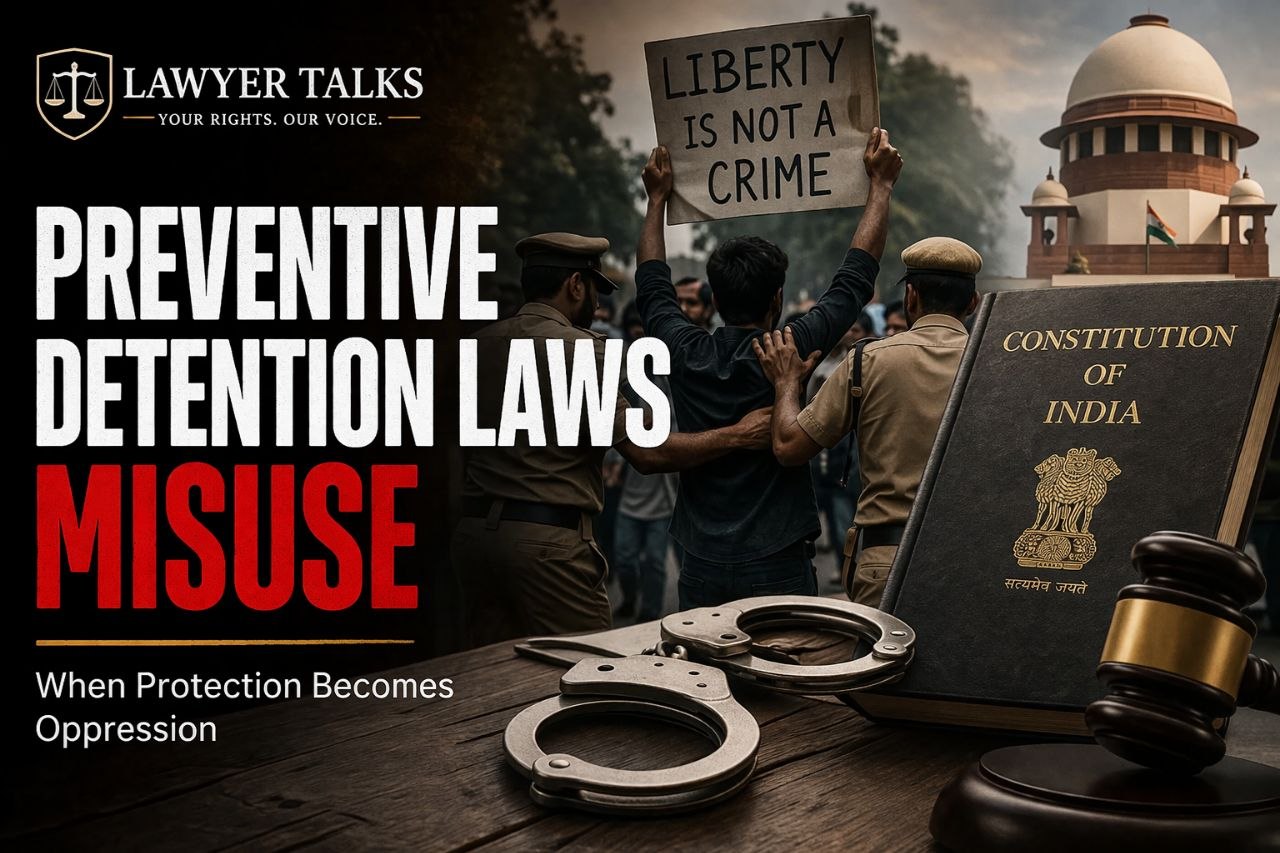
Preventive detention laws enable the government to imprison an individual without trial to avert any levels of threats to the civil order or national security. Though, these laws were enacted as an exception measure in exceptional cases, misuse of these laws has turned out to be a big problem in India.
What is Preventive Detention?
There is no emphasis on punishing a person who has committed a crime in preventive detention. Rather, it is founded on suspicion – arresting an individual prior to him being able, it is alleged, to be harmful to others. Such laws are allowed by the Indian Constitution in Article 22, although there are some safeguards on the article such as informing the detainees of the reasons and being represented.
Such laws on preventive detention are prominent, which include:
- National Security Act (NSA) of 1980.
- State public safety acts.
- COFEPOSA (economic offenses)
Gets to the Bottom of the Matter?
Ideally, preventive detention aims at securing society. But practically it has been attacked as being imprecise, arbitrary, and likely to be misused. Governments have been using these laws when their interest does not actually result in a threat against the national security.
Common concerns include:
- Absence of judicial control off the spot.
- Arrest on such vague or weak reasons.
- Application against political oppositionists, news makers, or activists.
- Courts have issued repeated detention orders to forego bail.
This leads to one of the most important questions: Can the laws be applied as means of governing or as means of controlling?
Effects on basic rights
The concept of preventive detention interferes directly with the right to personal liberty in Article 21. When citizens are kept without trials, it undermines the virtue of being innocent unless proven guilty.
Furthermore, cases drag in review boards and lack of access to legal redress can pin detainees in a state of limbo over several months. This does not only affect the individual but also diminishes the confidence of the people with the justice system.
Judicial Response
Misuse has at times been curbed by Indian courts. The courts have reiterated that the preventive detention should not be widely applied and must only be applied in true situations of necessity. There have also been courts that have nullified detention orders that have not been determined by sound reasoning or evidence.
The problem however is that the judicial intervention is usually undertaken after the detention has been carried out and this might not be able completely reverse the damage done.
The Way Forward
The laws of preventive detention are not necessarily bad but their abuse can be harmful within a democracy. There are steps required, some of which are:
- Before detention, stricter judicial scrutiny.
- Still more specific definitions of threat to public order.
- Time-bound review mechanisms
- Increased accounting and transparency.
Conclusion
The laws of preventive detention occupy a fragile place at the borderline of state security and freedom of a person. Although they might be needed in some situations, their abuse could end up with them being a freedom-sustaining mechanism. There should be a moderate course between overprotection and irresponsible consumption to maintain the rule of law in India.
– Team Lawyer Talks