
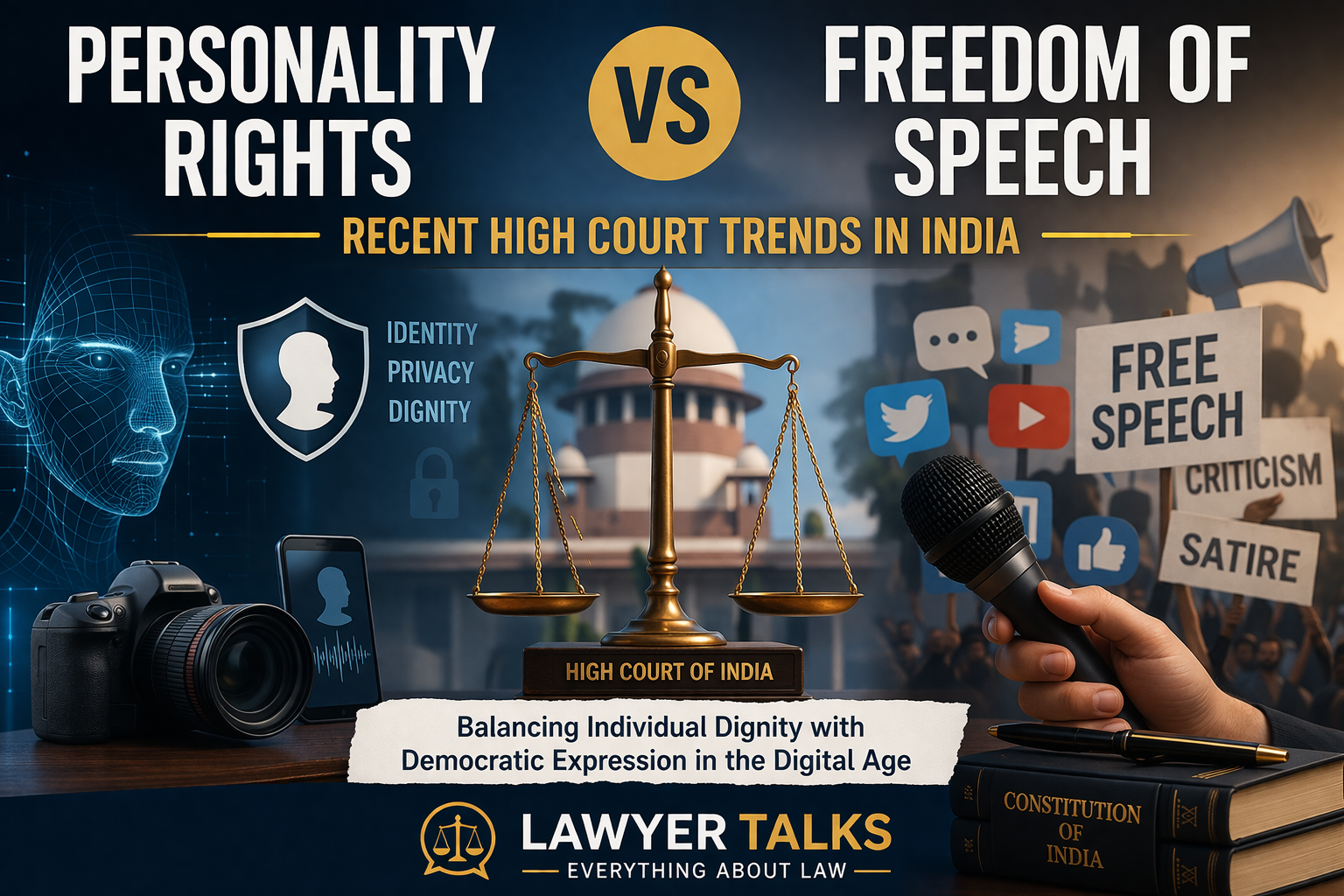
In recent years, Indian High Courts have been experiencing a keen constitutional quandary which is the clash of personality rights and the freedom of speech and expression. Following the rapid evolution of the social network, artificial intelligence, and online media, currently, the courts have to balance between preserving the identity of a person and free speech within democracy.
Understanding of the Two Rights
Personality rights (which are also known as publicity rights) are the right of a person to control commercial use of his/her name, image, voice, likeness or identity. They are primarily founded on Article 21 of the Constitution which entails the right to life, dignity and privacy.
On the other hand, the freedom of expression and speech, which is guaranteed under Article 19(1)(a) allows people to speak out, criticize people in the society and apply satire or parody.
The problem lies in the fact that the conflict may commence when expression, specifically, online, begins to exploit or harm the identity of an individual.
Recent High Court Trends (2025–2026)
1. Excessive Protection of Personality Rights (Especially the Digital Misuse)
The Indian High Courts, particularly the Delhi and Bombay High Courts have done well to protect the rights of personalities especially in the case of AI, deepfakes and other abuses of the internet.
The Delhi High Court in the Anil Kapoor case made an effort to stop the unlawful exploitation of name, voice, and image of a prominent person and emphasized that identity abuse on the Internet could not be tolerated.
In the other case, the Court defended a cricketer against the deepfakes created by artificial intelligence, and said that the threat of artificial intelligence has grown.
Similarly, the high court of Bombay has intervened in AI voice cloning and deepfake videos in which it has realized that identity and reputation are directly offended by such abuse.
In these decisions, we can easily see that there is a current of courts that personality must be a useful legal property that must be safeguarded, especially against commercial or technological abuse.
2. Expansion of the Digital Personality Rights
Courts are also starting to come to the realization that personality rights are not limited to the traditional media but apply to the digital ecosystem.
The usage of identity illegally in the social media, memes, or even AI is now considered a serious crime.To curb the presence of unknown criminals and to remove information on the internet within a short period of time, courts have devised orders dubbed, John Doe.
This is suggestive of a shifting viewpoint that in the digital age, identity itself might be commodified, manipulated and abused in any large scale fashion.
3. Judicial Vigilance (Protecting Free Speech)
The fact that the courts are protecting the personality rights is the same time when they are not misusing the free speech.
The Madras High Court failed to provide broad gag orders on the basis that the personalities of people must be allowed to receive criticism and internet publicity.
It clarified that it is impossible to violate the integrity by only talks or information running unless there is commercial exploitation.
It is a big shift: one cannot apply personality rights as the means of personal censorship and a silencing of criticism.
4. The focus on Responsible Free Speech
Freedom of speech has also been reiterated by courts not to be absolute.
The Andhra Pradesh High Court stressed that speech must not be misused to defame the reputation on the social media.
The High Court of Delhi has pointed out that the online material must not be offensive, degrading or hurtful to the dignity especially because of the large coverage that it has.
Thus, the judiciary is promoting the culture of responsible free speech and not free expression.
Key Legal Concepts that are Developing
Two or three principles are becoming clear out of decisions of the High Court in recent times:
- Commercial Exploitation Test: The highest protection of rights to personality is the case when identity is used to make commercial benefits against the desire of a person.
- The Public Good vs The Private Good: Courts allow the criticism, satire and reporting, especially when it is the interest of the people.
- No Blanket Injunctions: The judges are not prepared to issue blanket bans that have the power to freeze the speech.
- Digital Accountability: The online platform and online users are increasingly becoming accountable on identity abuse.
The Main dilemma: Finding the Middle Ground
The challenge is to have the right balance between two equally valuable values:
- Dignity and autonomy of the individual (Article 21)
- Freedom of speech and opposition (Article 19)
The fact of excessive expansion of personality rights may lead to censorship and the lack of the right to criticism, and the lack of regulation of free speech may lead to defamation, exploitation, and even cyber damage.
Indian High Courts are currently trying to create this balance through the case-by-case, nuanced approach, as opposed to strict rules.
Conclusion
The changing jurisprudence of personality rights and freedom of speech is a pointer of the changing reality of a digital society. High Courts in India are actively developing this area which are:
- Protecting people in an anti-AI and commercial abuse.
- But at the same time maintaining the freedom of speech, satire and citizens in their dialogues.
This balance will be even greater with the constantly evolving technology. It is now time to have a clear legislative framework that will provide the scope of the rights of personality without compromising the liberties of the constitution.
– Team Lawyer Talks