
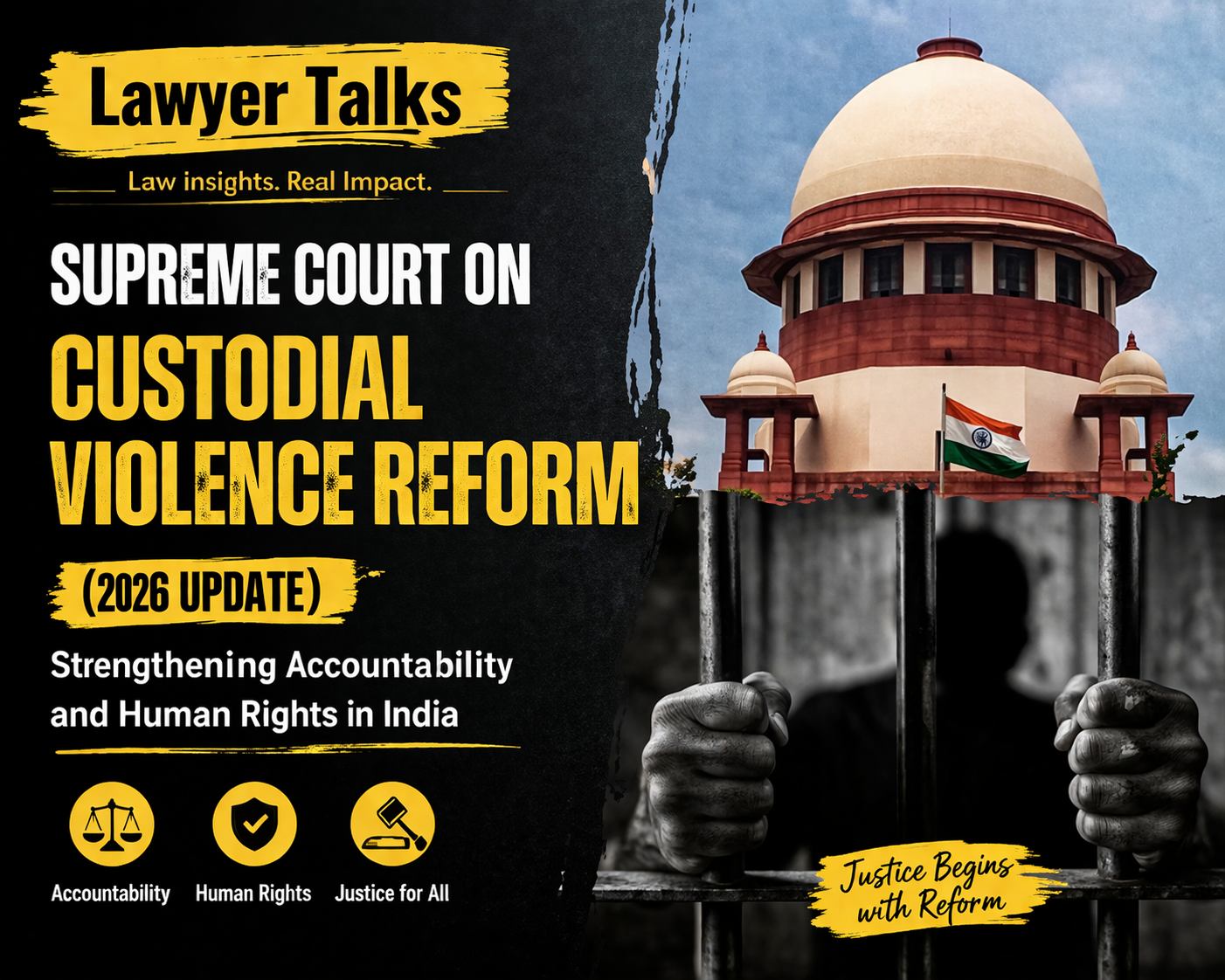
The issue of custodial violence has been among the gravest human rights issues in the criminal justice system of India. Although the constitution and judicial rulings have guaranteed these, cases of torture, unlawful detention and deaths in custody are still emerging. This issue has been again put under the limelight in 2026 by the Supreme Court of India, reasserting the necessity of stringent reforms, accountability measures and proper implementation of basic rights as guaranteed by Article 21 of the Constitution.
This is not only a legal update but a good reminder that the right to life and dignity does not end at the prison gate or the door of the police station.
Table of Contents
ToggleWhat is Custodial Violence?
Custodial violence is a type of violence directed at an individual as s/he is being held in custody by the police or in a court. It includes:
- Physical torture in interrogation.
- Unlawful arrest without trial.
- In-custodial deaths in the police force.
- Psychological harassment and coercion to get confessions.
Although there are effective constitutional protections in India, custodial violence is a frequent occurrence because of the absence of accountability, ineffective investigation systems, and institutionalized pressure on the law enforcement systems.
Stand of Supreme Court in 2026
The Supreme Court in its 2026 observations has reiterated the fact that custodial violence is not only a breach of law, but is a direct attack on constitutional values. The Court reiterated that:
- Article 21 provides the right to living with dignity even in custody.
- Any confessions made under force cannot be used in court.
- The liability of the state heightens when an individual is under its control.
- The inability to avert custodial violence is a failure to the constitution.
The Court has also been worried about the slow pace of the implementation of previous guidelines and it has advocated greater institutional accountability.
Significant Directions and Reform Focus Areas
The 2026 judicial strategy emphasizes various areas of reform to help lower the rate of custodial violence:
1. Mandatory CCTV Surveillance
The Court has strengthened the necessity of practical CCTV cameras to be installed in every police station, interrogation room, and lock-up. Notably, it has emphasized that:
- The video should be stored safely.
- Access should be provided to independent authorities.
- Violating should result in serious repercussions.
2. Investigation of Custodial Deaths Independently
The Court has pointed out the inadequacy of in-house police investigations. Custodial death cases should be:
- Researched by independent agencies or judicial oversight agencies.
- Supervised by magistrates every now and then.
- Finished according to a definite schedule.
3. Accountability of Officers
The ruling upholds that the blame should not be made to be only on lower-ranked officers. Top officials can also be answerable in case systemic negligence is discovered.
4. Medical Examination Protocols
The Court emphasized that the detainees should be examined by a doctor right away:
- At the time of arrest
- During custody
- Pre-interrogation and post interrogation
This is to facilitate transparency and avoid fabrication of injuries or falsification of records.
5. Victim Rights and Compensation
The Court once again pointed out that victims of custodial violence are entitled to be compensated or rather their families are entitled to compensation, but the Court also pointed out that financial compensation is not everything. There is also need to criminally prosecute the responsible officers.
Reasons Why Custodial Violence Continues
Despite repeated judicial interventions, custodial violence continues due to structural and systemic issues such as:
- Time pressure to find solutions.
- Inadequate education in scientific research.
- Lack of strong internal accountability mechanisms.
- Fear-based policing culture.
- Time lag in departmental and criminal processes.
The Supreme Court, in 2026, has indirectly noted that nothing can be done to reform the situation except by creating guidelines, a change in culture within the law enforcement agencies is needed.
Impact of the 2026 Supreme Court Observations
The most recent judicial drive is important in a number of ways:
- It enhances constitutional protection in Article 21.
- It strengthens the commitments of India to the international human rights norms.
- It enhances tighter observation of police actions.
- It can result in closer application of previous landmark decisions regarding custody rights.
To law students, law practitioners and policy observers, this development heralds further development of human rights jurisprudence in India.
Conclusion
The position of the Supreme Court in the reform of custodial violence of 2026 is an effective reminder of the fact that the law is not to be broken even in the name of investigation. Although there are already laws and guidelines, the implementation and accountability is the true challenge.
Real reform will not take judicial dictums, it will take institutional integrity, police education reforms, and a system of justice that does not put human dignity on the backburner to the expediency of procedure.
Up to that point, custodial violence is not only a matter of law, but also a challenge to the constitutional morality of India.
– Team Lawyer Talks