
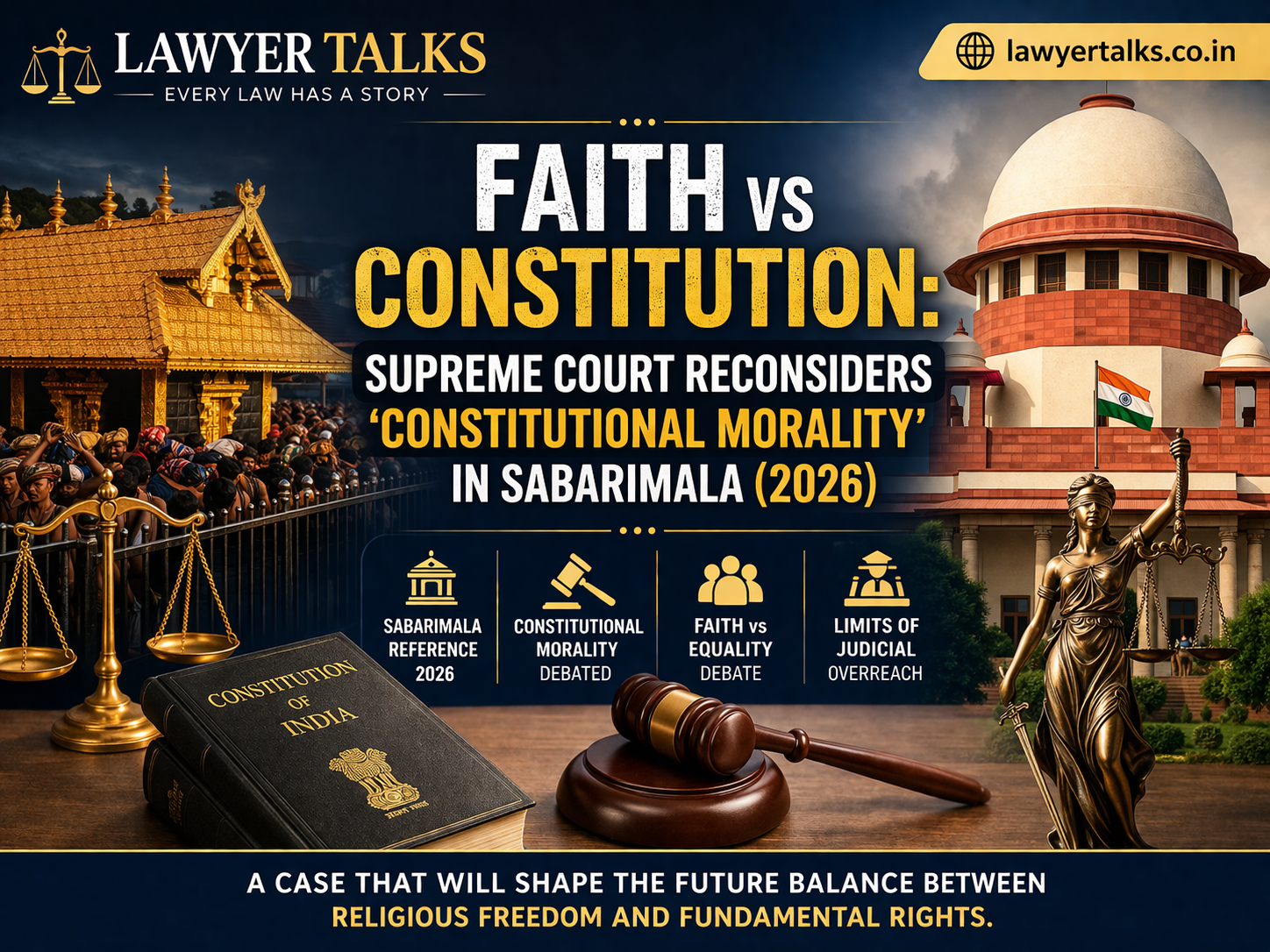
The Sabarimala case is re-emerging in 2026, brought the debate between faith and constitutional values to the forefront. The Supreme Court is revisiting a major issue: Can constitutional morality guide religious practices?
Senior Advocate Abhishek Manu Singhvi made a striking remark during the hearing:
“Applying constitutional morality in religious matters is like a bull in a china shop.”
This statement has intensified the discussion around the limits of judicial intervention in matters of faith.
Table of Contents
ToggleBackground of the Dispute
The problem is traced to the 2018 Sabarimala decision, which permitted admission of women of all ages to the temple, stating the equality and constitutional morality.
But the case did not end there. It was subsequently subject to a bigger bench to determine more general constitutional issues, especially those concerning:
- Constitution of India, Art. 25 – Freedom of religion.
- Article 26 of the Constitution of India -Management of religious affairs.
- The extent of judicial review over religion practices.
The Argument of Singhvi: Caution to the Court
Singhvi has been a vehement supporter of the argument that the Constitution does not refer to constitutional morality, but merely morality, in the religious clauses.
He warned that:
- Constitutional morality is relative and dynamic.
- Its use in religion can cause overreach in judicial procedures.
- Courts should not intervene in the deep-rooted beliefs.
The fact that he has used an analogy that implies that taking too much action is feared to be disruptive to the fine equilibrium of religious practices.
Supreme Court’s Observations
To date, the Supreme Court has made a cautious and moderate approach.
On the one hand, it recognized the fact that constitutional values cannot be neglected. On the other, it had fears that it would overstep into religious areas.
One point made on the bench was:
“It is difficult for courts to declare that the beliefs of millions are wrong.”
This brings out the sensitivity and understanding of the religious diversity in India on the part of the judiciary.
Centre’s Stand
The Union Government has also come in with its own argument as it claims that:
- Religious practices should be guided by public morality and not constitutional morality.
- Courts must not venture into theological issues.
- The role of the judiciary should be minimal and restrained.
This further complicates the discussion which is whether morality is a societal construct or it is a constitutionally constructed construct.
Why This Case is Important?
The Sabarimala case is not merely an issue of a single temple- it has nationwide implications.
It will be decided that:
- The level of judiciary intrusion into religion.
- The harmony of basic rights and religious liberty.
- The future of the Essential Religious Practices doctrine.
As simply put, it will be used to influence the manner in which India will balance its tradition with constitutional ideals.
Conclusion
The hearings of 2026 indicate another more profound constitutional issue- where should the line be drawn between faith and law?
Although the constitutional morality is meant to respect rights and equality, the implementation in religion is still a controversial issue. This tension is captured by Singhvi in his strong comment, not to take one side.
With the Supreme Court still in the process of deliberating, its ruling will have a decisive role in determining how religion and the Constitution will be related in the future in India.
– Team Lawyer Talks