
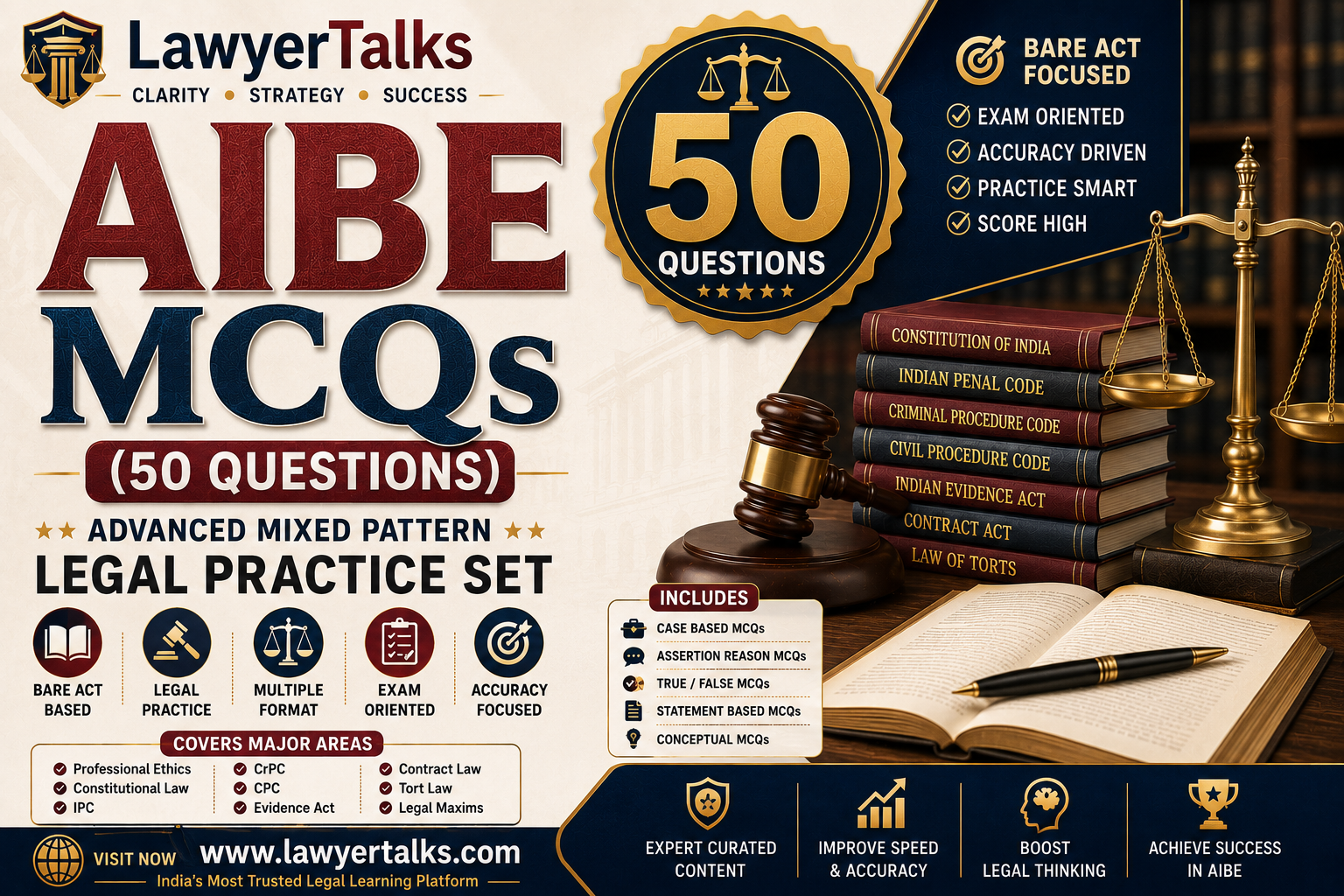
Sharpen your AIBE preparation with this specially designed mixed-format set of 50 advanced questions covering Bare Acts, Professional Ethics, IPC, CrPC, CPC, Evidence, Constitution, Contract, Tort, and practical legal application. Includes analytical, statement-based, assertion-reasoning, case-based, legal maxim, and conceptual questions to simulate real exam complexity.
1. Under the Advocates Act, disciplinary jurisdiction over advocates primarily vests in:
A. Supreme Court
B. District Court
C. Bar Council Disciplinary Committee
D. State Government
Answer: C
2. Assertion: Every advocate enrolled with State Bar Council has right to practice throughout India.
Reason: Advocates Act grants a statutory right to practice.
A. Both correct and Reason explains Assertion
B. Both correct but Reason not correct explanation
C. Assertion true, Reason false
D. Assertion false, Reason true
Answer: A
3. True or False: An advocate may advertise legal services through television commercials.
Answer: False
4. “Ubi jus ibi remedium” means:
A. Equity follows law
B. Law excuses none
C. Where there is a right, there is a remedy
D. Facts speak for themselves
Answer: C
5. A lawyer agrees to receive 25% of decretal amount as fees from client. Such agreement is:
A. Valid
B. Voidable
C. Opposed to professional ethics
D. Enforceable through suit
Answer: C
6. Res judicata under CPC is based on principle of:
A. Judicial bias
B. Finality of litigation
C. Criminal liability
D. Constitutional supremacy
Answer: B
7. True or False: Res sub judice is governed under Section 11 CPC.
Answer: False
8. Caveat under CPC is filed to:
A. Obtain stay
B. Prevent ex parte order
C. Transfer suit
D. Seek injunction
Answer: B
9. Assertion: Appeal is a statutory right.
Reason: No appeal can exist without legal provision.
A. Both correct and Reason explains Assertion
B. Both correct but Reason not explanation
C. Assertion true, Reason false
D. Assertion false, Reason true
Answer: A
10. A suit instituted in wrong court regarding territorial jurisdiction is generally:
A. Void ab initio
B. Illegal
C. Irregular but curable
D. Criminally punishable
Answer: C
11. FIR can be lodged by:
A. Victim only
B. Eye-witness only
C. Any person aware of cognizable offence
D. Magistrate only
Answer: C
12. True or False: FIR is substantive evidence.
Answer: False
13. Anticipatory bail is granted under:
A. Section 436 CrPC
B. Section 437 CrPC
C. Section 438 CrPC
D. Section 439 CrPC
Answer: C
14. A police officer records confession of accused during investigation. Such confession is generally:
A. Fully admissible
B. Partly admissible
C. Inadmissible
D. Conclusive proof
Answer: C
15. Assertion: Bail is rule and jail is exception.
Reason: Presumption of innocence exists until conviction.
A. Both correct and Reason explains Assertion
B. Both correct but Reason not explanation
C. Assertion true, Reason false
D. Assertion false, Reason true
Answer: A
16. Dying declaration is relevant under:
A. Section 24 Evidence Act
B. Section 32 Evidence Act
C. Section 45 Evidence Act
D. Section 65 Evidence Act
Answer: B
17. True or False: Hearsay evidence is always inadmissible without exception.
Answer: False
18. “Res gestae” is embodied under:
A. Section 5 Evidence Act
B. Section 6 Evidence Act
C. Section 24 Evidence Act
D. Section 114 Evidence Act
Answer: B
19. Expert opinion becomes relevant under:
A. Section 32 Evidence Act
B. Section 45 Evidence Act
C. Section 73 Evidence Act
D. Section 115 Evidence Act
Answer: B
20. Assertion: Accomplice evidence is admissible.
Reason: Corroboration is mandatory rule of law.
A. Both correct and Reason explains Assertion
B. Both correct but Reason not explanation
C. Assertion true, Reason false
D. Assertion false, Reason true
Answer: C
21. Theft is defined under:
A. Section 378 IPC
B. Section 390 IPC
C. Section 405 IPC
D. Section 415 IPC
Answer: A
22. True or False: Every murder is culpable homicide.
Answer: True
23. “Mens rea” generally signifies:
A. Guilty act
B. Guilty intention
C. Legal injury
D. Wrongful gain
Answer: B
24. Common intention is embodied under:
A. Section 34 IPC
B. Section 149 IPC
C. Section 120A IPC
D. Section 511 IPC
Answer: A
25. A and B jointly attack C after pre-planned arrangement. Liability of B arises mainly through:
A. Section 149 IPC
B. Section 34 IPC
C. Section 120B IPC only
D. Section 511 IPC
Answer: B
26. Assertion: Mistake of fact may excuse criminal liability.
Reason: IPC recognizes good faith and absence of guilty intention in certain cases.
A. Both correct and Reason explains Assertion
B. Both correct but Reason not explanation
C. Assertion true, Reason false
D. Assertion false, Reason true
Answer: A
27. True or False: Every breach of contract amounts to cheating.
Answer: False
28. Criminal breach of trust requires:
A. Entrustment of property
B. Mere possession only
C. Contractual relationship only
D. Negligence alone
Answer: A
29. Consideration under Indian Contract Act may move from:
A. Promisee only
B. Promisor only
C. Third party
D. Court only
Answer: C
30. Minor’s agreement is:
A. Voidable
B. Illegal
C. Void ab initio
D. Enforceable
Answer: C
31. Assertion: Privity of contract prevents stranger from suing.
Reason: Only parties to contract acquire enforceable rights generally.
A. Both correct and Reason explains Assertion
B. Both correct but Reason not explanation
C. Assertion true, Reason false
D. Assertion false, Reason true
Answer: A
32. “Consensus ad idem” means:
A. Compensation
B. Meeting of minds
C. Legal injury
D. Strict liability
Answer: B
33. True or False: Every agreement is enforceable by law.
Answer: False
34. “Volenti non fit injuria” is defence in:
A. Contract
B. Tort
C. Crime
D. Evidence
Answer: B
35. Rylands v. Fletcher established doctrine of:
A. Negligence
B. Absolute liability
C. Strict liability
D. Constitutional tort
Answer: C
36. A factory stores hazardous gas which leaks and causes widespread damage. Principle mainly applicable in India would be:
A. Strict liability
B. Absolute liability
C. Vicarious liability
D. Contributory negligence
Answer: B
37. Assertion: Negligence requires duty of care.
Reason: Mere accident automatically creates tortious liability.
A. Both correct and Reason explains Assertion
B. Both correct but Reason not explanation
C. Assertion true, Reason false
D. Assertion false, Reason true
Answer: C
38. “Injuria sine damno” means:
A. Damage without legal injury
B. Legal injury without actual damage
C. Tort without fault
D. Wrong without remedy
Answer: B
39. Article 14 guarantees:
A. Freedom of religion
B. Equality before law
C. Freedom of speech
D. Right against exploitation
Answer: B
40. True or False: Judicial review forms part of basic structure doctrine.
Answer: True
41. The doctrine of eclipse applies to:
A. Pre-constitutional laws violating Fundamental Rights
B. Tax statutes only
C. Emergency laws exclusively
D. Constitutional amendments only
Answer: A
42. “Audi alteram partem” means:
A. No one should judge own cause
B. Hear the other side
C. Equity follows law
D. Law protects rights
Answer: B
43. Assertion: Article 32 itself is a Fundamental Right.
Reason: Dr. Ambedkar called it heart and soul of Constitution.
A. Both correct and Reason explains Assertion
B. Both correct but Reason not explanation
C. Assertion true, Reason false
D. Assertion false, Reason true
Answer: A
44. Lok Adalat award is:
A. Advisory only
B. Binding on parties
C. Temporary order
D. Automatically appealable
Answer: B
45. “Actus non facit reum nisi mens sit rea” means:
A. Facts speak for themselves
B. Guilty act alone sufficient
C. Guilty mind and guilty act together constitute offence
D. Ignorance excuses no one
Answer: C
46. True or False: Standard of proof in civil cases is beyond reasonable doubt.
Answer: False
47. Standard of proof in criminal cases is:
A. Preponderance of probabilities
B. Beyond reasonable doubt
C. Prima facie satisfaction
D. Suspicion
Answer: B
48. A witness intentionally gives false evidence before court. Offence committed is:
A. Defamation
B. Perjury
C. Criminal intimidation
D. Sedition
Answer: B
49. Assertion: Ignorance of law is no excuse.
Reason: Everyone is presumed to know law.
A. Both correct and Reason explains Assertion
B. Both correct but Reason not explanation
C. Assertion true, Reason false
D. Assertion false, Reason true
Answer: A
50. “Nemo judex in causa sua” primarily relates to:
A. Burden of proof
B. Rule against bias
C. Doctrine of eclipse
D. Strict liability
Answer: B
– Team Lawyer Talks