
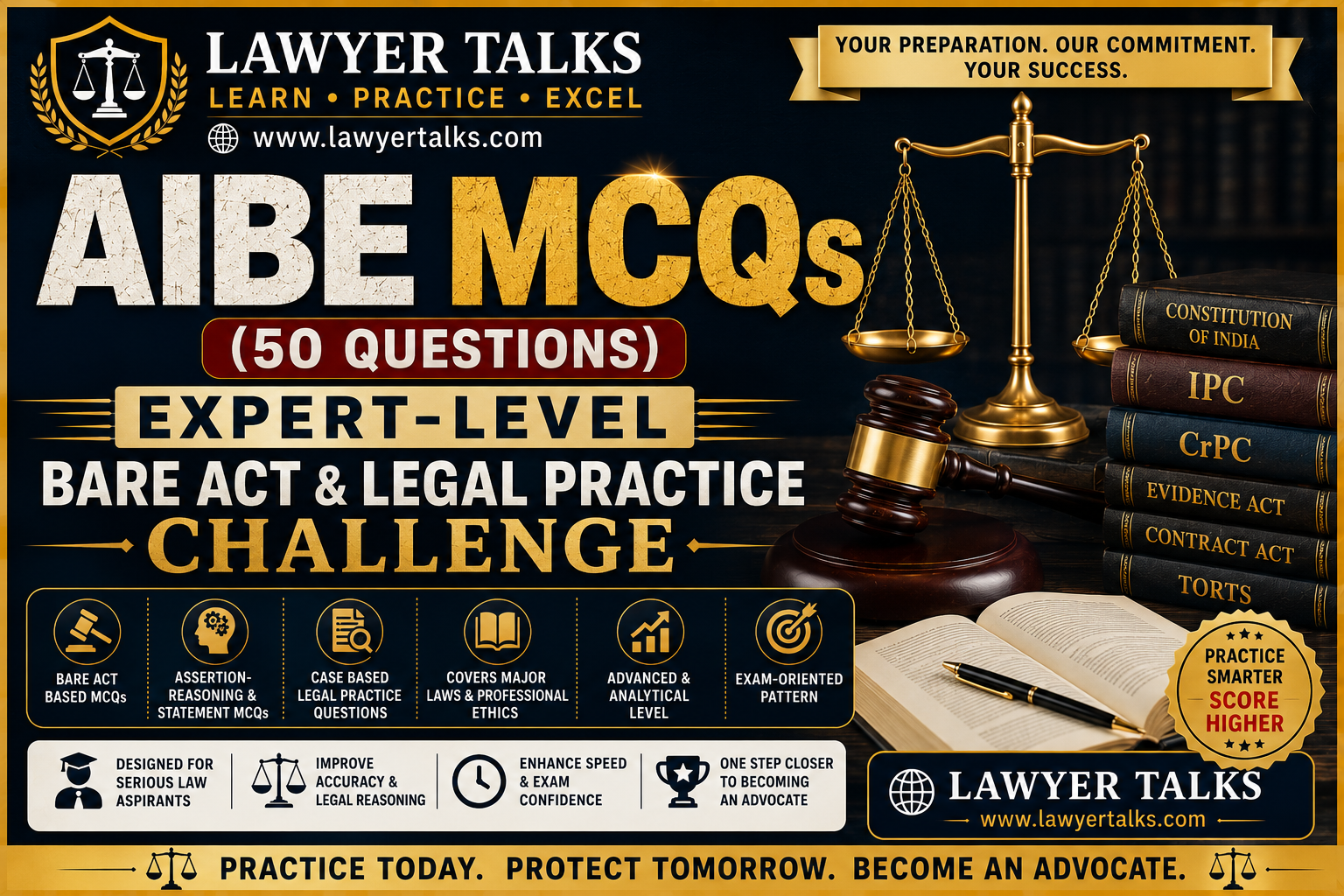
Challenge your preparation with this expert-level AIBE MCQ set specially designed for law graduates and aspiring advocates. This difficult mixed-pattern practice set covers Professional Ethics, IPC, CrPC, CPC, Evidence, Constitution, Contract, Tort, and practical legal application through analytical, assertion-reasoning, statement-based, and case-oriented questions.
1. An advocate appearing in a matter despite conflict of interest may primarily be liable for:
A. Criminal contempt only
B. Professional misconduct
C. Defamation
D. Tortious negligence only
Answer: B
2. True or False: An advocate can legally advertise professional services freely like commercial businesses.
Answer: False
3. “Ubi jus ibi remedium” means:
A. Facts speak for themselves
B. Where there is right, there is remedy
C. Ignorance excuses none
D. Equity follows law
Answer: B
4. Assertion: Advocates are officers of the court.
Reason: Duty toward court overrides personal interest of client in administration of justice.
A. Both correct and Reason explains Assertion
B. Both correct but Reason not explanation
C. Assertion true, Reason false
D. Assertion false, Reason true
Answer: A
5. Res judicata applies when:
A. Matter substantially identical and finally decided
B. Cause of action partially similar
C. Suit dismissed for default
D. Evidence differs completely
Answer: A
6. True or False: A decree passed without jurisdiction is nullity.
Answer: True
7. Res sub judice under CPC aims to prevent:
A. Double punishment
B. Multiplicity of proceedings
C. Criminal liability
D. Execution of decree
Answer: B
8. Caveat under CPC ensures:
A. Automatic stay
B. Prior hearing before adverse order
C. Review jurisdiction
D. Interim compensation
Answer: B
9. Appeal is regarded as:
A. Fundamental right
B. Constitutional guarantee
C. Statutory right
D. Human right
Answer: C
10. Assertion: Review jurisdiction is limited.
Reason: Review is not rehearing of entire matter.
A. Both correct and Reason explains Assertion
B. Both correct but Reason not explanation
C. Assertion true, Reason false
D. Assertion false, Reason true
Answer: A
11. FIR under Section 154 CrPC relates to:
A. Non-cognizable offences only
B. Cognizable offences
C. Civil disputes only
D. Constitutional remedies
Answer: B
12. True or False: FIR can be used for corroboration or contradiction.
Answer: True
13. Anticipatory bail is generally sought when person apprehends:
A. Civil liability
B. Arrest
C. Conviction
D. Attachment of property
Answer: B
14. Confession before police officer is generally inadmissible because of:
A. Constitutional prohibition only
B. Risk of coercion and unreliability
C. Executive privilege
D. Parliamentary restriction
Answer: B
15. Assertion: Bail is rule and jail is exception.
Reason: Liberty under Article 21 is significant in criminal jurisprudence.
A. Both correct and Reason explains Assertion
B. Both correct but Reason not explanation
C. Assertion true, Reason false
D. Assertion false, Reason true
Answer: A
16. Dying declaration becomes relevant because:
A. Maker is under oath
B. Law presumes solemnity in expectation of death
C. It is primary evidence
D. Magistrate records every declaration
Answer: B
17. True or False: Hearsay evidence is always inadmissible without exception.
Answer: False
18. “Res gestae” under Evidence Act permits admission of:
A. Character evidence
B. Facts forming part of same transaction
C. Secondary evidence only
D. Expert testimony only
Answer: B
19. Expert opinion under Evidence Act is:
A. Conclusive proof
B. Relevant but not binding
C. Inadmissible evidence
D. Documentary proof only
Answer: B
20. Accomplice testimony may sustain conviction when:
A. Corroborated materially in important particulars
B. Witness is hostile
C. Police approves testimony
D. Defence admits guilt
Answer: A
21. Theft requires:
A. Entrustment
B. Dishonest intention to take movable property
C. Violence
D. Deception only
Answer: B
22. True or False: Every culpable homicide amounts to murder.
Answer: False
23. “Mens rea” refers to:
A. Guilty act
B. Guilty intention
C. Wrongful gain
D. Strict liability
Answer: B
24. Common intention under Section 34 IPC requires:
A. Mere presence
B. Prior meeting of minds, which may develop instantly
C. Written agreement
D. Common object only
Answer: B
25. A person assisting offenders during commission of robbery may incur liability through:
A. Common intention
B. Negligence only
C. Civil liability only
D. Constitutional tort
Answer: A
26. Assertion: Criminal conspiracy is complete upon agreement.
Reason: Overt act is unnecessary in several conspiracies under IPC.
A. Both correct and Reason explains Assertion
B. Both correct but Reason not explanation
C. Assertion true, Reason false
D. Assertion false, Reason true
Answer: A
27. True or False: Mistake of fact may operate as valid defence under IPC in certain situations.
Answer: True
28. Criminal breach of trust differs from theft because it involves:
A. Violence
B. Entrustment of property
C. Illegal confinement
D. Defamation
Answer: B
29. Consideration under Indian Contract Act may move from:
A. Promisee only
B. Promisor only
C. Third party
D. Court direction only
Answer: C
30. Minor’s agreement is void because:
A. It is immoral
B. Minor lacks contractual capacity
C. It is opposed to public policy
D. Consideration absent
Answer: B
31. Assertion: Every contract is agreement.
Reason: Enforceability by law converts agreement into contract.
A. Both correct and Reason explains Assertion
B. Both correct but Reason not explanation
C. Assertion true, Reason false
D. Assertion false, Reason true
Answer: A
32. “Consensus ad idem” primarily signifies:
A. Compensation
B. Identity of consideration
C. Meeting of minds upon same thing
D. Judicial review
Answer: C
33. True or False: Mere breach of contract automatically constitutes cheating.
Answer: False
34. “Volenti non fit injuria” is based on principle of:
A. Absolute liability
B. Consent
C. Negligence
D. Constitutional remedy
Answer: B
35. Rylands v. Fletcher established liability based on:
A. Fault principle only
B. Escape of dangerous substance
C. Criminal negligence
D. Fraudulent conduct
Answer: B
36. MC Mehta case introduced absolute liability because:
A. Strict liability exceptions were inadequate for hazardous industries
B. Criminal law failed entirely
C. Contract law prevailed
D. Evidence Act mandated change
Answer: A
37. Assertion: Negligence requires breach of duty of care.
Reason: Every accident creates liability irrespective of duty.
A. Both correct and Reason explains Assertion
B. Both correct but Reason not explanation
C. Assertion true, Reason false
D. Assertion false, Reason true
Answer: C
38. “Injuria sine damno” means:
A. Damage without legal injury
B. Legal injury without actual damage
C. Tort without negligence
D. Wrong without remedy
Answer: B
39. Article 14 permits classification when classification is:
A. Arbitrary
B. Reasonable with intelligible differentia
C. Political only
D. Temporary only
Answer: B
40. True or False: Judicial review is part of basic structure doctrine.
Answer: True
41. Doctrine of eclipse mainly applies to:
A. Constitutional amendments only
B. Pre-constitutional laws inconsistent with Fundamental Rights
C. Criminal trials only
D. Tax legislation only
Answer: B
42. “Audi alteram partem” embodies principle of:
A. Double jeopardy
B. Fair hearing
C. Strict liability
D. Estoppel
Answer: B
43. Assertion: Article 32 itself is Fundamental Right.
Reason: It provides remedy for enforcement of Fundamental Rights.
A. Both correct and Reason explains Assertion
B. Both correct but Reason not explanation
C. Assertion true, Reason false
D. Assertion false, Reason true
Answer: A
44. Lok Adalat award is treated as:
A. Advisory opinion
B. Decree of civil court
C. Interim order
D. Non-binding settlement
Answer: B
45. “Actus non facit reum nisi mens sit rea” emphasizes requirement of:
A. Guilty act alone
B. Guilty act with guilty mind
C. Judicial discretion only
D. Motive alone
Answer: B
46. True or False: Standard of proof in civil cases is beyond reasonable doubt.
Answer: False
47. Standard of proof in criminal cases primarily aims to protect:
A. State revenue
B. Presumption of innocence
C. Executive authority
D. Police discretion
Answer: B
48. A witness intentionally giving false evidence commits:
A. Sedition
B. Perjury
C. Criminal intimidation
D. Contempt only
Answer: B
49. Assertion: Ignorance of law is no excuse.
Reason: Everyone is presumed to know law.
A. Both correct and Reason explains Assertion
B. Both correct but Reason not explanation
C. Assertion true, Reason false
D. Assertion false, Reason true
Answer: A
50. “Nemo judex in causa sua” primarily relates to:
A. Burden of proof
B. Rule against bias
C. Strict liability
D. Estoppel
Answer: B
– Team Lawyer Talks