
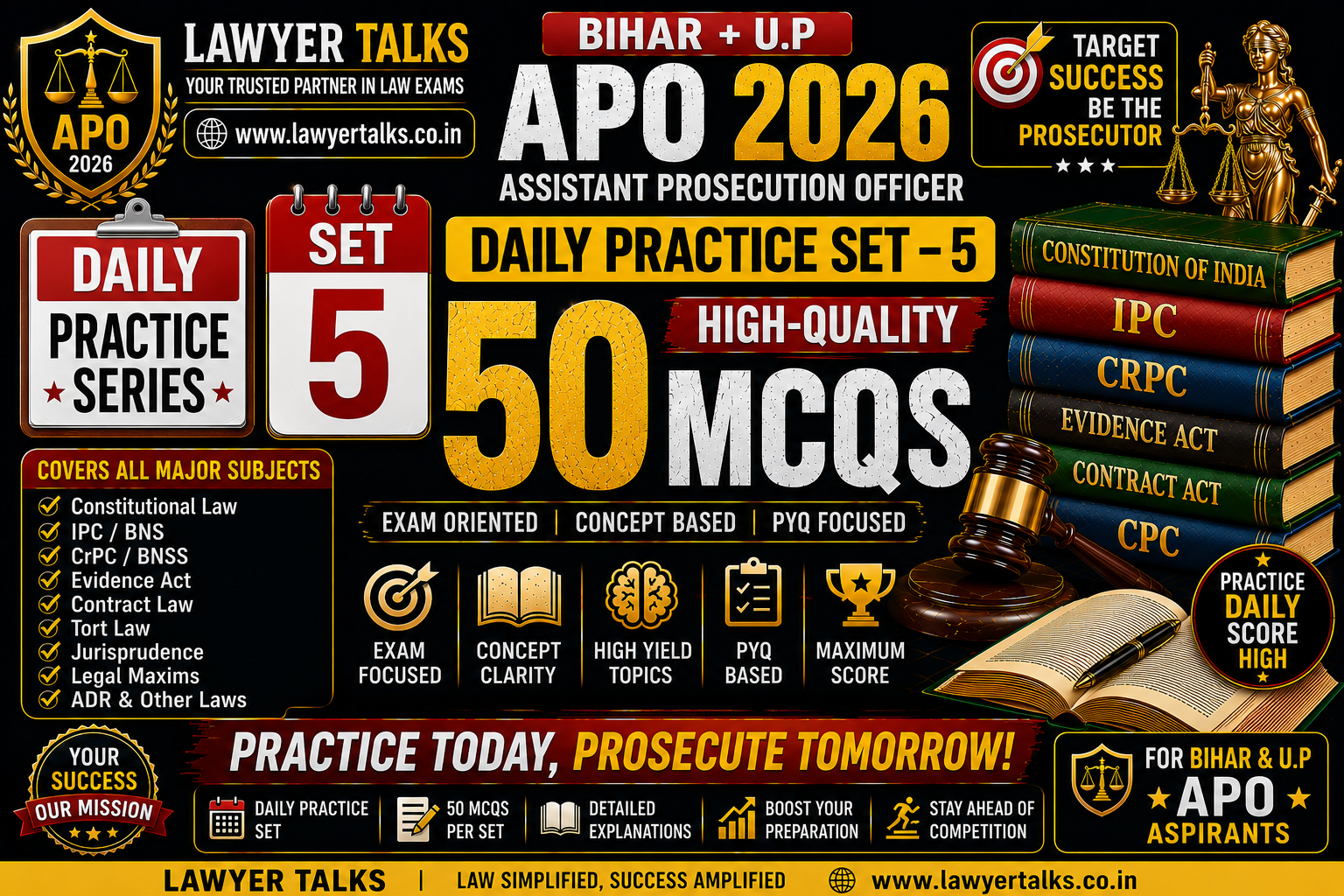
This APO Daily Practice Set–5 is designed for Bihar APO and UP APO aspirants. It contains a balanced mix of Bare Act-based, conceptual, PYQ-pattern, and prosecution-oriented questions from IPC/BNS, CrPC/BNSS, Evidence Act, Constitution, and Procedural Law.
1. Which Article guarantees protection against ex-post facto laws?
A. Article 20(1)
B. Article 19
C. Article 21
D. Article 32
2. Article 20(3) embodies the principle of:
A. Double jeopardy
B. Self-incrimination
C. Equality
D. Liberty
3. True/False: An accused can be compelled to be a witness against himself.
A. True
B. False
4. Which section deals with common object?
A. Section 149 IPC
B. Section 34 IPC
C. Section 120A IPC
D. Section 107 IPC
5. Unlawful assembly requires a minimum of:
A. 3 persons
B. 5 persons
C. 7 persons
D. 10 persons
6. Abetment by conspiracy is covered under:
A. Section 107 IPC
B. Section 120A IPC
C. Section 149 IPC
D. Section 34 IPC
7. Criminal intimidation is defined under:
A. Section 503 IPC
B. Section 378 IPC
C. Section 415 IPC
D. Section 499 IPC
8. Defamation is defined under:
A. Section 499 IPC
B. Section 500 IPC
C. Section 503 IPC
D. Section 378 IPC
9. Punishment for defamation is under:
A. Section 499 IPC
B. Section 500 IPC
C. Section 503 IPC
D. Section 302 IPC
10. Dacoity requires participation of at least:
A. 3 persons
B. 4 persons
C. 5 persons
D. 7 persons
11. FIR can be lodged by:
A. Victim only
B. Police only
C. Any person aware of offence
D. Magistrate only
12. Charge sheet is filed under:
A. Section 173 CrPC
B. Section 154 CrPC
C. Section 161 CrPC
D. Section 190 CrPC
13. True/False: Police can investigate a cognizable offence without Magistrate’s order.
A. True
B. False
14. A warrant case is one relating to offences punishable with:
A. Death, life imprisonment or imprisonment exceeding 2 years
B. Fine only
C. 6 months only
D. Civil liability
15. Anticipatory bail is provided under:
A. Section 438 CrPC
B. Section 437 CrPC
C. Section 439 CrPC
D. Section 436 CrPC
16. Which court can grant anticipatory bail?
A. High Court or Sessions Court
B. Magistrate only
C. Supreme Court only
D. Police Officer
17. Leading questions are generally allowed in:
A. Examination-in-chief
B. Re-examination
C. Cross-examination
D. None
18. Expert opinion is relevant under:
A. Section 45 Evidence Act
B. Section 32
C. Section 24
D. Section 114
19. Judicial notice is covered under:
A. Section 56 Evidence Act
B. Section 32
C. Section 45
D. Section 17
20. True/False: Admissions are substantive evidence.
A. True
B. False
21. Article 226 empowers:
A. Supreme Court
B. High Courts
C. Parliament
D. President
22. Which writ is issued to inquire into legality of a person’s claim to public office?
A. Certiorari
B. Mandamus
C. Quo Warranto
D. Habeas Corpus
23. The Preamble declares India to be:
A. Sovereign Socialist Secular Democratic Republic
B. Federal Monarchy
C. Unitary State
D. Welfare Kingdom
24. Fundamental Duties were added by:
A. 42nd Amendment
B. 44th Amendment
C. 24th Amendment
D. 86th Amendment
25. Right to Education is under:
A. Article 21A
B. Article 20A
C. Article 22A
D. Article 19A
26. Consideration may be past, present or:
A. Future
B. Illegal
C. Void
D. Impossible
27. A minor’s agreement is:
A. Void
B. Voidable
C. Valid
D. Illegal
28. Caveat Emptor means:
A. Seller beware
B. Buyer beware
C. Contract void
D. Let justice prevail
29. True/False: Every promise is a contract.
A. True
B. False
30. Tort of negligence was established in:
A. Donoghue v Stevenson
B. Rylands v Fletcher
C. Carlill v Carbolic
D. Ashby v White
31. Res Ipsa Loquitur means:
A. Thing speaks for itself
B. Buyer beware
C. No injury no action
D. Act of God
32. False imprisonment is a:
A. Tort
B. Crime only
C. Contract
D. Trust
33. Which is not a source of Hindu Law?
A. Smritis
B. Customs
C. Judicial Decisions
D. UN Charter
34. Muslim Law recognizes:
A. Ijma
B. Qiyas
C. Quran
D. All of these
35. True/False: Custom can be a source of law.
A. True
B. False
36. Who propounded the Command Theory?
A. Austin
B. Hart
C. Kelsen
D. Pound
37. Who gave the theory of Social Engineering?
A. Roscoe Pound
B. Austin
C. Bentham
D. Savigny
38. Grundnorm is associated with:
A. Kelsen
B. Hart
C. Austin
D. Duguit
39. Rule of Recognition was developed by:
A. Hart
B. Austin
C. Kelsen
D. Salmond
40. Public International Law mainly governs relations between:
A. States
B. Companies
C. Individuals
D. Courts
41. The principal judicial organ of the UN is:
A. ICJ
B. ICC
C. WTO
D. ILO
42. Treaty is a source of:
A. International Law
B. Criminal Law
C. Constitutional Law
D. Contract Law only
43. Ratio Decidendi means:
A. Reason for decision
B. Observation
C. Dicta
D. Statute
44. Obiter Dicta means:
A. Incidental remark
B. Binding precedent
C. Decree
D. Judgment
45. True/False: Ratio Decidendi is binding.
A. True
B. False
46. Lok Adalat functions under:
A. Legal Services Authorities Act, 1987
B. CPC
C. CrPC
D. Evidence Act
47. Permanent Lok Adalat deals with:
A. Public Utility Services
B. Criminal Trials
C. Constitutional Cases
D. Election Disputes
48. Arbitration is based on:
A. Agreement of parties
B. Police report
C. FIR
D. Court decree only
49. Which of the following is an ADR mechanism?
A. Mediation
B. Conciliation
C. Arbitration
D. All of these
50. The most effective APO preparation strategy is:
A. Bare Acts + PYQs + Mock Tests
B. Only Notes
C. Only Coaching
D. Guesswork
📌 ANSWER KEY
1-A, 2-B, 3-B, 4-A, 5-B, 6-A, 7-A, 8-A, 9-B, 10-C
11-C, 12-A, 13-A, 14-A, 15-A, 16-A, 17-C, 18-A, 19-A, 20-A
21-B, 22-C, 23-A, 24-A, 25-A, 26-A, 27-A, 28-B, 29-B, 30-A
31-A, 32-A, 33-D, 34-D, 35-A, 36-A, 37-A, 38-A, 39-A, 40-A
41-A, 42-A, 43-A, 44-A, 45-A, 46-A, 47-A, 48-A, 49-D, 50-A
– Team Lawyer Talks