
Table of Contents
ToggleIntroduction
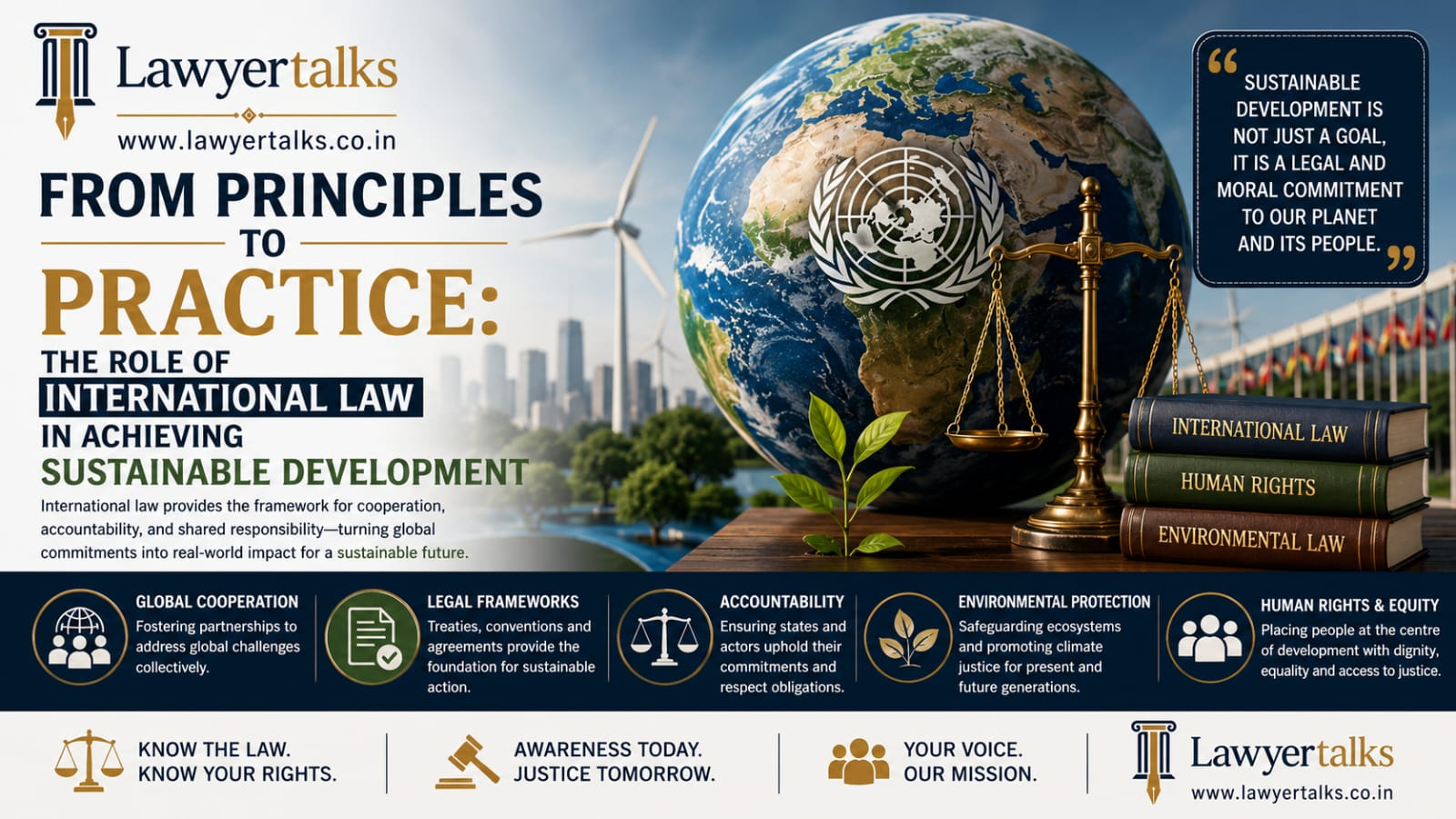
Sustainable development has evolved from a political aspiration into a guiding principle of international governance. As environmental degradation, climate change, poverty, food insecurity, and social inequalities transcend national borders, international law has emerged as a critical mechanism for fostering cooperation and establishing shared responsibilities among States. However, despite the proliferation of treaties, declarations, and institutional frameworks, the world remains far from achieving the Sustainable Development Goals (SDGs) adopted under the United Nations 2030 Agenda. This raises an important question: Can international law effectively transform global commitments into sustainable action?
International Law as a Framework for Sustainable Development
International law provides the normative foundation for sustainable development by integrating environmental protection, economic growth, and social justice. The concept first gained international recognition through the Stockholm Declaration (1972) and was formally defined in the Brundtland Report (1987) as development that satisfies present needs without compromising the ability of future generations to meet their own.
The Rio Declaration (1992) expanded this vision by introducing principles such as precaution, public participation, and common but differentiated responsibilities (CBDR). Rather than treating environmental protection and development as competing objectives, international law increasingly recognizes them as mutually reinforcing pillars of global governance.
The Principle of Integration: A New Legal Paradigm
One of the most significant contributions of international law is the principle of integration. Sustainable development cannot be achieved through environmental regulation alone; it requires simultaneous consideration of human rights, economic policies, trade, public health, and climate governance.
This integrated approach has transformed international legal discourse. Climate change negotiations now include discussions on poverty reduction, technology transfer, indigenous rights, and gender equality. International institutions increasingly evaluate development projects not only by economic returns but also by their environmental and social impacts.
The integration principle therefore represents a shift from sector-specific governance to holistic global decision-making.
Sustainable Development and Human Rights
Modern international law increasingly recognizes that sustainable development is inseparable from the protection of human rights. Access to clean water, sanitation, healthcare, education, and a healthy environment directly influences the realization of fundamental rights.
The United Nations Human Rights Council’s recognition of the right to a clean, healthy, and sustainable environment has strengthened the relationship between environmental protection and human dignity. Likewise, international courts and tribunals have emphasized that climate change disproportionately affects vulnerable communities, indigenous peoples, women, and future generations.
By incorporating human rights obligations into environmental governance, international law broadens sustainable development beyond resource management to include social justice and equality.
Challenges Limiting Effectiveness
Despite its ambitious legal framework, international law faces significant implementation challenges.
First, most sustainable development commitments rely on voluntary compliance rather than enforceable sanctions. States often prioritize domestic economic interests over international environmental obligations, leading to inconsistent implementation.
Second, inequalities between developed and developing countries continue to undermine global cooperation. While developing nations argue that industrialized countries bear greater historical responsibility for environmental degradation, developed countries frequently emphasize universal obligations. This disagreement slows negotiations on climate finance, technology transfer, and capacity building.
Third, globalization has created new complexities. International investment, trade liberalization, and multinational corporate activities often generate economic growth while simultaneously contributing to environmental degradation and resource exploitation. Existing international legal mechanisms remain fragmented and struggle to regulate these competing interests effectively.
Emerging Trends in International Law
Recent developments indicate that international law is becoming increasingly responsive to sustainable development challenges.
Climate litigation is expanding worldwide, with courts requiring governments to justify inadequate climate policies. International organizations are promoting transparency in climate finance, while biodiversity agreements increasingly recognize equitable benefit-sharing and indigenous knowledge.
Artificial intelligence, digital governance, and sustainable finance are also emerging as new areas requiring international legal regulation. These developments demonstrate that sustainable development is no longer confined to environmental law but influences virtually every branch of international law.
The Way Forward
To achieve meaningful sustainable development, international law must move beyond declarations toward stronger accountability mechanisms. Greater cooperation between States, international organizations, private corporations, and civil society is essential. Financial assistance, technology transfer, and inclusive governance should complement legal obligations rather than remain political promises.
Equally important is strengthening the principle of integration by ensuring that trade agreements, investment treaties, and development policies incorporate environmental and human rights considerations. Sustainable development should become a guiding standard across all areas of international decision-making rather than a separate policy objective.
Conclusion
International law has successfully established a comprehensive normative framework for sustainable development, bringing together environmental protection, human rights, economic development, and global cooperation. Yet the true measure of its success lies not in the number of treaties adopted but in their practical implementation. The future of sustainable development depends on transforming legal principles into enforceable commitments, promoting equitable partnerships between nations, and recognizing that the protection of people and the planet is a shared responsibility. In an increasingly interconnected world, international law must evolve from a system of promises into a system of accountability capable of securing sustainable development for present and future generations.