
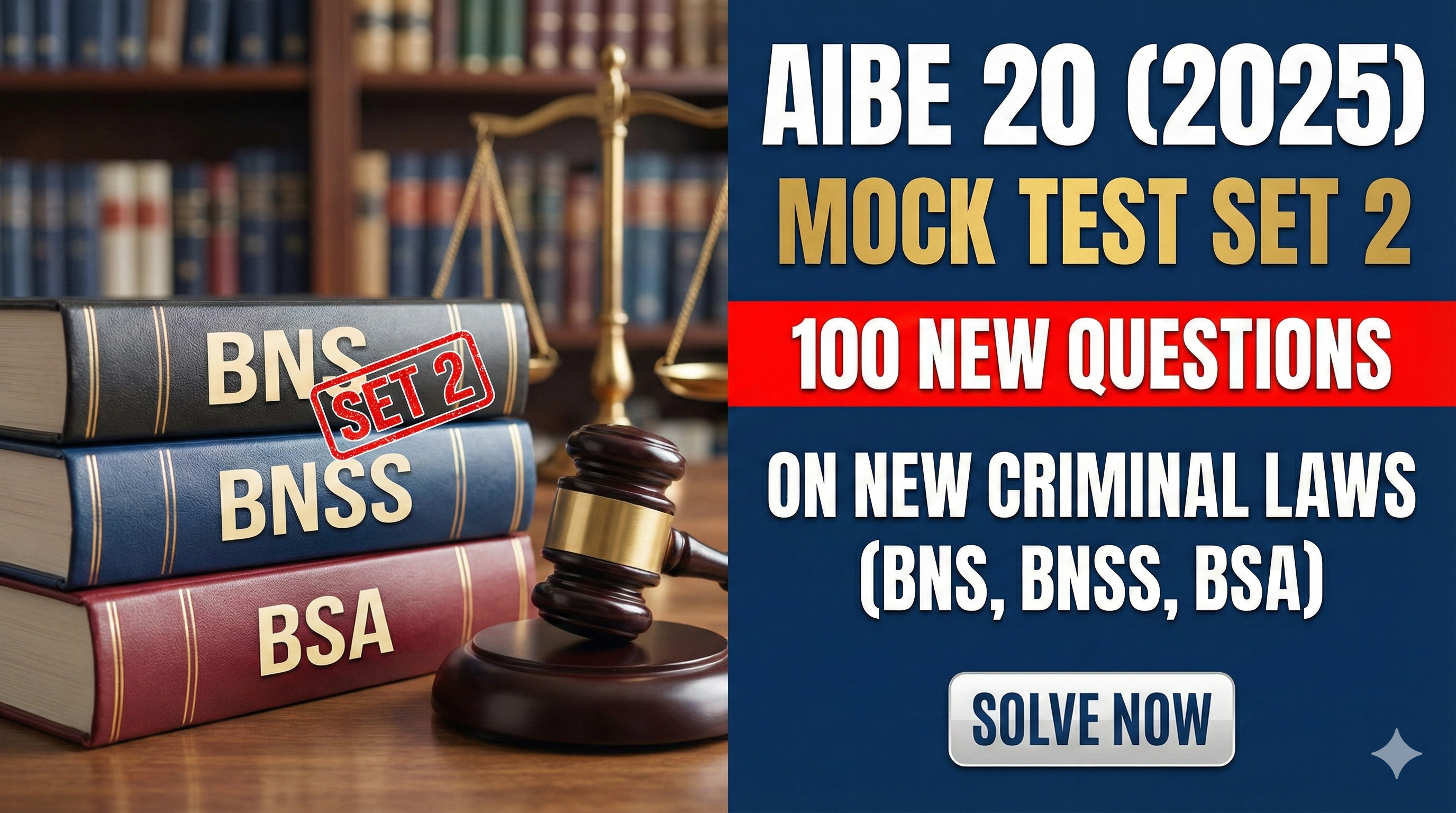
Part I: Constitutional Law (10 Questions)
1. The “Power of Judicial Review” originated from which famous case?
A) Marbury v. Madison
B) Plessy v. Ferguson
C) Donoghue v. Stevenson
D) R v. Dudley and Stephens
2. Which Article of the Indian Constitution safeguards the “Freedom of Press”?
A) Article 19(1)(a)
B) Article 19(1)(b)
C) Article 21
D) Article 32
3. The “Directive Principles of State Policy” (DPSP) are borrowed from the constitution of:
A) USA
B) Canada
C) Ireland
D) UK
4. Who decides whether a bill is a “Money Bill”?
A) The President
B) The Finance Minister
C) The Speaker of Lok Sabha
D) The Chairman of Rajya Sabha
5. The concept of “Equal Pay for Equal Work” is a:
A) Fundamental Right
B) Constitutional Right
C) Directive Principle of State Policy
D) Statutory Right
6. Which Amendment Act added the “Fundamental Duties” to the Constitution?
A) 42nd Amendment
B) 44th Amendment
C) 86th Amendment
D) 91st Amendment
7. The maximum gap between two sessions of Parliament cannot exceed:
A) 3 months
B) 4 months
C) 6 months
D) 1 year
8. Article 300A (Right to Property) is a:
A) Fundamental Right
B) Legal/Constitutional Right
C) Moral Right
D) Directive Principle
9. The Election Commission of India is established under:
A) Article 320
B) Article 324
C) Article 330
D) Article 356
10. “Double Jeopardy” is prohibited under:
A) Article 20(1)
B) Article 20(2)
C) Article 20(3)
D) Article 21
Part II: Bharatiya Nyaya Sanhita (BNS) / IPC (8 Questions)
(Based on BNS 2023)
11. Under BNS, “Murder” is punishable under which section?
A) Section 300
B) Section 302
C) Section 103
D) Section 101
12. The offense of “Theft” is defined under Section ____ of BNS.
A) 378
B) 303
C) 305
D) 379
13. Under BNS, “Terrorist Act” is specifically defined and punishable under:
A) Section 113
B) Section 111
C) Section 152
D) Section 121
14. “Culpable Homicide not amounting to murder” is punishable under:
A) Section 105 of BNS
B) Section 304 of IPC
C) Section 100 of BNS
D) Both A and B (context dependent)
15. The right of private defense of the body extends to causing death if the assault causes reasonable apprehension of:
A) Simple Hurt
B) Wrongful Restraint
C) Death or Grievous Hurt
D) Theft
16. “Defamation” under BNS is covered under:
A) Section 499
B) Section 356
C) Section 354
D) Section 500
17. For an act to be a crime, there must be:
A) Actus Reus only
B) Mens Rea only
C) Actus Reus and Mens Rea
D) Motive
18. Nothing is an offense which is done by a child under:
A) 5 years
B) 7 years
C) 12 years
D) 10 years
Part III: Bharatiya Nagarik Suraksha Sanhita (BNSS) / CrPC (10 Questions)
(Based on BNSS 2023)
19. Under BNSS, the “Zero FIR” provision allows:
A) Filing FIR without details
B) Filing FIR at any police station regardless of jurisdiction
C) Filing FIR online only
D) Police to refuse FIR
20. Information to police as to non-cognizable cases is recorded under Section ____ of BNSS (equivalent to old Sec 155).
A) 174
B) 173
C) 154
D) 175
21. A “Search Warrant” can be issued by:
A) Any Police Officer
B) A Magistrate
C) A Lawyer
D) An Inspector
22. Under BNSS, the period of police custody can be authorized in parts during the initial:
A) 15 days
B) 40 or 60 days
C) 30 days
D) 90 days
23. “Plea Bargaining” applies to offenses punishable with imprisonment up to:
A) 7 years
B) 10 years
C) Life
D) 5 years
24. Which section of BNSS empowers the High Court to exercise “Inherent Powers”?
A) Section 482
B) Section 528
C) Section 438
D) Section 397
25. An arrested person has a right to meet an advocate of his choice during interrogation. This is provided in:
A) Article 22(1) & BNSS
B) Article 19
C) Only Police Manual
D) Not a legal right
26. “Cognizable Offense” means an offense where police can arrest:
A) With warrant
B) Without warrant
C) Only with Magistrate’s permission
D) After 24 hours
27. Under Section 144 of BNSS (Power to issue order in urgent cases of nuisance), the order can remain in force for a maximum of:
A) 1 month
B) 2 months
C) 6 months
D) 1 year
28. The limitation period for taking cognizance of an offense punishable with fine only is:
A) 6 months
B) 1 year
C) 3 years
D) No limit
Part IV: Code of Civil Procedure (CPC) (10 Questions)
29. “Decree” is defined under Section ____ of CPC.
A) 2(2)
B) 2(9)
C) 2(11)
D) 2(14)
30. The doctrine of “Constructive Res Judicata” is explained in:
A) Explanation III to Section 11
B) Explanation IV to Section 11
C) Explanation VI to Section 11
D) Section 10
31. A suit can be instituted by:
A) Filing a Plaint
B) Filing an Application
C) Sending a Notice
D) Filing an Affidavit
32. Under Order 8 Rule 1, a defendant must file a Written Statement within:
A) 30 days
B) 60 days
C) 90 days
D) 120 days
33. “Set-off” is a claim by:
A) Plaintiff against Defendant
B) Defendant against Plaintiff
C) Witness against Party
D) Court against Party
34. Which Order deals with “Temporary Injunctions”?
A) Order 38
B) Order 39
C) Order 40
D) Order 21
35. Section 115 of CPC deals with:
A) Review
B) Revision
C) Reference
D) Appeal
36. A “Next Friend” is appointed for:
A) An indigent person
B) A minor plaintiff
C) A lunatic defendant
D) A foreign national
37. Attachment of property before judgment is dealt with in:
A) Order 38
B) Order 39
C) Order 21
D) Order 26
38. “Caveat Emptor” is not a CPC principle, but a “Caveat” petition under CPC prevents:
A) Ex-parte orders
B) Filing of suit
C) Execution of decree
D) Arrest
Part V: Bharatiya Sakshya Adhiniyam (BSA) / Evidence Act (8 Questions)
(Based on BSA 2023)
39. Under BSA, “Secondary Evidence” now explicitly includes:
A) Oral accounts of document contents (under specific conditions)
B) Original documents
C) Hearsay
D) Confessions
40. A “Dying Declaration” is admissible under Section ____ of BSA (equivalent to old Sec 32).
A) 26
B) 32
C) 45
D) 60
41. Facts which are not otherwise relevant become relevant if they are inconsistent with any fact in issue. This is known as:
A) Plea of Alibi
B) Res Gestae
C) Estoppel
D) Admission
42. The opinion of an Expert is:
A) Conclusive proof
B) Relevant fact
C) Irrelevant
D) Binding on Judge
43. “Character” of a person is irrelevant in civil cases except:
A) To prove conduct
B) To affect damages
C) When character is in issue
D) Both B and C
44. Section 112 (Old Act) / Equivalent in BSA regarding “Legitimacy of child” presumes legitimacy if born during valid marriage or within ____ days of dissolution.
A) 270
B) 280
C) 290
D) 300
45. Who is a “Hostile Witness”?
A) Witness who speaks truth
B) Witness who refuses to answer
C) Witness who gives evidence against the party calling him
D) Witness who is an enemy of the accused
46. Electronic records are admissible if accompanied by a certificate (Self-certification permitted now) under:
A) Section 65B (Old) / Sec 63 (BSA)
B) Section 45
C) Section 90
D) Section 100
Part VI: Alternative Dispute Redressal (4 Questions)
47. The UNCITRAL Model Law on International Commercial Arbitration was adopted in:
A) 1980
B) 1985
C) 1996
D) 2000
48. Under Section 34 of the Arbitration Act, a court can set aside an award on grounds of:
A) Error of fact
B) Insufficiency of evidence
C) Public Policy of India
D) Any reason
49. “Conciliation” proceedings are:
A) Binding like a court decree immediately
B) Non-binding until a settlement agreement is signed
C) Open to public
D) Same as Arbitration
50. Can an Arbitrator be a foreigner in International Commercial Arbitration seated in India?
A) Yes
B) No
C) Only if BCI permits
D) Only if Supreme Court appoints
Part VII: Family Law (8 Questions)
51. Which Hindu marriage is voidable?
A) Bigamous marriage
B) Marriage within prohibited degrees
C) Marriage where consent was obtained by fraud
D) Marriage between Sapindas
52. Under Muslim Law, “Khula” is a form of divorce initiated by:
A) Husband
B) Wife
C) Court
D) Mutual Agreement
53. The “Uniform Civil Code” is currently in force in which Indian state?
A) Maharashtra
B) Kerala
C) Goa
D) Sikkim
54. A Hindu wife can claim maintenance under Section 125 CrPC even if she:
A) Lives separately by mutual consent
B) Lives in adultery
C) Refuses to live with husband without cause
D) Is divorced and has not remarried
55. Adoption is not recognized under:
A) Hindu Law
B) Muslim Law
C) Secular Law
D) Customary Law
56. “Restitution of Conjugal Rights” is a remedy available to:
A) Wife only
B) Husband only
C) Both Husband and Wife
D) Parents
57. Who is a Class I heir of a Hindu male?
A) Brother
B) Father
C) Son
D) Uncle
58. Special Marriage Act, 1954 applies to:
A) Hindus only
B) Inter-religious marriages
C) Muslims only
D) Foreigners only
Part VIII: Public Interest Litigation (4 Questions)
59. “Locus Standi” in PIL means:
A) Right to be heard
B) Right to travel
C) Relaxation of the rule that only the aggrieved can file a case
D) Right to property
60. Which case deals with “Sexual Harassment at Workplace”?
A) Vishaka v. State of Rajasthan
B) Shah Bano Case
C) Nirbhaya Case
D) Puttaswamy Case
61. PIL cannot be filed for:
A) Bonded Labour
B) Service matters and private disputes
C) Environmental pollution
D) Rights of prisoners
62. The “Epistolary Jurisdiction” allows courts to treat _____ as a Writ Petition.
A) A letter
B) An SMS
C) A WhatsApp message
D) A Tweet
Part IX: Administrative Law (3 Questions)
63. The concept of “Rule of Law” was propounded by:
A) Montesquieu
B) A.V. Dicey
C) Salmond
D) Austin
64. “Audi Alteram Partem” means:
A) No one should be condemned unheard
B) Hear the other side
C) Both A and B
D) The King can do no wrong
65. Which Writ is issued to quash an order passed by a lower court without jurisdiction?
A) Mandamus
B) Certiorari
C) Quo Warranto
D) Habeas Corpus
Part X: Professional Ethics (4 Questions)
66. The Bar Council of India consists of members elected from:
A) State Bar Councils
B) Supreme Court Judges
C) Parliament
D) Law Colleges
67. An advocate cannot appear in a case where he is a:
A) Witness
B) Neighbor of the party
C) Friend of the party
D) Former employee
68. Which section of the Advocates Act protects advocates from arrest in civil cases?
A) Section 135 CPC (applicable via Advocates Act context)
B) Section 30
C) Section 45
D) No such protection
69. “Soliciting work” by an advocate is:
A) Allowed online
B) Allowed via brochures
C) Strict misconduct
D) Allowed if unpaid
Part XI: Company Law (2 Questions)
70. A “Private Company” must have a minimum of ____ directors.
A) 1
B) 2
C) 3
D) 7
71. The doctrine of “Indoor Management” protects:
A) The Company
B) The Outsiders dealing with the company
C) The Directors
D) The Shareholders
Part XII: Environmental Law (2 Questions)
72. The “Wild Life (Protection) Act” was enacted in:
A) 1972
B) 1980
C) 1986
D) 1991
73. The National Green Tribunal (NGT) was established in:
A) 2005
B) 2008
C) 2010
D) 2012
Part XIII: Cyber Law (2 Questions)
74. Which section of the IT Act deals with “Punishment for identity theft”?
A) Section 66C
B) Section 66D
C) Section 67
D) Section 43
75. A “Digital Signature” uses:
A) Symmetric Cryptography
B) Asymmetric Cryptography (Public-Private Key)
C) Manual Signature
D) Biometrics only
Part XIV: Labour & Industrial Laws (4 Questions)
76. “Retrenchment” does not include:
A) Voluntary Retirement
B) Termination due to ill health
C) Termination as punishment
D) All of the above
77. The “Maternity Benefit Act” provides for paid leave of:
A) 12 weeks
B) 18 weeks
C) 26 weeks
D) 30 weeks
78. Under the Industrial Disputes Act, a “Workman” includes a person employed in:
A) Managerial capacity
B) Administrative capacity
C) Supervisory capacity earning > ₹10,000
D) Manual or clerical work
79. Registration of a Trade Union is:
A) Compulsory
B) Optional
C) Illegal
D) Automatic
Part XV: Law of Tort, MV Act, Consumer Law (5 Questions)
80. In Tort, “Volenti non fit injuria” means:
A) Voluntary taking of risk is no injury
B) To a willing person, injury is done
C) Negligence is excused
D) Necessity knows no law
81. “Strict Liability” rule was laid down in:
A) Rylands v. Fletcher
B) Donoghue v. Stevenson
C) Ashby v. White
D) MC Mehta case
82. Under Consumer Protection Act 2019, an appeal against District Commission lies to:
A) High Court
B) State Commission
C) National Commission
D) Supreme Court
83. “No Fault Liability” in MV Act applies to:
A) Section 140 (Old) / Sec 164 (New)
B) Section 166
C) Section 184
D) Section 304A
84. Libel is a representation in:
A) Temporary form (Gesture)
B) Permanent form (Writing/Video)
C) Oral form
D) Thought form
Part XVI: Law of Taxation (4 Questions)
85. Income Tax is a:
A) Direct Tax
B) Indirect Tax
C) Local Tax
D) State Tax
86. The “Assessment Year” is the year:
A) In which income is earned
B) Following the Financial Year in which income is earned
C) Previous to Financial Year
D) Calendar Year
87. Deduction under Section 80C is allowed up to:
A) ₹1 Lakh
B) ₹1.5 Lakhs
C) ₹2 Lakhs
D) ₹5 Lakhs
88. PAN stands for:
A) Permanent Account Number
B) Personal Account Number
C) Public Account Number
D) Private Account Number
Part XVII: Contract, SRA, Property, NI Act (8 Questions)
89. Acceptance must be:
A) Absolute and Unqualified
B) Conditional
C) Partial
D) Tentative
90. An agreement in restraint of trade is:
A) Voidable
B) Void (Section 27)
C) Valid
D) Illegal
91. “Specific Performance” of a contract is a:
A) Discretionary remedy (Pre-2018) / Mandated remedy (Post-2018 subject to exceptions)
B) Matter of right
C) Criminal remedy
D) Constitutional remedy
92. “Lease” is a transfer of:
A) Ownership
B) Right to enjoy property
C) Interest in property for security
D) Actionable claim
93. “Mortgage” involves transfer of interest for:
A) Sale
B) Lease
C) Securing the payment of money (Loan)
D) Gift
94. A “Promissory Note” contains:
A) An unconditional order
B) An unconditional undertaking/promise
C) A conditional promise
D) A request
95. Under NI Act, a cheque is valid for:
A) 3 months
B) 6 months
C) 12 months
D) 1 month
96. “Caveat Emptor” means:
A) Seller beware
B) Buyer beware
C) Court beware
D) State beware
Part XVIII: Land Acquisition Act (2 Questions)
97. Under the 2013 Act, consent of ____ of affected families is required for LARR in private projects.
A) 50%
B) 70%
C) 80%
D) 90%
98. “Public Purpose” includes:
A) Strategic purposes (Defense)
B) Infrastructure
C) Projects for project affected families
D) All of the above
Part XIX: Intellectual Property Laws (2 Questions)
99. Which of the following is NOT an IPR?
A) Patent
B) Trademark
C) Copyright
D) Real Estate
100. The term of Copyright for literary works is:
A) 60 years
B) Life of author + 60 years
C) 20 years
D) 50 years
Answer Key (Set 2)
1.A 2.A 3.C 4.C 5.C 6.A 7.C 8.B 9.B 10.B
11.C 12.B 13.A 14.A 15.C 16.B 17.C 18.B 19.B 20.A
21.B 22.B 23.A 24.A 25.A 26.B 27.B 28.A 29.A 30.B
31.A 32.A 33.B 34.B 35.B 36.B 37.A 38.A 39.A 40.A
41.A 42.B 43.D 44.B 45.C 46.A 47.B 48.C 49.B 50.A
51.C 52.B 53.C 54.D 55.B 56.C 57.C 58.B 59.C 60.A
61.B 62.A 63.B 64.C 65.B 66.A 67.A 68.A 69.C 70.B
71.B 72.A 73.C 74.A 75.B 76.D 77.C 78.D 79.B 80.A
81.A 82.B 83.A 84.B 85.A 86.B 87.B 88.A 89.A 90.B
91.A 92.B 93.C 94.B 95.A 96.B 97.C 98.D 99.D 100.B
- Top 25 Bihar Judiciary Previous Year Questions (MCQs) – PRELIMS PRACTICE SET
- Case Comment: INTERNET FREEDOM FOUNDATION v. UNION OF INDIA AND ORS. (AADHAAR CASE)

- When Foreign Divorce Meets Indian Law: Supreme Court Resolves an 18-Year Marital Dispute
- One Nation, One Election – Reform or Risk for Indian Democracy?
- Breach of Contract and Legal Remedies