”Main Kisi Supreme Court Ka Aadesh Nahi Maanunga”: UP Cop’s Arrogance Shocks SC; Court Vows “Iron Hand” Action.

In a shocking case that strikes at the very heart of judicial authority, the Supreme Court of India has taken extremely strong exception to the conduct of a Station House Officer (SHO) from Uttar Pradesh. The officer not only willfully disobeyed a direct protection order from the apex court but also brazenly declared, “Main kisi […]
HC rules: Criminal Law cannot be used as revenge when a Consensual Relationship turns sour

Recently, the Delhi High Court granted anticipatory bail to a 20-year-old accused booked under Section 376 IPC, observing that the relationship between the parties appeared consensual and not one induced by a false promise of marriage. The Court held that criminal law cannot be used as an instrument of coercion or revenge when a consensual relationship turns sour, emphasizing the paramount importance of personal liberty under Article 21 of the Constitution.
Understanding the Indian Penal Code (IPC): A Complete Guide to India’s Criminal Law Framework
The **Indian Penal Code (IPC)** is the backbone of criminal law in India, defining offenses, punishments, and legal procedures. Enacted in 1860 during British colonial rule, the IPC remains a cornerstone of the Indian justice system. Whether you’re a law student, a legal professional, or simply curious about India’s criminal laws, this comprehensive guide covers […]
Free Consent (Sections 13-22) || Indian Contract Act, 1872 || lawyer Talks

Introduction: What is “Free Consent”? For any agreement to be a valid contract, the consent of the parties must be genuine and free. The law says that two or more people “consent” (Section 13) when they agree upon the same thing in the same sense. This is the principle of consensus ad idem (meeting of […]
Weekly Legal Wrap: SC on Modifying Awards, “Refusal to Marry” & Attorney Privilege

Welcome to your weekly legal roundup, where we dissect the most significant judgments, legislative changes, and legal developments from across India. This week, the Supreme Court delivered several landmark rulings on arbitration law, abetment of suicide, and the eligibility of judicial officers. Here’s what you need to know from the week of October 26 to […]
E.P. Royappa v. State of Tamil Nadu (1974): The Case That Redefined Equality

Case Citation: AIR 1974 SC 555 Judges: A.N. Ray (CJI), D.G. Palekar, Y.V. Chandrachud, P.N. Bhagwati, V.R. Krishna Iyer Core Principle: Introduced the “Arbitrariness Doctrine,” expanding the scope of Article 14 of the Indian Constitution. 🏛️ Introduction: A New Test for Equality In the landscape of Indian Constitutional Law, few cases stand as tall as […]
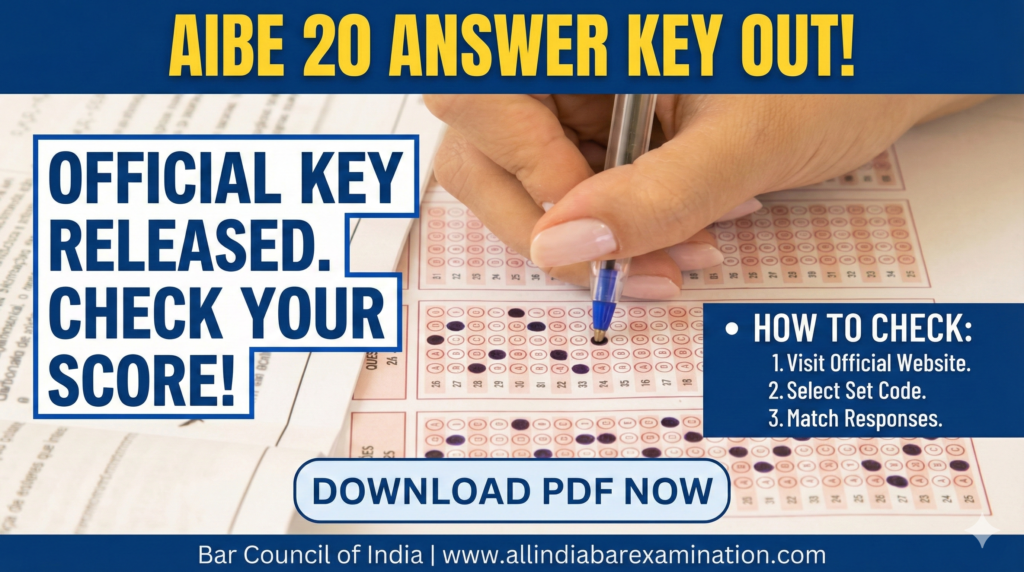
AIBE XX के लिए ज़रूरी सूचना: रजिस्ट्रेशन की अंतिम तिथि 31 अक्टूबर तक बढ़ाई गई!

अखिल भारतीय बार परीक्षा (AIBE) XX का इंतजार कर रहे लॉ ग्रेजुएट्स के लिए एक बड़ी राहत की खबर है। बार काउंसिल ऑफ इंडिया (BCI) ने AIBE XX के लिए ऑनलाइन रजिस्ट्रेशन की अंतिम तिथि एक बार फिर बढ़ा दी है। नई अंतिम तिथि 31 अक्टूबर 2025 है। यह खबर उन हजारों कानून स्नातकों के […]
Romesh Thappar v. State of Madras (1950) : The Case That Defined Press Freedom in India

In the nascent years of the Republic of India, the Supreme Court delivered a judgment that would become a cornerstone of free speech and press freedom. Romesh Thappar v. State of Madras (1950) was not just a case; it was the first major test of the fundamental right to freedom of speech and expression, and […]
Privacy is Your Fundamental Right: How the K.S. Puttaswamy Case Changed India

In an age of smartphones, social media, and digital IDs, a single question defines our freedom: How much of your life is truly your own? Can the government track your every move, link all your data, and create a complete profile of your life? For decades, the answer in India was dangerously unclear. Then came […]
When Can Courts Interfere in Elections? A Look at N.P. Ponnuswami v. Returning Officer

In the vibrant democracy of India, elections are the cornerstone of governance. But what happens when the process itself is questioned? Can you walk into a court and halt an election mid-way because of an error? This fundamental question was decisively answered by the Supreme Court in the landmark 1952 case of N. P. Ponnuswami […]