

Contracts form the backbone of legal and commercial relationships. Whether it’s a simple agreement between two individuals or a complex business deal, contracts create binding obligations. But what happens when one party fails to fulfill their promise? This is where the concept of breach of contract comes into play.
What is a Breach of Contract?
A breach of contract occurs when one party fails to perform their obligations as agreed in the contract, without any lawful excuse. The failure can be partial, complete, or even anticipatory (when a party indicates beforehand that they will not perform).
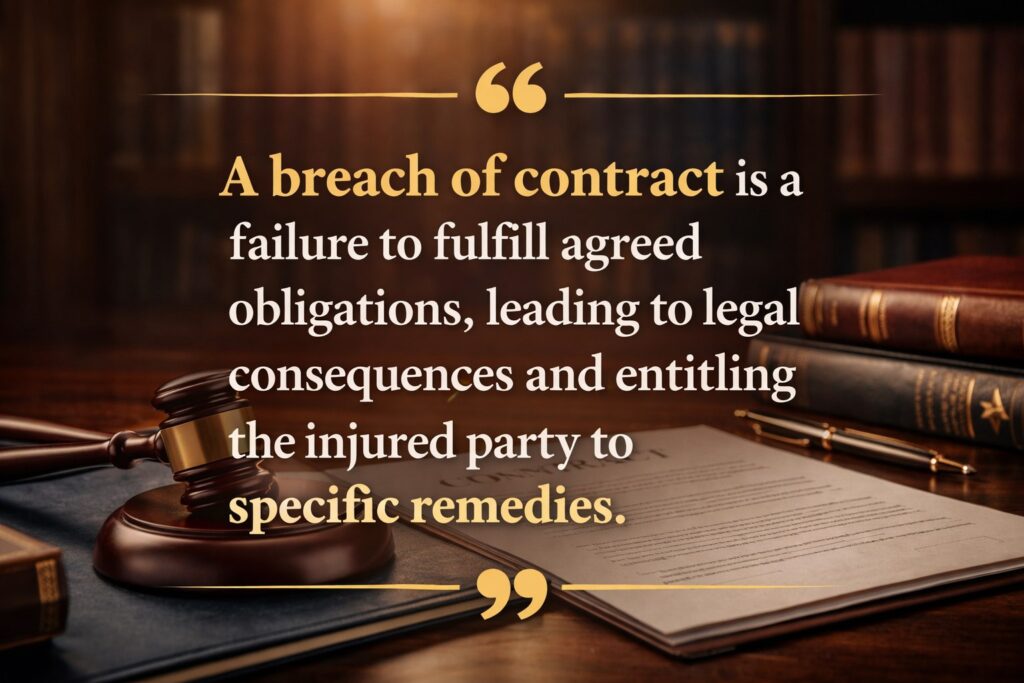
In simple terms, if one side does not do what they promised, it is considered a breach.
Types of Breach of Contract
Understanding the different types of breach helps in determining the appropriate remedy:
1. Actual Breach
This occurs when a party fails to perform their obligation on the due date or during the performance of the contract.
2. Anticipatory Breach
When one party clearly indicates, before the due date, that they will not perform their contractual obligation.
3. Minor (Partial) Breach
A slight failure in performance that does not destroy the whole purpose of the contract.
4. Material (Fundamental) Breach
A serious breach that goes to the root of the contract, allowing the other party to terminate the agreement.
Legal Remedies for Breach of Contract
When a breach occurs, the law provides several remedies to protect the aggrieved party. The goal is usually to place the injured party in the position they would have been in if the contract had been performed.
1. Damages
Damages are the most common remedy. It involves monetary compensation for the loss suffered.
- Compensatory Damages: Cover direct losses.
- Consequential Damages: Cover indirect losses arising from special circumstances.
- Nominal Damages: Small amount awarded when a breach occurred but no actual loss is proven.
- Liquidated Damages: Pre-decided amount mentioned in the contract.
2. Specific Performance
In certain cases, the court may order the party to actually perform their contractual obligation instead of paying damages. This is commonly applied in contracts involving unique goods or property where monetary compensation is inadequate.
3. Injunction
An injunction is a court order restraining a party from doing a particular act. It is often used to prevent further breach or protect rights under a contract.
4. Rescission
Rescission means cancellation of the contract. The parties are restored to their original position as if the contract never existed.
5. Quantum Meruit
This remedy allows a party to claim reasonable payment for the work done when a contract is partially performed or becomes void.
Conclusion
Breach of contract is a common issue in both personal and commercial dealings. However, the law ensures that the aggrieved party is not left without relief. From monetary compensation to court orders enforcing performance, legal remedies aim to ensure fairness and justice.
Understanding these concepts not only helps in academic learning but also equips individuals to handle real-life legal situations more effectively.
Tip for Readers: Always read and understand the terms of a contract carefully before signing. A well-drafted contract can prevent disputes and provide clarity in case things go wrong.
– Team Lawyer Talks