
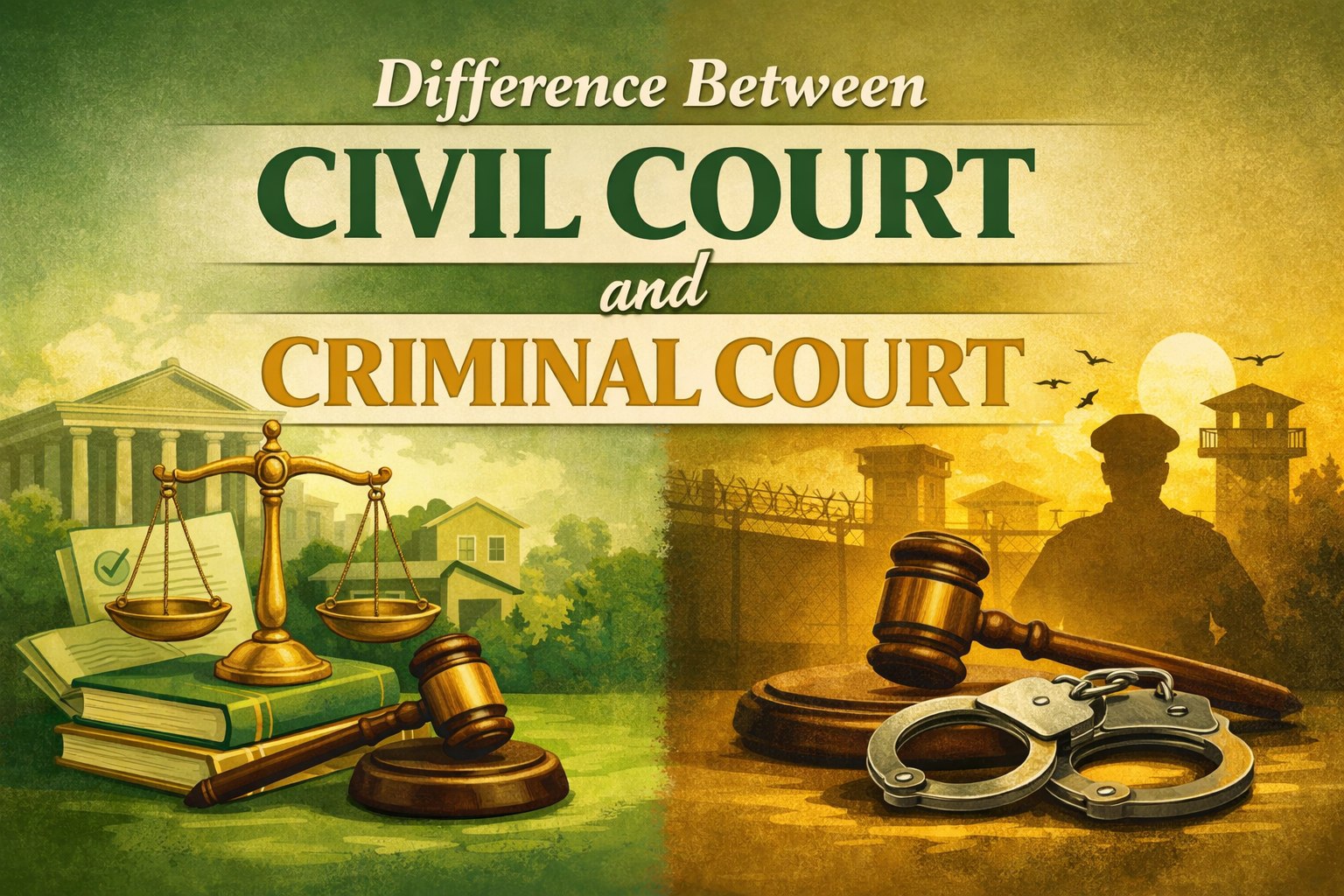
Courts play an essential role in delivering justice and resolving legal disputes. In most legal systems, including India, courts are broadly divided into civil courts and criminal courts based on the nature of the cases they handle. While both aim to uphold justice, the type of disputes they deal with and the remedies they provide are different.
Understanding the difference between civil court and criminal court helps people better understand how the legal system works.
What is a Civil Court?
A civil court deals with disputes between individuals, families, businesses, or organizations where a person believes that their legal rights have been violated. These cases usually involve private rights rather than crimes against society.
The main purpose of a civil court is to resolve conflicts and provide relief to the affected party. Instead of punishing someone with imprisonment, civil courts usually order remedies such as compensation, declaration of rights, or injunctions.
Civil courts commonly hear matters related to property disputes, contract disagreements, recovery of money, family disputes such as divorce or child custody, and issues related to ownership or possession of land.
In civil proceedings, the person who files the case is called the plaintiff, and the person against whom the case is filed is called the defendant.
If the court finds that the defendant has violated the rights of the plaintiff, it may order payment of damages, return of property, or specific performance of a legal obligation.
What is a Criminal Court?
A criminal court deals with cases where a person is accused of committing an offence that is considered harmful to society or against the state. Criminal law focuses on maintaining public order and ensuring that individuals who commit crimes are held accountable.
In criminal cases, the prosecution is generally initiated by the state, and the person accused of committing the crime is referred to as the accused.
Criminal courts handle offences such as theft, assault, fraud, kidnapping, murder, cybercrime, and other punishable offences under criminal law.
If the accused is found guilty after the trial, the court may impose punishments such as imprisonment, fines, community service, or other penalties prescribed by law.
Key Differences Between Civil Court and Criminal Court

The primary difference between civil and criminal courts lies in the nature and purpose of the cases they handle.
Civil courts deal with disputes between private parties where the goal is to resolve conflicts and compensate the injured party. Criminal courts, on the other hand, deal with offences that affect society, and their main purpose is to punish wrongdoing and maintain law and order.
Another important difference is the parties involved in the case. In civil cases, the dispute is between a plaintiff and a defendant, while in criminal cases the proceedings are usually between the state and the accused person.
The standard of proof is also different. Civil cases are decided on the basis of the balance or preponderance of probabilities, meaning the court determines which side’s version is more likely to be true. In criminal cases, the prosecution must prove the guilt of the accused beyond a reasonable doubt, which is a much higher standard of proof.
The outcome of the case also differs. Civil courts generally provide remedies such as compensation, injunctions, or declarations of rights, whereas criminal courts may impose punishments such as imprisonment or fines if the accused is found guilty.
Can a Case Be Both Civil and Criminal?
In some situations, the same incident can lead to both civil and criminal proceedings. For example, if a person commits fraud, the victim may file a civil suit to recover the financial loss, while the state may initiate criminal proceedings to punish the offender.
This means that the matter may be addressed in both types of courts for different purposes.
Conclusion
Civil courts and criminal courts are both essential parts of the legal system, but they serve different functions. Civil courts focus on resolving disputes and protecting private rights, while criminal courts aim to punish offences and maintain public order.
Understanding this distinction helps individuals recognize how different legal issues are addressed and how justice is delivered through the court system.
– Team Lawyer Talks