
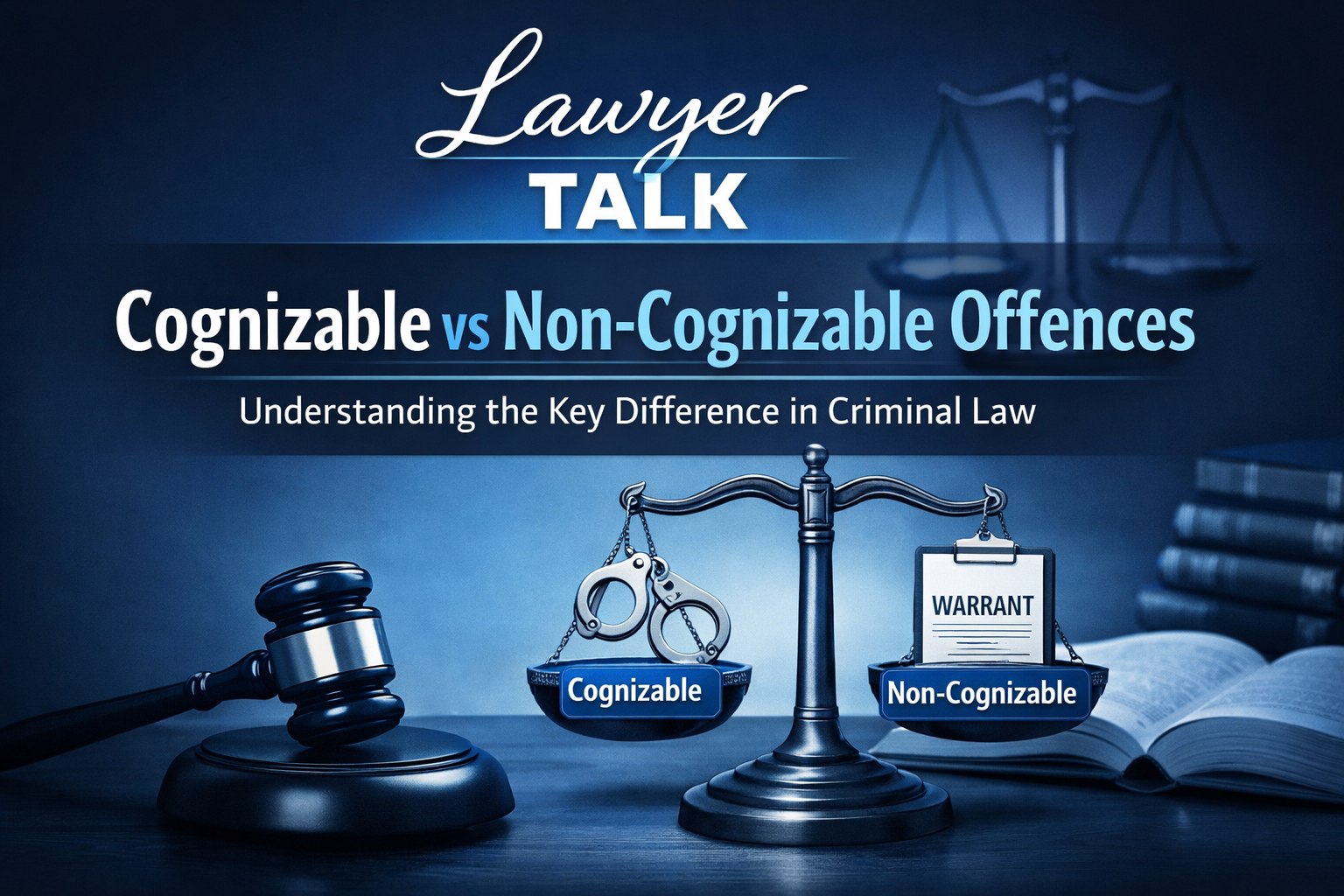
In criminal law, the classification of offences into cognizable and non-cognizable categories is a cornerstone of legal procedure. This distinction dictates the boundaries of police authority, the necessity of judicial oversight, and the speed at which the justice system moves.
For law students and judiciary aspirants, mastering this topic is essential, as it bridges the gap between theoretical statutes and practical law enforcement.
1. Cognizable Offences: Immediate Action
A cognizable offence is a serious crime where the police are empowered to act independently. Under the law, “cognizable” means the police can take “cognizance” (notice) of the crime on their own.
- Authority to Arrest: The police can arrest the accused without a warrant.
- Immediate Investigation: Officers can initiate an investigation and register a First Information Report (FIR) without seeking a Magistrate’s order.
- Nature of Crime: These are typically “public wrongs” or heinous crimes that threaten the safety of society at large.
Common Examples:
- Murder and Culpable Homicide
- Rape or Sexual Assault
- Kidnapping and Abduction
- Dacoity and Robbery
- Dowry Death
2. Non-Cognizable Offences: Judicial Oversight
A non-cognizable offence involves relatively less serious crimes where the police lack the authority to act on their own. In these instances, the judiciary acts as a gatekeeper to ensure that police powers are not misused for minor disputes.
- Warrant Requirement: The police cannot arrest an individual without a valid warrant issued by a Magistrate.
- Procedural Restraint: Investigation cannot commence until a Magistrate specifically authorizes it.
- Nature of Crime: These are often considered “private wrongs” or disputes that do not pose an immediate, massive threat to public order.
Common Examples:
- Defamation
- Public Nuisance
- Simple Hurt (Minor injury)
- Cheating (in specific contexts)
- Forgery (non-serious variations)
Key Distinctions at a Glance
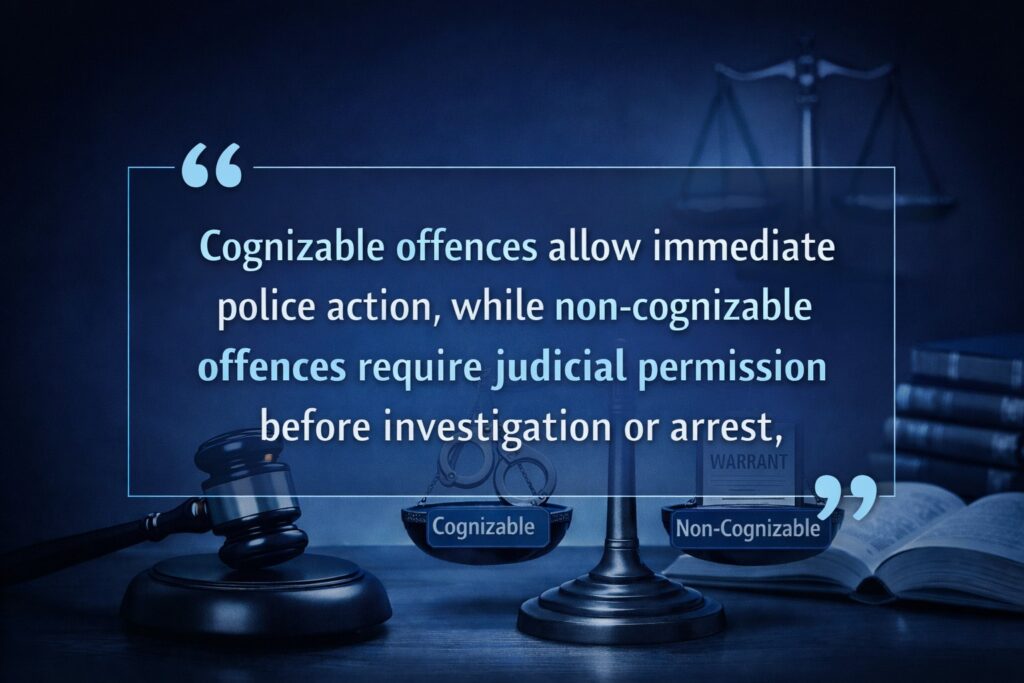
- Police Power: In cognizable cases, the police have broad, autonomous powers of arrest. In non-cognizable cases, their power is contingent upon a judicial warrant.
- Registration of Case: While an FIR is registered for cognizable crimes, non-cognizable crimes are typically recorded in a “Daily Diary” or “Non-Cognizable Report” (NCR), which is then referred to the Magistrate.
- The “Urgency” Factor: Cognizable offences demand an immediate response to preserve evidence and prevent the accused from fleeing. Non-cognizable offences allow for a more deliberative, court-monitored process.
- Societal Impact: Cognizable crimes are seen as offences against the State, whereas non-cognizable crimes are often viewed as disputes between individuals.
Why This Classification Matters
This binary system exists to balance public safety with individual liberty. If every minor dispute allowed for a “warrantless arrest,” the jails would overflow and the police might abuse their power. Conversely, if the police had to wait for a court order to arrest a murderer, the criminal might escape or cause further harm.
For any legal professional, recognizing the category of an offence is the first step in determining the correct procedural path whether you are defending a client or prosecuting a case.
– Team Lawyer Talks