
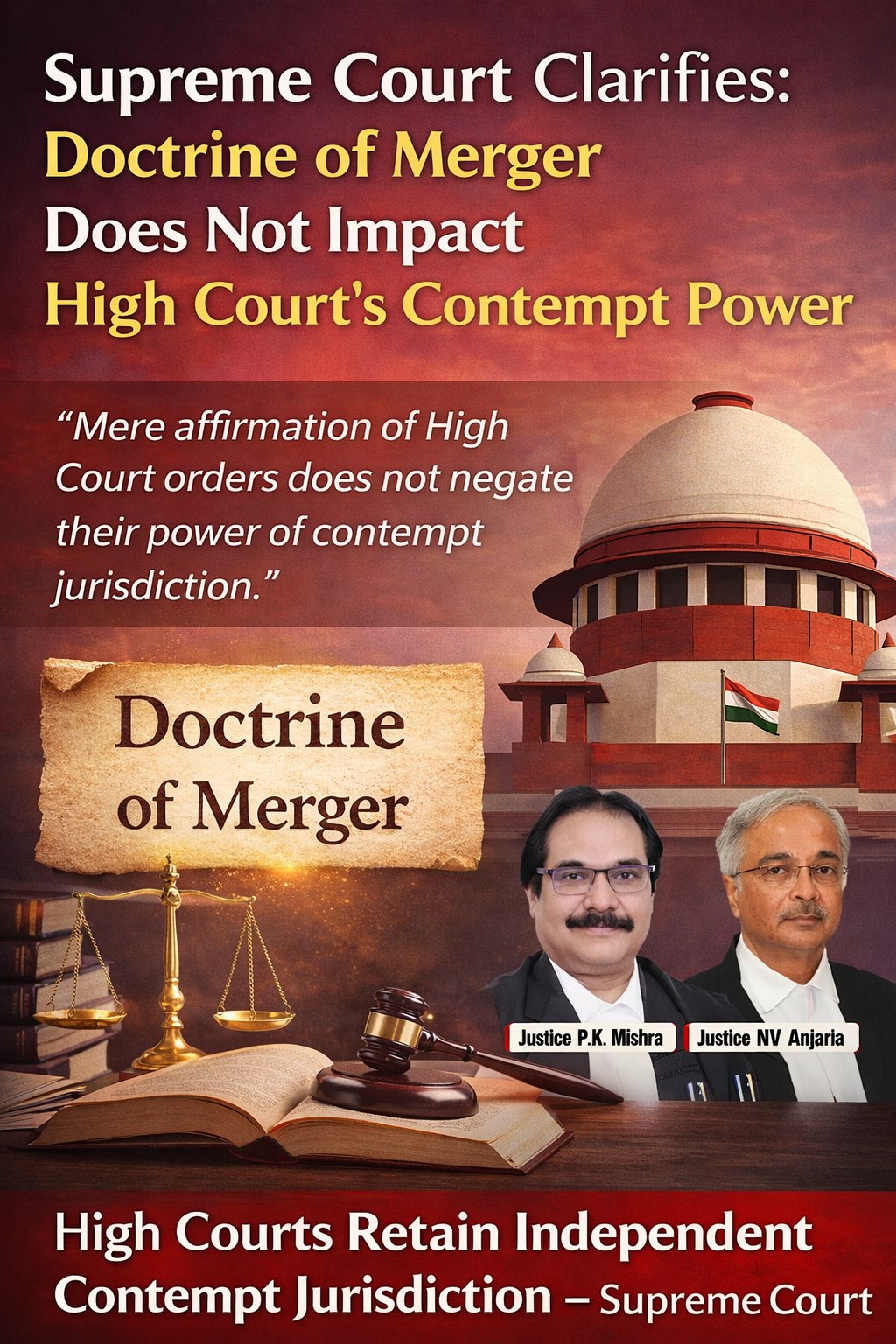
The law is not a ‘light’ that can be switched off at will; the authority of the Court remains absolute, regardless of the level of appeal.
In a significant move to protect the authority of the judiciary, the Supreme Court recently clarified a vital point: a High Court doesn’t lose its power to punish for contempt just because its order was affirmed by the Supreme Court.
The Court emphasized that contempt powers are independent and are not wiped out by the “Doctrine of Merger.” This ruling is a big win for the institutional authority of High Courts, reinforcing the idea that judicial orders aren’t just suggestions and that they must be followed.
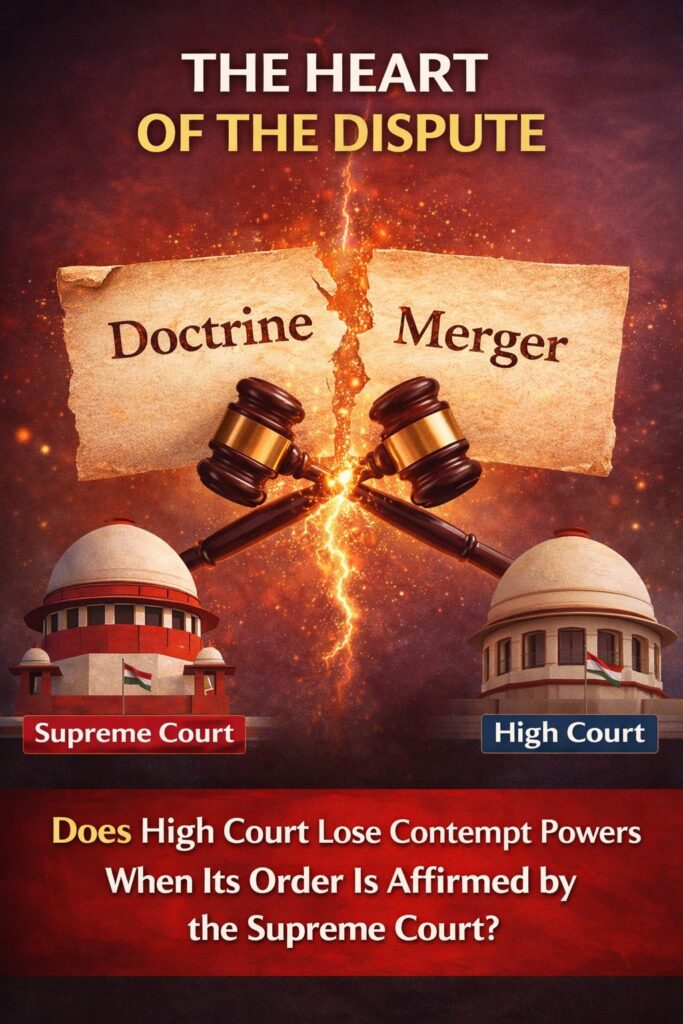
The Heart of the Dispute
The confusion arose from a common legal scenario:
- A High Court passes an order.
- The losing party appeals to the Supreme Court.
- The Supreme Court agrees with the High Court and affirms the decision.
The Argument: Some argued that once the Supreme Court affirms the order, the High Court’s original order “merges” into the Supreme Court’s judgment. Therefore, they claimed that only the Supreme Court could handle contempt cases for non-compliance. This argument relied on the Doctrine of Merger, a principle where a lower court’s order is absorbed by the superior court’s decision during an appeal.
What is the Doctrine of Merger?
In simple terms, the Doctrine of Merger suggests that when a higher court passes a judgment, the lower court’s order effectively disappears into the new one. After this happens, the “operative” order—the one that technically exists—is the one from the higher court.
However, the Supreme Court has now made it clear: this doctrine isn’t a “get out of jail free” card for those ignoring High Court directions.
Key Observations from the Supreme Court
The Court’s stance was firm and centered on the Constitution:
- Constitutional Mandate: Under Article 215 of the Constitution, High Courts are “Courts of Record” with the inherent power to punish for contempt.
- Independence: This power is independent. A Supreme Court affirmation doesn’t “strip” a High Court of its right to see its directions through.
- Purpose of Contempt: These proceedings exist to uphold the dignity of the law. The Court noted that the Doctrine of Merger shouldn’t be applied “mechanically” to weaken constitutional powers.

Why This Judgment Matters
This ruling isn’t just a technicality; it has real-world implications for the Indian legal system:
- Protecting High Court Authority: High Courts are not just “subordinate” branches; they are powerful constitutional courts. This ruling prevents their authority from being diluted.
- Closing Loopholes: If contempt powers vanished after an appeal, parties could use the appellate process as a tactic to delay or dodge compliance.
- Procedural Clarity: Litigants now know exactly where they stand: compliance is mandatory, and the High Court remains the watchdog of its own orders.
Practical Takeaways for Litigants
- Compliance is Non-Negotiable: You must follow High Court orders even if the case has moved to the Supreme Court.
- No Automatic Shield: Winning an affirmation at the Supreme Court doesn’t protect you from a contempt notice at the High Court level.
- End of Strategic Evasion: Litigation shouldn’t be used as a game to avoid accountability.
Final Thoughts
The Supreme Court’s clarification is a timely reminder that procedural rules like “merger” cannot override constitutional mandates. Contempt jurisdiction ensures that the law has teeth. By reaffirming the independent power of High Courts, the Supreme Court has strengthened the integrity of the entire judicial framework.
– Team Lawyer Talks