
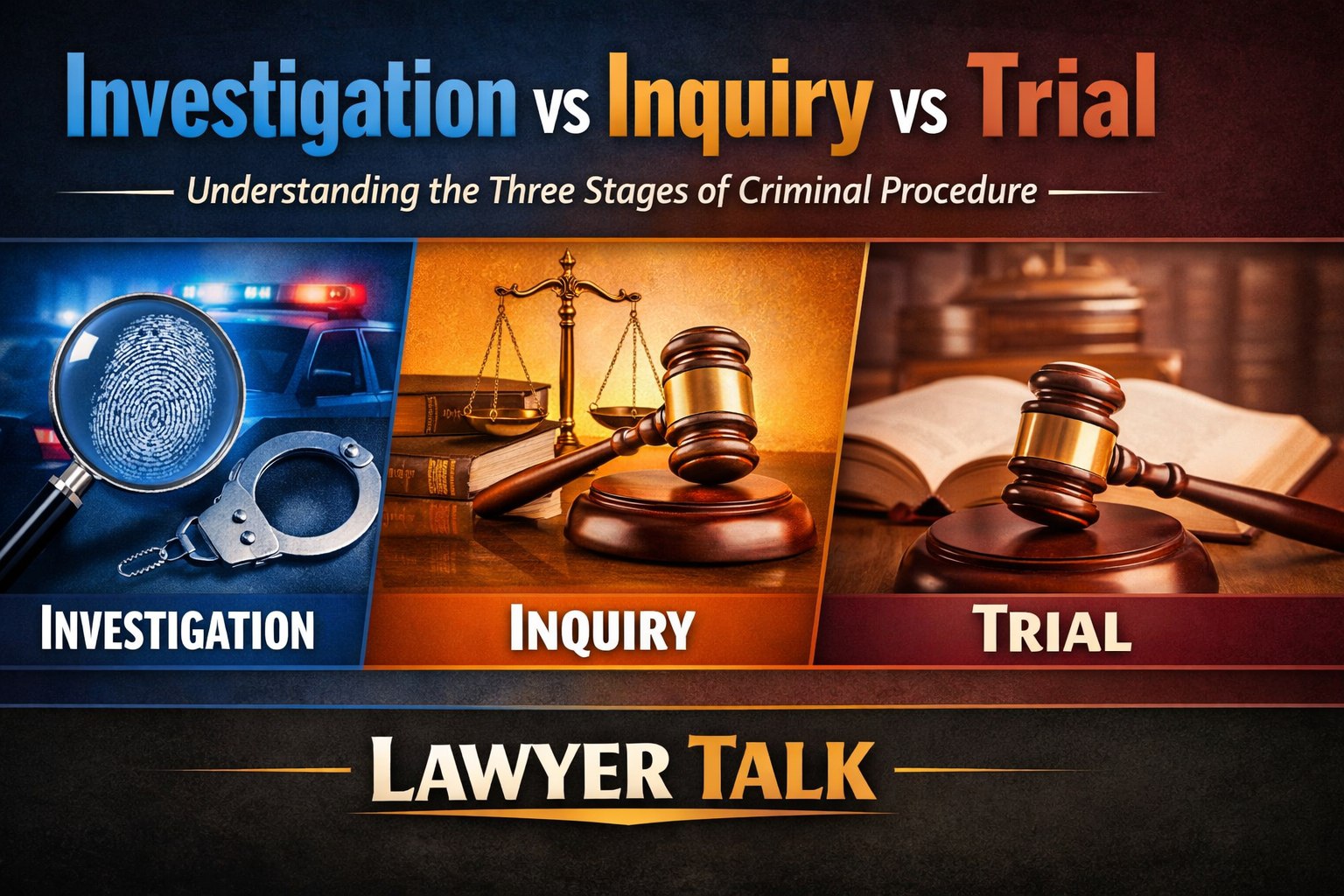
In the criminal justice system, a case does not immediately reach the stage where a judge decides whether a person is guilty or innocent. Before the final decision is made, the case passes through several procedural stages. Among the most important stages are Investigation, Inquiry, and Trial.
These terms are often used interchangeably in everyday conversations, but in law they have very different meanings and purposes. Understanding the difference between them is important for law students, judiciary aspirants, and anyone who wants to understand how criminal cases move through the legal system.
This article explains these three stages in a simple and clear manner.
Investigation
Investigation is the first stage of a criminal case. It begins when the police receive information about the commission of a crime. After receiving such information, the police start collecting facts and evidence related to the incident.
Under the Code of Criminal Procedure, 1973, investigation refers to the process carried out by police officers to gather evidence and determine whether a crime has been committed and who may be responsible for it.
During the investigation stage, police officers perform several important activities. They may visit the crime scene, examine physical evidence, question witnesses, record statements, and identify possible suspects. In certain situations, the police may also arrest individuals who are believed to be involved in the crime.
The purpose of investigation is to discover the truth and collect enough material that can help the court understand what actually happened. Once the investigation is completed, the police submit their findings to the court in the form of a report or charge sheet.
This report becomes the foundation for the next stage of the criminal process.
Inquiry
Inquiry is the second stage of the criminal procedure, which takes place after the investigation but before the trial begins.
Unlike investigation, which is conducted by the police, inquiry is conducted by a magistrate or a court. The purpose of an inquiry is to examine whether the evidence collected during the investigation is sufficient to proceed with a full trial.
At this stage, the court reviews the materials submitted by the police, such as documents, statements, and reports. The judge does not decide guilt or innocence during the inquiry. Instead, the court determines whether there are reasonable grounds to move forward with the case.
Inquiry acts as an important safeguard in the legal system. It prevents unnecessary trials when the available evidence is weak or insufficient. If the court finds that the evidence does not support the allegations, the accused person may be discharged.
However, if the court believes that there is enough material to proceed, the case is sent for trial.
Trial
Trial is the final stage of a criminal case and the most crucial part of the justice process.
During the trial, the court carefully examines the evidence presented by both sides—the prosecution and the defence. Witnesses are called before the court to give their testimony, and lawyers from both sides question them to test the credibility of their statements.
The prosecution tries to prove that the accused committed the crime, while the defence attempts to challenge the allegations and protect the rights of the accused.
Throughout the trial, the judge ensures that the proceedings are conducted fairly and according to the law. After hearing the evidence and the arguments from both sides, the court finally delivers its judgment.
At the end of the trial, the court may either convict the accused if the charges are proven beyond reasonable doubt or acquit the accused if the evidence is insufficient.
Why These Stages Are Important
Each stage of the criminal procedure serves a specific purpose and helps maintain fairness in the justice system.
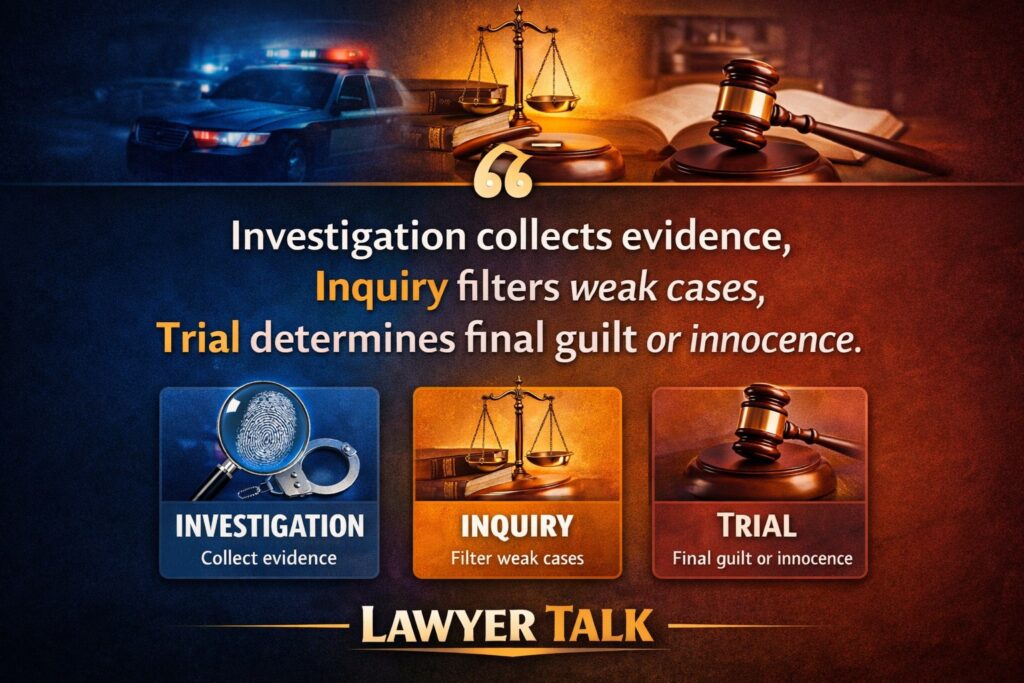
The investigation stage focuses on gathering facts and evidence. The inquiry stage acts as a filter to determine whether the case should proceed further. Finally, the trial stage ensures that a proper judicial decision is made after examining all the evidence.
Together, these stages help protect the rights of both the accused and the victim while ensuring that justice is delivered through a structured and transparent process.
Conclusion
Investigation, inquiry, and trial are three essential stages in the criminal justice process. Although they are closely connected, each stage has a distinct role.
Investigation is concerned with collecting evidence, inquiry evaluates whether the case deserves a full trial, and trial determines the final outcome of the case. Understanding these differences helps us appreciate how the legal system works to ensure justice and accountability.
– Team Lawyer Talk