
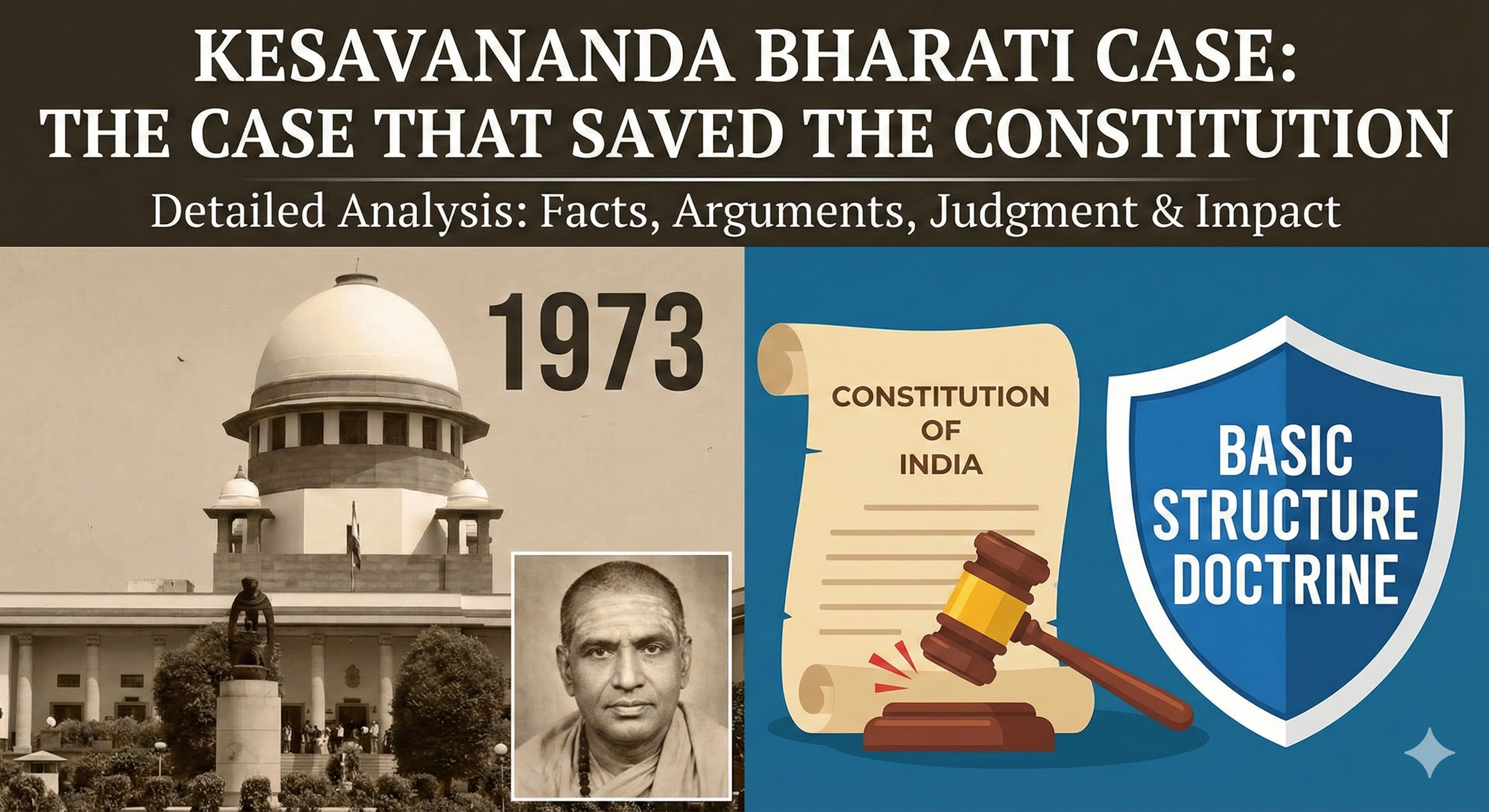
In the history of Indian constitutional law, one case stands as the “Everest.” It was a battle not just about land or property, but about the very soul of India’s democracy. This is the story of Kesavananda Bharati Sripadagalvaru v. State of Kerala, a case that lasted 68 days, involved 13 judges, and gave birth to the famous “Basic Structure Doctrine.”
Table of Contents
Toggle1. The Facts of the Case
Who was Kesavananda Bharati?
His Holiness Kesavananda Bharati was the pontiff (head) of a Hindu religious mutt called the Edneer Mutt in Kasaragod, Kerala. The Mutt owned thousands of acres of land which were used to support its religious activities, charitable work, and educational institutions.
The Trigger:
In the late 1960s and early 1970s, the Kerala state government introduced radical land reform laws (specifically the Kerala Land Reforms Act, 1963 as amended in 1969). Under these laws, the government sought to impose restrictions on the management of religious property and acquire the “surplus” land held by the Mutt.
The Petition:
Feeling that his fundamental rights were being violated, Kesavananda Bharati filed a writ petition in the Supreme Court under Article 32. He challenged the land reform laws on the grounds that they violated his Fundamental Rights under:
- Article 25: Right to practice and propagate religion.
- Article 26: Right to manage religious affairs.
- Article 31: Right to property (which was a fundamental right at the time).
2. The Context: A War Between Parliament and Judiciary
To understand this case, you must understand the tension of that era.
- Golaknath Case (1967): The Supreme Court had previously ruled that Parliament could not amend Fundamental Rights.
- Parliament’s Retaliation: The government, led by Prime Minister Indira Gandhi, wanted to implement socialist reforms. To bypass the Supreme Court’s restrictions, they passed a series of amendments:
- 24th Amendment: Explicitly stated that Parliament has the power to amend any part of the Constitution, including Fundamental Rights.
- 25th Amendment: Weakened the Right to Property and introduced Article 31C, stating that laws made to implement socialistic goals (Directive Principles) could not be challenged even if they violated Fundamental Rights.
- 29th Amendment: Placed the Kerala Land Reforms Acts into the 9th Schedule, making them immune from judicial review.
The Kesavananda Bharati case was expanded to challenge the validity of these very amendments.
3. The Issues Before the Court
The 13-judge bench had to answer critical constitutional questions:
- Validity of Amendments: Are the 24th, 25th, and 29th Constitutional Amendments valid?
- Extent of Amending Power: Does Article 368 give Parliament the “absolute” power to amend the Constitution? Can they rewrite the entire document if they wish?
- Implied Limitations: Are there any implied limitations on the power of Parliament to amend the Constitution?
4. Arguments by Both Parties
The Petitioner’s Arguments (Led by Nani Palkhivala)
Legendary jurist Nani Palkhivala argued on behalf of Kesavananda Bharati. His arguments were philosophical and structural:
- Creature vs. Creator: Parliament is a creature of the Constitution; it cannot become its master. A constituted body cannot destroy the Constitution that created it.
- Identity of the Constitution: He argued that the word “amend” implies making changes within a framework. It does not mean “destroy.” You cannot use the power of amendment to alter the core identity or “essential features” of the Constitution.
- Example of Abuse: He famously argued that if Parliament had unlimited power, they could theoretically convert India into a monarchy or a one-party dictatorship, or strip away all human rights.
The Respondent’s Arguments (State of Kerala & Union of India)
The State argued for the supremacy of the elected legislature:
- Will of the People: Parliament represents the will of the people. If the people want to change the Constitution, no court should stop them.
- Unlimited Power: They argued that the power to amend under Article 368 was unlimited and unfettered. This included the power to repeal or abrogate any provision, including Fundamental Rights.
- Social Justice: They contended that to implement necessary socio-economic reforms (like land distribution), individual rights (like property) must yield to the greater good.
5. The Judgment (April 24, 1973)
The judgment was delivered by a razor-thin majority of 7:6. It is the longest judgment in Indian history.
The Verdict Breakdown:
- Majority View (7 Judges): Chief Justice Sikri, Justices Shelat, Grover, Hegde, Mukherjea, Reddy, and Khanna.
- Minority View (6 Judges): Justices Ray, Palekar, Mathew, Beg, Dwivedi, and Chandrachud.
Key Findings:
- Overruling Golaknath: The Court upheld the 24th Amendment. It ruled that Parliament does have the power to amend Fundamental Rights.
- The Basic Structure Doctrine: However, the Court placed a massive condition. It held that while Parliament can amend the Constitution, it cannot alter, damage, or destroy the Basic Structure of the Constitution.
- Validity of Other Amendments:
- 25th Amendment: Upheld mostly, but the part that said courts “cannot question” the laws was struck down. Judicial review is part of the Basic Structure.
- 29th Amendment: Upheld, but the laws inside the 9th Schedule are still open to scrutiny if they violate the Basic Structure.
6. What is the “Basic Structure”?
The Court did not give an exhaustive definition, but the judges listed examples of what constitutes the “Basic Structure” (features that cannot be removed):
- Supremacy of the Constitution
- Republican and Democratic form of Government
- Secularism (added specifically by Justice Sikri)
- Separation of Powers (Legislature, Executive, Judiciary)
- Federal character of the Constitution
- Unity and sovereignty of India
- Individual Freedom and Dignity
Conclusion: Why This Matters Today
The Kesavananda Bharati judgment is the reason why India remains a democracy today. It drew a “line in the sand” that Parliament cannot cross.
It saved Democracy: It prevented any single political party with a super-majority from turning the country into a dictatorship.
It saved the Judiciary: It preserved the power of courts to review government actions (Judicial Review).