
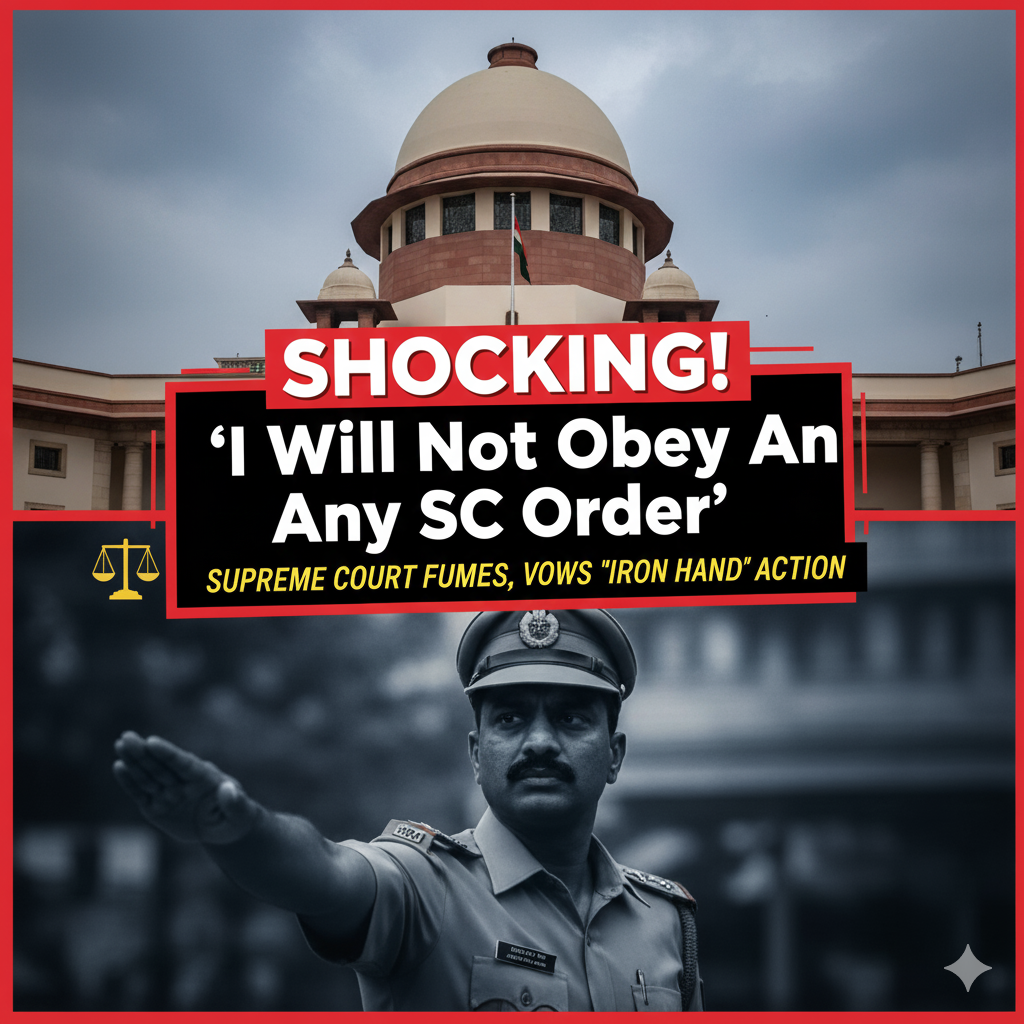
In a shocking case that strikes at the very heart of judicial authority, the Supreme Court of India has taken extremely strong exception to the conduct of a Station House Officer (SHO) from Uttar Pradesh. The officer not only willfully disobeyed a direct protection order from the apex court but also brazenly declared, “Main kisi Supreme Court ka aadesh nahi maanunga.”
This incident has escalated into a serious contempt of court matter, with the bench vowing to deal with the officer’s “willful disobedience” with “iron hands.”
🏛️ The Case Background: A Petitioner’s Plea for Protection
The matter began when a petitioner, Ram Sagar Tiwari, faced an FIR lodged against him at the Kandhai Police Station in Pratapgarh, UP, under several sections of the IPC related to cheating and forgery (Sections 419, 420, 467, 468, and 471).
Fearing coercive action, Tiwari approached the Supreme Court. On March 28, 2025, the apex court granted him protection, issuing a clear and specific direction that “no coercive measures or steps” should be taken against him in connection with the FIR.
👮♂️ The Brazen Act of Defiance
Despite this unambiguous order from the highest court in the land, what happened next was a flagrant abuse of power.
According to the contempt petition filed by Tiwari, on April 23, 2025, the SHO of Kandhai police station, Gulaab Singh Sonkar, along with other officers, allegedly dragged the petitioner from his workplace. They proceeded to arrest him and reportedly subjected him to physical and sexual assault.
When the petitioner, in a desperate attempt to uphold his rights, presented a copy of the Supreme Court’s protection order, SHO Sonkar allegedly retorted with a statement that has now become the center of the controversy:
“Main kisi Supreme Court ka aadesh nahin manunga, mai tumhara sara High Court aur Supreme Court nikal dunga aaj.”
(I will not obey any Supreme Court order; I’ll get your entire High Court and Supreme Court removed today.)
This act was not just a violation of an individual’s rights but a direct and contemptuous challenge to the authority of the Supreme Court itself.
🔥 The Supreme Court’s “Iron Hand” Response
Hearing the contempt plea, a Supreme Court bench comprising Justice Aravind Kumar and Justice NV Anjaria did not mince words. The court had previously directed the Uttar Pradesh Home Department to conduct a high-level inquiry into the incident, to be led by an officer not below the rank of Additional Director General of Police (ADGP).
That inquiry report, which was placed before the bench, confirmed the SHO’s deliberate and willful disobedience.
The bench made several scathing observations, highlighting the gravity of the officer’s misconduct:
- On the Officer’s Conduct: The Court stated that such conduct “clearly indicated prima facie there was willful disobedience” which “requires to be dealt with iron hands.”
- On Polluting Justice: The bench remarked that an officer “under the guise of police uniform, cannot be allowed to pollute the stream of justice.”
- On Public Confidence: The judges noted that such brazen behavior “erodes public confidence in the judicial system” and constitutes a “gross contempt and a direct attack on the rule of law.”
⚖️ Why This Case Is Critically Important
This incident goes far beyond a single case of police misconduct. It touches upon the foundational principles of the Indian Constitution.
- The Rule of Law: The core principle of a democracy is that no one is above the law—especially not the law-enforcers themselves. The SHO’s actions represent a slide into “police raj” where an officer’s whim supersedes a Supreme Court directive.
- Article 141 & 144: Article 141 of the Constitution states that the law declared by the Supreme Court is binding on all courts within India. Furthermore, Article 144 mandates that all authorities, civil and judicial, in the territory of India shall act in aid of the Supreme Court. The SHO’s defiance is a direct violation of this constitutional mandate.
- Contempt of Court: This is a classic, if not egregious, case of criminal contempt. It’s not just disobedience (civil contempt) but an act that “scandalizes or tends to scandalize, or lowers or tends to lower the authority of, any court.”
⏳ What Happens Next?
Faced with the damning inquiry report and the Supreme Court’s severe stance, the Additional Advocate General for Uttar Pradesh gave an assurance that the state government would take “swift action” against the delinquent officer immediately.
Taking this assurance on record, the Supreme Court has listed the matter for its next hearing on November 7, 2025. The entire legal and administrative fraternity will be watching to see what action is taken.
For the rule of law to prevail and for public faith in the judiciary to be maintained, accountability in this case is not just an option—it is an absolute necessity.
- AIBE 20 (2025) Mock Test Series: Set 2 (100 Questions with Answers)

- AIBE 20 (2025) Full-Length Mock Test: 100 Questions with Answer Key

- CLAT 2026 Admit Card Released: Download Link & Exam Day Instructions

- Weekly Legal News Roundup (Nov 17-23, 2025): Top Supreme Court & High Court Judgments
- Justice Surya Kant Takes Charge: A New Era for the Indian Judiciary
One Response
The action of the SHO is highly punishable and he is fit to be cashiered from his position with immediate effect.
No trial or inquiry to be conducted.
He is simply a viral to our society and the whole of India.
Adv.v.sundaresan
Hyderabad