
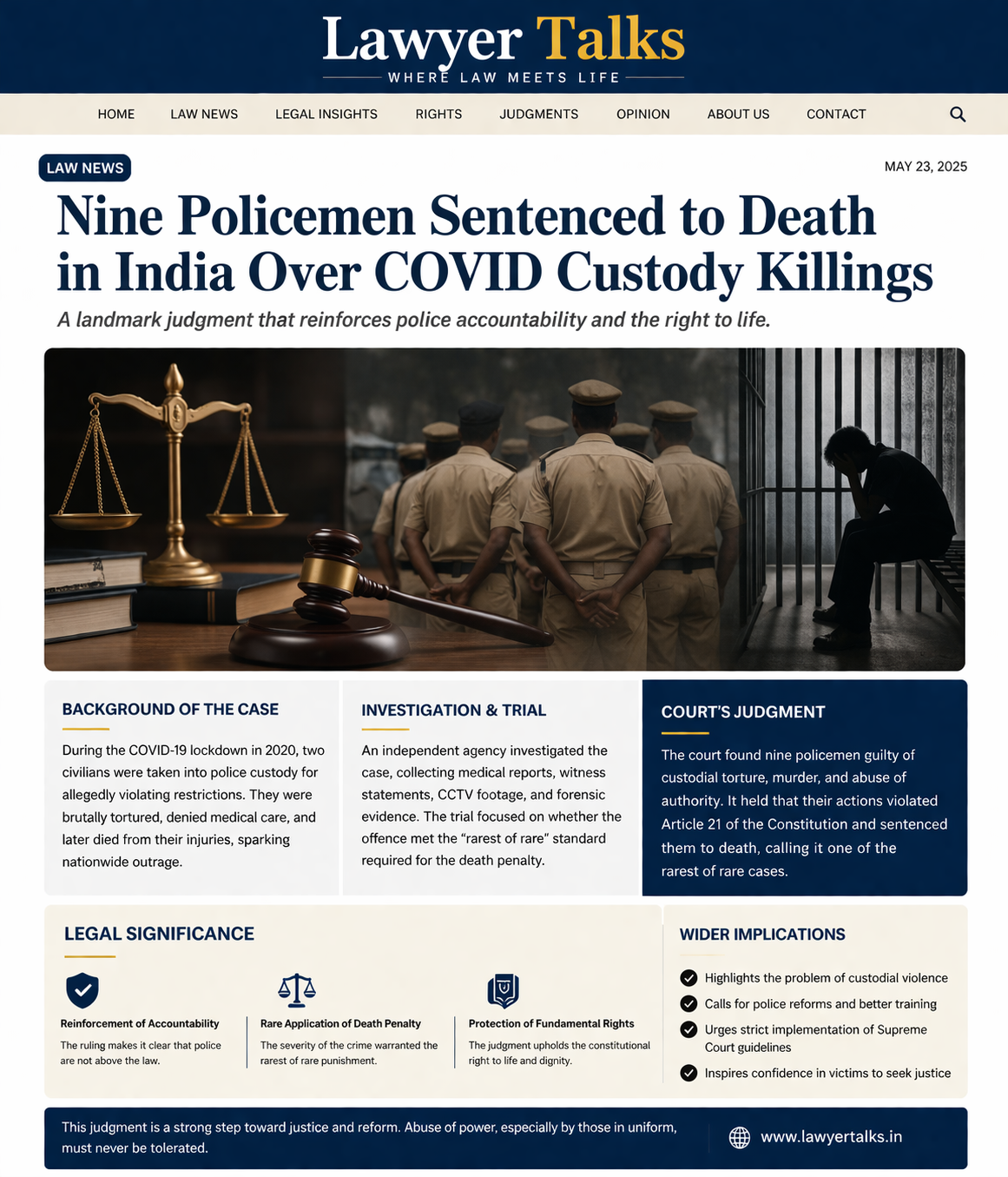
A major and uncommon occurrence in the Indian criminal justice system just took place, in which nine policemen were condemned to death on grounds of their contribution to a heinous custodial murder that occurred during the COVID-19 lockdown. This verdict has revived the arguments on police accountability, custodial violence and the necessity of systemic changes.
Background of the Case
The case can be traced back to the national lockdown that was enforced in the pandemic of COVID-19 in 2020. In the midst of tight control over the imposition, two civilians became the prisoners of the police, due to the allegations of breaching the norms of lockdown. What ensued was a startling event of the use of excessive force.
It was also alleged that the victims were cruelly physically tortured in custody. They were not provided with medical services in time even though their conditions were getting worse. The two would later succumb to their injuries which caused uproar in the nation and brought serious questions to the issue of power abuse by the law enforcement authorities.
Investigation and Trial
Because the incident was severe and there was pressure on the government, the case was resolved to an independent investigative agency. During the investigation, evidence was gathered to include:
- Medical reports that attest to custodial torture
- Witness statements
- CCTV evidence and forensic evidence
The trial court took a keen look at whether the conduct of the policemen was in the “rarest of rare category that is the constitutional requirement of death penalty in India.
Court’s Judgment
After a detailed evaluation of evidence, the court found nine policemen guilty of:
- Custodial torture
- Murder
- Abuse of authority
The court ruled that the cruelty with which the victims were subjected to, the misuse of his/her official authority, was a sufficient reason to sentence the victims to the death penalty. It has made it clear that the people charged with the responsibility of law enforcement cannot be the offenders of basic rights.
The judgment heavily reiterated that custodial violence is a direct contravention of Article 21 of the Constitution that safeguards the right to life and personal liberty.
Legal Significance
The case is of particular importance due to a number of reasons:
1. Reinforcement of Accountability
The decision sends a powerful message stating the fact that police officials cannot be above the law and will suffer severe repercussions of misconduct.
2. Small Use of Death Penalty
The death penalty is a rare case in Indian courts. Sentencing police officers to death is meant to emphasize on the severity of the offense.
3. Guarding of Fundamental Rights
The decision reinforces the constitutional promise of safeguarding individuals against arbitrary state action and custodial mistreatment.
Wider Implications
The case has more general implications to the criminal justice system:
- It brings to the fore the long term problem of custodial violence in India.
- It underscores the need for police reforms and better training.
- It demands the tightening of the belt in the application of the guidelines prescribed by the Supreme Court in custody cases.
This decision can also make victims and their families brave enough and bring justice in case of abuse by authorities.
Conclusion
The death penalty of nine policemen is a milestone in India to combat custodial violence. It is an indication of a strong will of the judiciary to ensure that it does not tolerate any form of abuse of power, in particular by the people in uniform.
Although the ruling provides justice in the case under consideration, it also reminds that the much-needed reforms, structures of accountability, and sensitization in the police force is necessary to avoid such a situation in the future.
– Team Lawyer Talks