
In the legal system, disputes must eventually come to an end. Courts cannot keep deciding the same matter again and again between the same parties. To prevent this, the law provides an important principle known as Res Judicata.
Under Section 11 of the Civil Procedure Code, 1908, the doctrine of Res Judicata ensures that once a court has decided a matter, the same issue cannot be reopened in another suit between the same parties. This principle protects the finality of judgments and avoids unnecessary litigation.
For law students, judiciary aspirants, and anyone interested in civil law, understanding Res Judicata is essential because it frequently appears in exams and court practice.
Meaning of Res Judicata
The term Res Judicata is derived from Latin, which means “a matter that has already been judged.”
In simple words, when a competent court has already decided a dispute, the same issue cannot be raised again in another case between the same parties.
The doctrine is based on three important ideas:
- There must be finality in litigation
- A person should not be harassed twice for the same matter
- Courts should avoid unnecessary repetition of cases
This rule promotes efficiency in the judicial system and saves valuable court time.
Section 11 of the Civil Procedure Code
Section 11 of the CPC states that no court shall try any suit or issue in which the matter directly and substantially in issue has already been decided in a former suit between the same parties by a competent court.
This provision makes the doctrine legally enforceable in civil proceedings.
Essential Conditions of Res Judicata
For the doctrine of Res Judicata to apply, certain conditions must be satisfied:
1. Matter Must Be Directly and Substantially in Issue
The issue raised in the later suit must be the same as the issue decided in the previous suit.
2. Same Parties or Their Representatives
The earlier case and the later case must involve the same parties or parties claiming under them.
3. Competent Court
The previous case must have been decided by a court that had jurisdiction to hear the matter.
4. Final Decision
The matter must have been finally decided in the earlier suit.
5. Same Title
The parties must have litigated under the same legal capacity or title in both suits.
If all these conditions are satisfied, the later suit will be barred under the doctrine of Res Judicata.
Example to Understand Res Judicata
Suppose A files a suit against B for ownership of a piece of land. The court examines the evidence and decides that the land belongs to B.
Later, if A again files another case against B claiming the same ownership over the same land, the court will dismiss the suit because the matter has already been decided.
This is the application of Res Judicata.
Constructive Res Judicata
Apart from the basic doctrine, the law also recognizes Constructive Res Judicata.
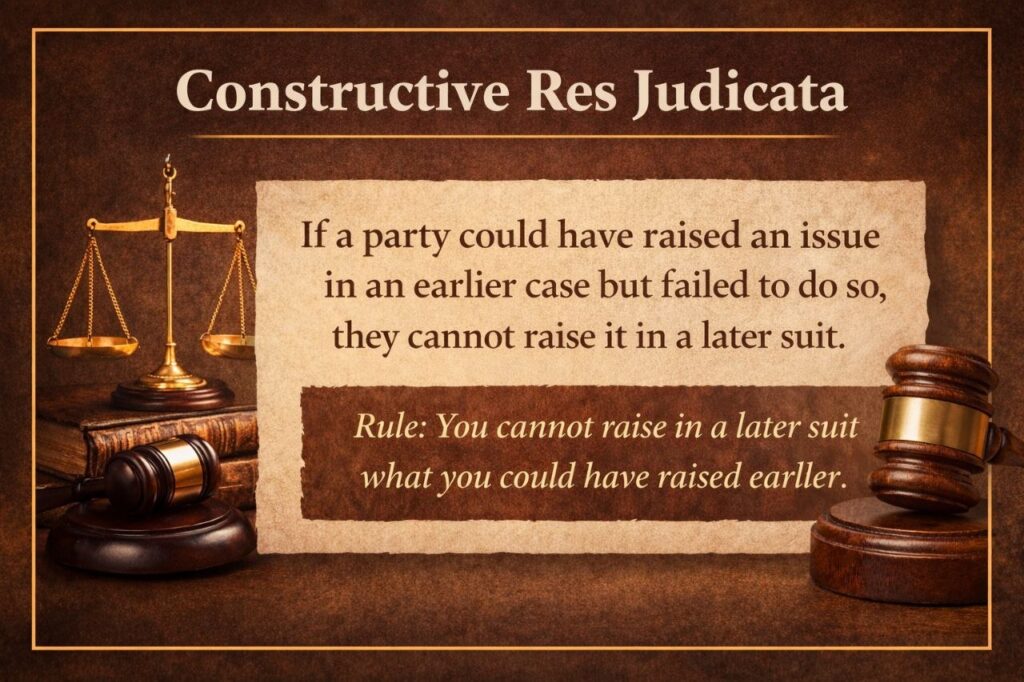
This means that if a party could have raised a particular issue in the earlier case but failed to do so, they cannot raise it in a later suit.
The law assumes that the party had the opportunity to raise the issue earlier, and therefore it should not be allowed to reopen the matter later.
This rule prevents parties from splitting their claims and filing multiple cases on the same dispute.
Importance of the Doctrine of Res Judicata
The doctrine plays a very important role in the legal system. Its significance includes:
1. Prevents Multiple Litigation
It stops the same dispute from being repeatedly brought before the court.
2. Protects Judicial Time
Courts already deal with a heavy workload, and this principle helps avoid unnecessary cases.
3. Ensures Finality of Judgments
Once a matter is decided, the parties must accept the judgment.
4. Promotes Justice and Fairness
It protects individuals from being harassed through repeated lawsuits.
Key Case Law (For Aspirants)
One of the most important cases related to this doctrine is:
Satyadhyan Ghosal v. Deorajin Debi (1960)
In this case, the Supreme Court explained that the doctrine of Res Judicata is based on the principle that there should be an end to litigation and that individuals should not be troubled twice for the same cause.
This case is frequently cited in legal studies and competitive exams.
Conclusion
The doctrine of Res Judicata under the Civil Procedure Code is an essential principle that ensures stability and efficiency in the judicial system. By preventing the same dispute from being litigated repeatedly, it saves court time and protects individuals from unnecessary legal harassment.
For law students, judiciary aspirants, and legal professionals, understanding this doctrine is crucial because it forms a fundamental part of civil procedure law and frequently appears in examinations as well as practical legal work.
– Team Lawyer Talks