
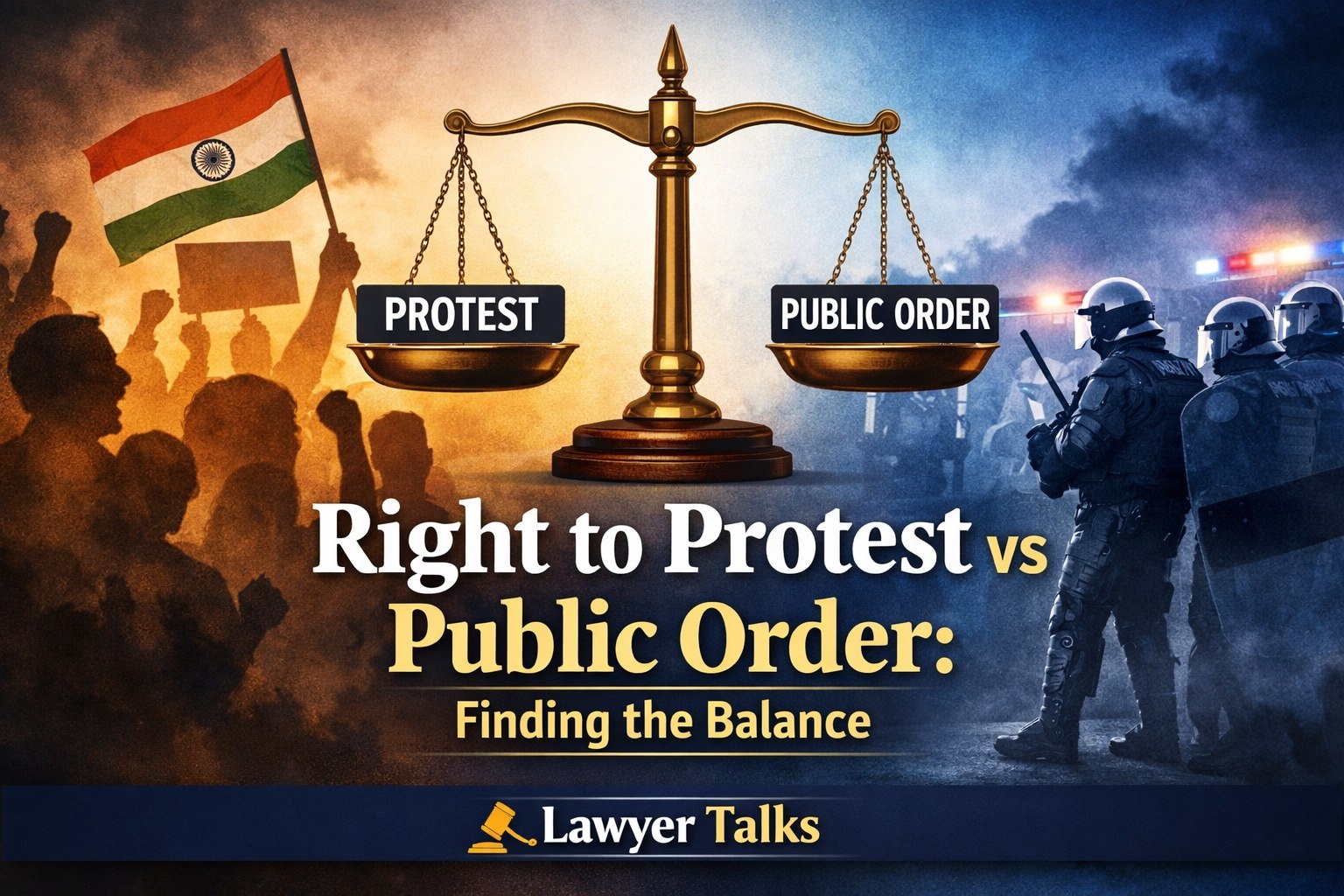
The right to protest is an effective instrument of citizens in a democratic nation such as India. It enables individuals to air their voices, criticize governmental ruling and seek justice. Since independence movements to the present day demonstrations, protests have never ceased to be a very fundamental aspect of democracy.
This right is however not absolute. It tends to conflict with the responsibility of the State to uphold the order of the people. The actual challenge is not which right holds more importance and the question is how two can exist together and not conflict.
Table of Contents
ToggleA constitutional Guarantee: Rights to Protest
Article 19 of the Constitution of India gives the right to protest. It includes:
- Freedom of expression and speech.
- The right to peacefully assemble.
- Right to form associations
These rights allow the citizens the freedom to speak out and to engage in democratic proceedings. Healthy democracy is demonstrated in peaceful demonstrations whereby individuals do not fear to challenge authority.
Meanwhile, it is explicitly mentioned in the Constitution that these rights can be limited through reasonable restrictions. This will make the exercise of freedom responsible.
Public Order: It is a Necessary Responsibility
Public order is the definition of peace, safety, and normal life in the society. The government has the responsibility of providing the citizens with the ability to conduct their daily activities with no fear or disturbance.
Cases in which the public order is significant include:
- Demonstrations that block roads, highways or other places.
- The violence, riots, or conflicts in demonstrations.
- Destruction of property whether in the form of public or private property.
- Non-sensitization of the vital services.
The government can in this case control or go to an extent of censoring protests in the interest of the greater good.
What Have Courts Said?
The judiciary has been significant in balancing such rights. The Supreme Court has on multiple occasions determined that:
- The freedom of protest is absolute but not absolute.
- The demonstrations should be non-violent and peaceful.
- It is impossible to inhabit the public spaces forever.
- The law enforcement should not be extreme.
These ideals demonstrate that citizens, as well as the State, have some duties to be done.
Challenges in Reality
As a matter of fact, this balance is not always easy to maintain in practice. Some common issues include:
- Protests which create inconvenience to the masses in the long run.
- Unpredictable bursts of violence.
- Ruthless measures by the government, even to the extent of restricting real opposition.
- Inadequacy of adequate areas to hold protests.
Such difficulties tend to bring conflict between people and the government.
The Way Forward
A moderate position between the right to protest on the one hand and on the other hand, the public order should be established:
- Protests must be peaceful, organized and time bound.
- Governments ought to have specified places where protests can be held.
- The police should act reasonably but not excessively.
- Government and protests should be allowed to engage in open dialogue.
These measures can be used to safeguard democracy and maintain peace in the society.
Conclusion
The right to demonstration and order in the society are fundamental to democracy. One is the voice of the people and the other one is the stability in the society.
A real democracy is not one that tries to stifle or even enable anarchy, but one that tries to balance that one should be able to voice their opinion without interfering with the rights of other individuals.
“The strength of a democracy lies not just in the freedom to protest, but in the responsibility to do so peacefully.”
– Team Lawyer Talks