
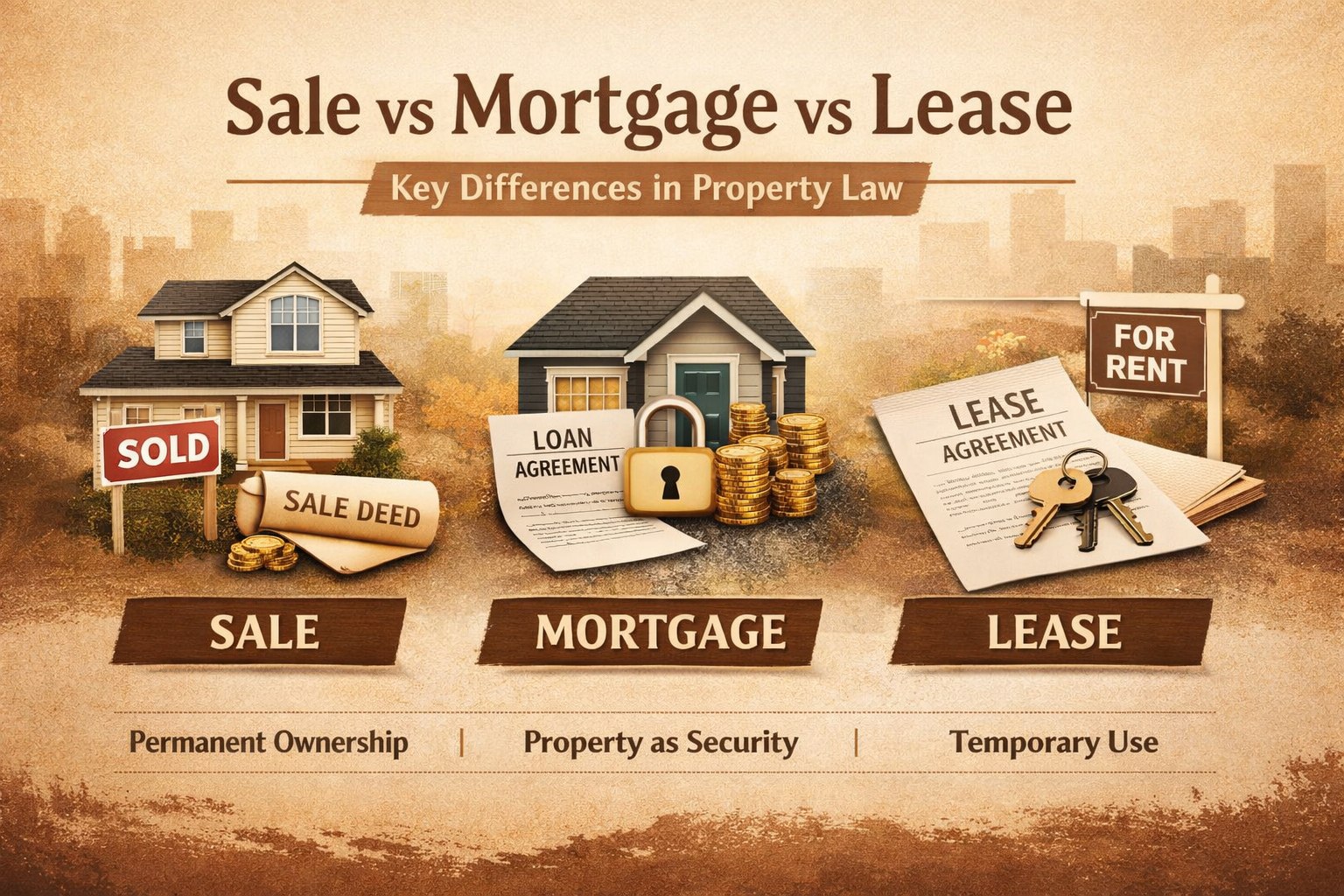
Property transactions are very common in everyday life. People buy houses, rent shops, or use property as security for loans. In legal terms, these arrangements are known as Sale, Mortgage, and Lease.
Although they all involve property, their legal meaning, rights, and purpose are completely different. Understanding these concepts is important not only for property owners but also for law students and judiciary aspirants.
In this article, we will clearly understand the difference between Sale, Mortgage, and Lease in simple terms.
What is Sale?
A Sale refers to the permanent transfer of ownership of property from one person to another in exchange for a price.
Under property law, when a sale takes place, the seller transfers all ownership rights to the buyer. After the transaction is complete, the buyer becomes the legal owner of the property.
For example, if A sells his house to B for ₹20 lakh, B becomes the new owner and A loses all rights over that property.
Key Features of Sale
- Ownership of property is completely transferred.
- It is done in exchange for money or price.
- The transfer is permanent.
- The buyer gets full rights over the property.
A sale is usually documented through a Sale Deed, which acts as proof of ownership.
What is Mortgage?
A Mortgage is a transaction where a property owner uses their property as security for a loan.
In this case, the owner does not sell the property. Instead, they promise the property to the lender as a guarantee that the loan will be repaid.
If the borrower fails to repay the loan, the lender may take legal action to recover the money through the property.
For example, if A takes a loan of ₹10 lakh from a bank and keeps his house as security, the house is considered mortgaged.
Key Features of Mortgage
- Property is used as security for a loan.
- Ownership usually remains with the borrower.
- The lender gets a legal right over the property until the loan is repaid.
- Once the loan is repaid, the property becomes free from mortgage.
Mortgages are very common in home loans and bank financing.
What is Lease?
A Lease is an arrangement where the owner of a property allows another person to use the property for a specific period in exchange for rent.
Unlike a sale, the ownership does not change. The person using the property is called the lessee, while the owner is called the lessor.
For example, if A gives his house to B for 2 years and B pays rent every month, it is a lease agreement.
Key Features of Lease
- Ownership remains with the original owner.
- The property is given for temporary use.
- The lessee pays rent or lease amount.
- The agreement is for a specific time period.
Lease agreements are common in residential rentals, commercial spaces, and land use arrangements.
Major Differences Between Sale, Mortgage, and Lease
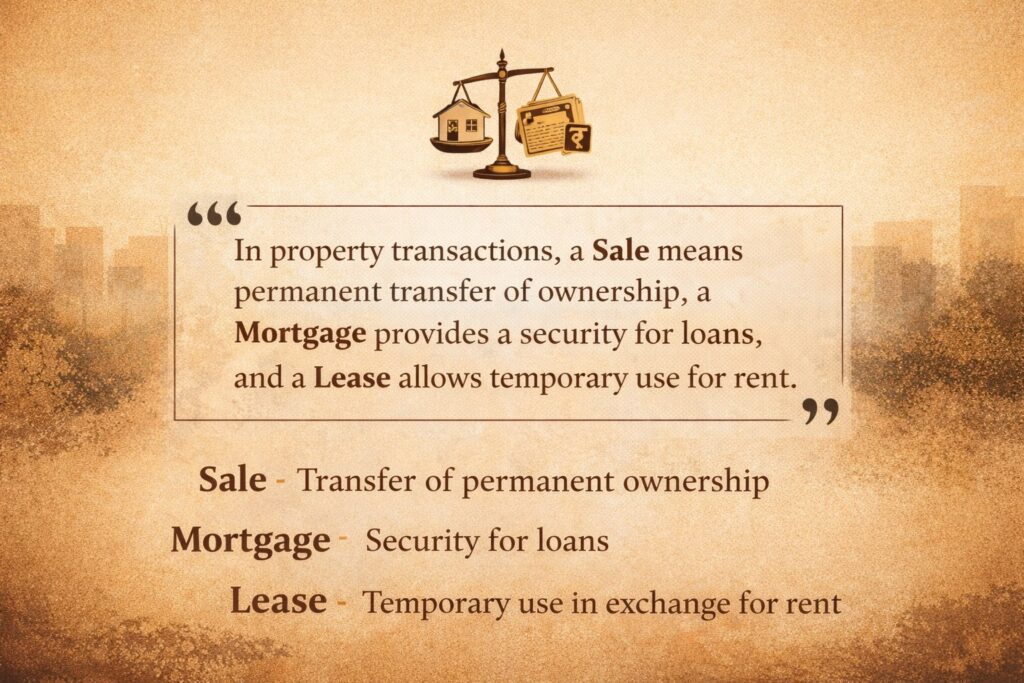
The main difference between these three concepts lies in ownership and purpose.
In a Sale, ownership is permanently transferred from seller to buyer.
In a Mortgage, the property is only kept as security for a loan.
In a Lease, the property is temporarily given for use while ownership remains with the owner.
Another important difference is the duration. A sale is permanent, a mortgage continues until the loan is repaid, and a lease is limited to a fixed time period.
Why Understanding These Concepts is Important
For law students and judiciary aspirants, understanding the difference between Sale, Mortgage, and Lease is very important because these concepts frequently appear in property law, civil law, and competitive examinations.
In real life as well, knowing these differences helps individuals make informed property decisions and avoid legal confusion.
Conclusion
Sale, Mortgage, and Lease are three fundamental concepts in property law, but they serve very different purposes.
A Sale transfers ownership permanently, a Mortgage provides security for a loan, and a Lease allows temporary use of property for rent.
Understanding these distinctions helps both legal professionals and common individuals navigate property transactions more confidently.
– Team Lawyer Talks