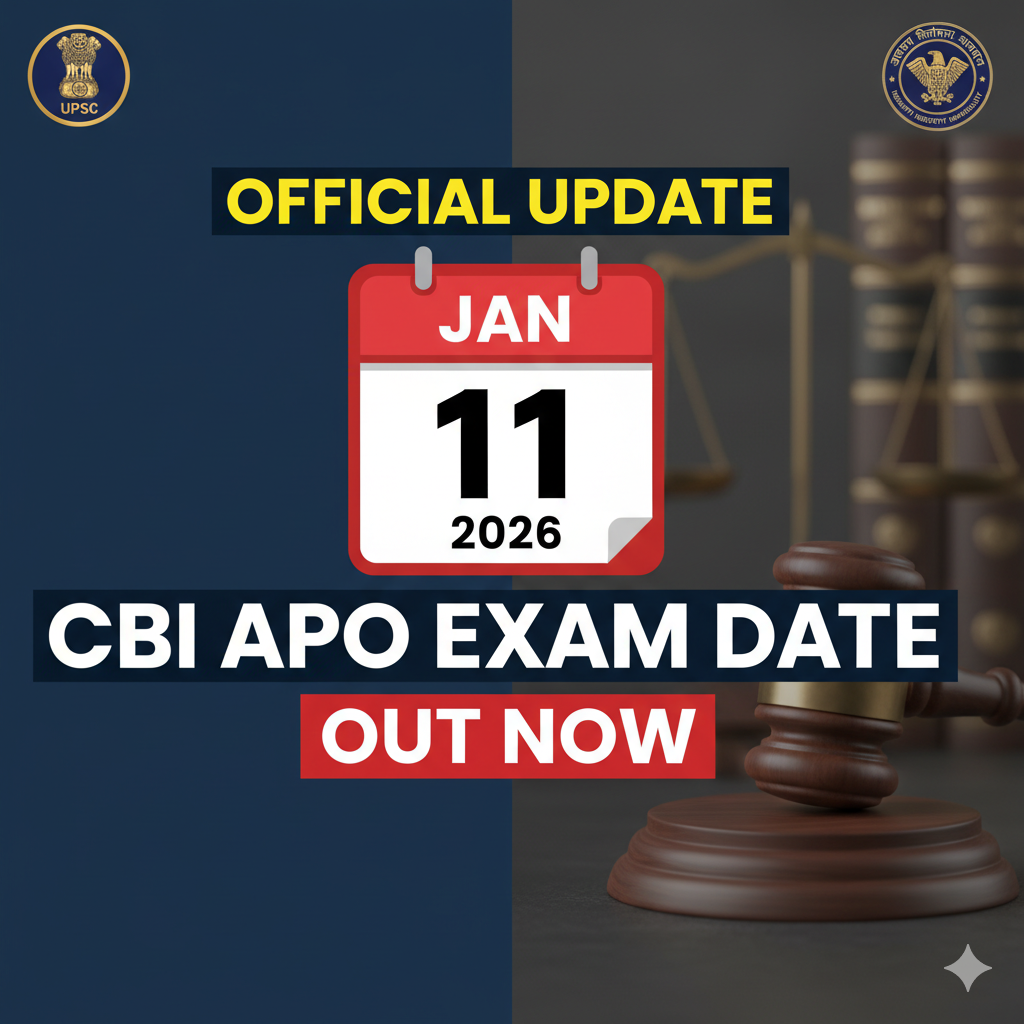
CBI Assistant Public Prosecutor (APO) Exam Date Announced: Schedule & Strategy
The Countdown Begins: Official Exam Date is Out If you applied for the CBI Assistant Public Prosecutor (APO/APP) recruitment earlier […]

The Countdown Begins: Official Exam Date is Out If you applied for the CBI Assistant Public Prosecutor (APO/APP) recruitment earlier […]
Introduction The Doctrine of Inevitable Discovery is a legal principle found primarily in criminal law. It serves as an exception

The Madhya Pradesh Public Service Commission (MPPSC) is gearing up to release a wave of new recruitment notifications this December. According to reports, more than 10 new advertisements are in the pipeline, bringing significant opportunities across various departments.

The past week was action-packed for the Indian judiciary, with the Supreme Court delivering significant pronouncements on property law, secularism, and public health. Simultaneously, High Courts across the country made several noteworthy observations.
Here are 50 most important questions to test and strengthen your understanding and ideal for CLAT PG, AIBE, or judicial prelim prep.
It includes MCQs with 4 options each and answers with brief explanations after every 10 questions.
The game has changed. Your preparation must now be laser-focused on the new criminal laws: the Bharatiya Nyaya Sanhita (BNS), Bharatiya Nagarik Suraksha Sanhita (BNSS), and Bharatiya Sakshya Adhiniyam (BSA).

In a shocking case that strikes at the very heart of judicial authority, the Supreme Court of India has taken

Recently, the Delhi High Court granted anticipatory bail to a 20-year-old accused booked under Section 376 IPC, observing that the relationship between the parties appeared consensual and not one induced by a false promise of marriage. The Court held that criminal law cannot be used as an instrument of coercion or revenge when a consensual relationship turns sour, emphasizing the paramount importance of personal liberty under Article 21 of the Constitution.

Introduction: What is “Free Consent”? For any agreement to be a valid contract, the consent of the parties must be

Welcome to your weekly legal roundup, where we dissect the most significant judgments, legislative changes, and legal developments from across