
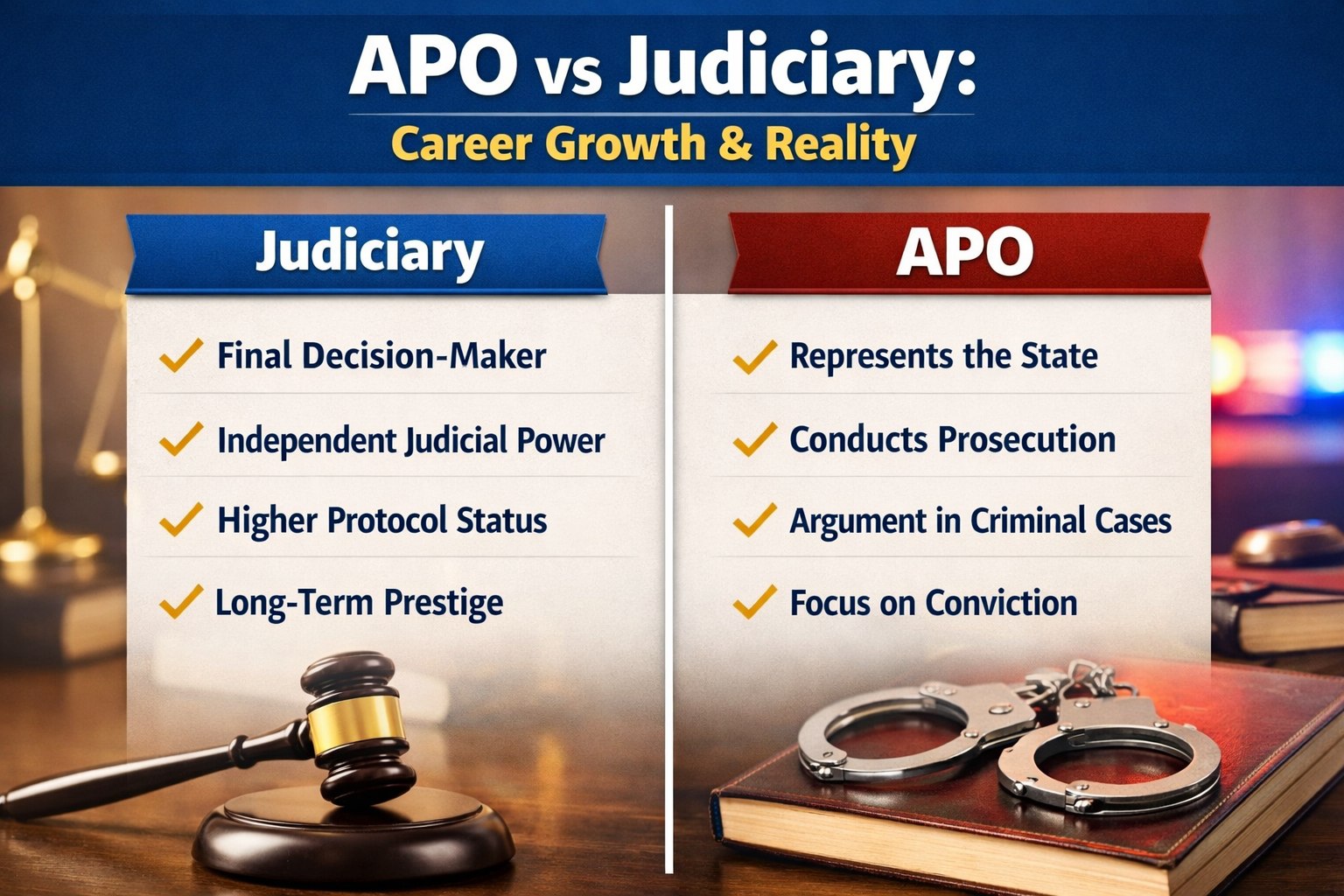
For law graduates, the choice between the Judiciary and the Prosecution is more than just a job preference; it’s a choice of legal identity. Both roles are prestigious, secure, and vital to the justice system, but they demand entirely different temperaments.
If you are currently eyeing state service exams like the BPSC, here is the “no-nonsense” breakdown of how these two roles actually compare.
1. The Core Roles: Who Does What?
The Civil Judge (The Bench)
As a Civil Judge (Junior Division), you are the arbiter of law. Your day isn’t spent arguing; it is spent listening, analyzing, and deciding. You are the final authority in your courtroom, responsible for granting bail, issuing injunctions, and ultimately delivering the judgment that ends a dispute.
- The Power: You hold the “pen.” Your orders are legally binding and enforceable.
The Assistant Prosecution Officer (The State’s Voice)
The APO is the legal warrior for the State. Your job is to ensure that criminals are brought to justice. You work closely with the police, scrutinize case diaries, and lead the evidence during trials.
- The Power: You hold the “argument.” You influence the outcome by how effectively you present the facts and examine witnesses.
2. Authority and Decision-Making: Who Holds the Reins?
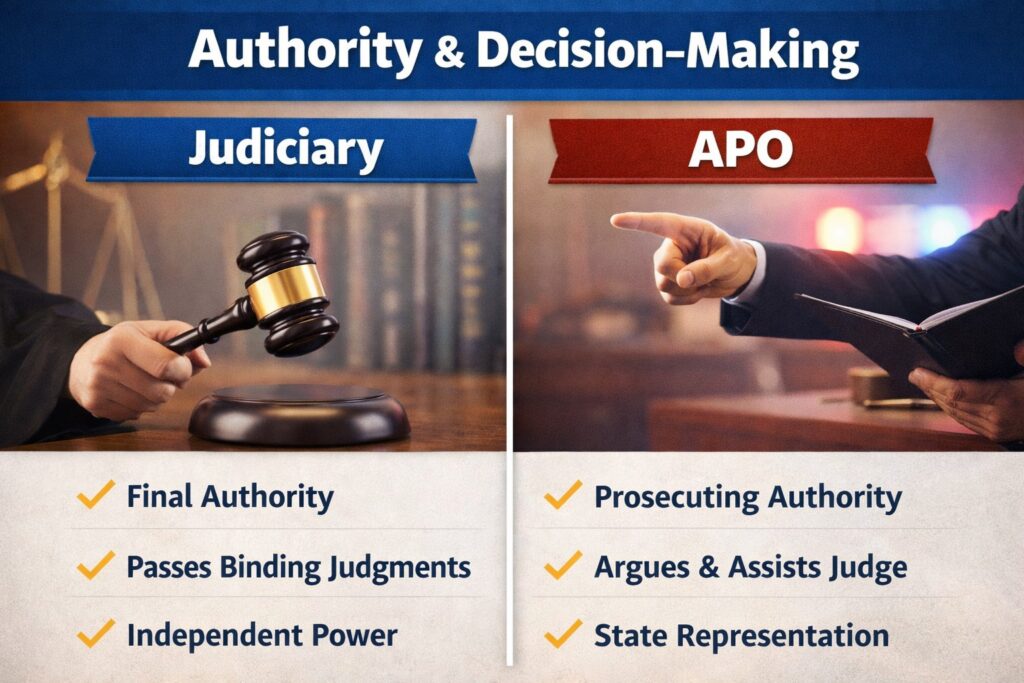
There is a fundamental difference in the type of power these roles exercise:
- The Judiciary (The Neutral Arbiter): A Judge operates with complete independence. You aren’t on anyone’s “team.” Instead, you sit above both parties, listen to the arguments, and apply the law neutrally. Your role is to be the objective voice of justice.
- The APO (The State’s Advocate): An APO’s role is rooted in advocacy. Unlike a judge, you aren’t neutral; you represent the State (Government). Your primary goal is to present a waterproof case to ensure that criminals are convicted and justice is served for the public.
The Verdict: Who Has the Final Say?
- The Judiciary (The Final Word): Delivering the final verdict is the exclusive power of the Judge. Whether it’s granting bail or sentencing a convict, your orders are legally binding and must be followed by everyone involved.
- The APO (The Influencer): An APO does not deliver the judgment. Instead, you influence the outcome through your arguments, evidence, and witness examinations. Your job is to convince the Judge that the State’s version of the story is the truth.
Autonomy: How Much Independence Do You Have?
- The Judiciary (High Autonomy): Judicial officers enjoy a very high level of independence. You aren’t answerable to any government department or political figure; your primary accountability is to the law and the High Court.
- The APO (Departmental Coordination): An APO has moderate autonomy. While you are a powerful officer, you must coordinate closely with the Police Department and work under the guidelines of the Directorate of Prosecution.
3. Career Trajectory and Promotions
The Judicial Path:
Civil Judge (Jr. Div) \rightarrow Senior Civil Judge \rightarrow District & Sessions Judge.
- The Peak: For the exceptionally distinguished, there is a constitutional path to the High Court, though this is a long and competitive journey.
The Prosecution Path:
APO \rightarrow Senior APO \rightarrow Deputy Director of Prosecution \rightarrow Director of Prosecution.
- The Peak: Your growth happens within the Directorate of Prosecution. It is a specialized administrative and legal leadership role.
4. The “Ground Reality”: Lifestyle & Stress
The Judge’s Burden:
Being a judge can be isolating. You must maintain a degree of social distance to ensure impartiality. The pressure isn’t just the “backlog” of cases; it’s the mental weight of knowing your judgment can change a person’s life forever. You will spend late nights drafting orders and researching precedents.
The APO’s Hustle:
An APO’s life is more active and extroverted. You are constantly interacting with police officers, witnesses, and victims. The stress here is “performance-based”—can you break a witness in cross-examination? Can you fix a procedural error made by the police? It’s high-energy and litigation-heavy.
5. Perks, Salary, and Status
While both are Gazetted officers, the Judiciary typically enjoys a higher “Protocol” rank.
- Judiciary: Higher pay scales (often following the National Judicial Pay Commission), official housing, and dedicated staff.
- APO: Competitive government salary and benefits, but often with fewer personal perks (like staff or housing) compared to the Bench.
Which One Should You Choose?
Choose Judiciary if:
- You have a contemplative personality and enjoy deep legal research.
- You value independence and want to be the final decision-maker.
- You are prepared for the weight of responsibility and a more reserved social life.
Choose APO if:
- You have a passion for criminal law and trial advocacy.
- You enjoy the thrill of the courtroom battle and cross-examining witnesses.
- You want a career that is deeply integrated with law enforcement and public safety.
Final Verdict
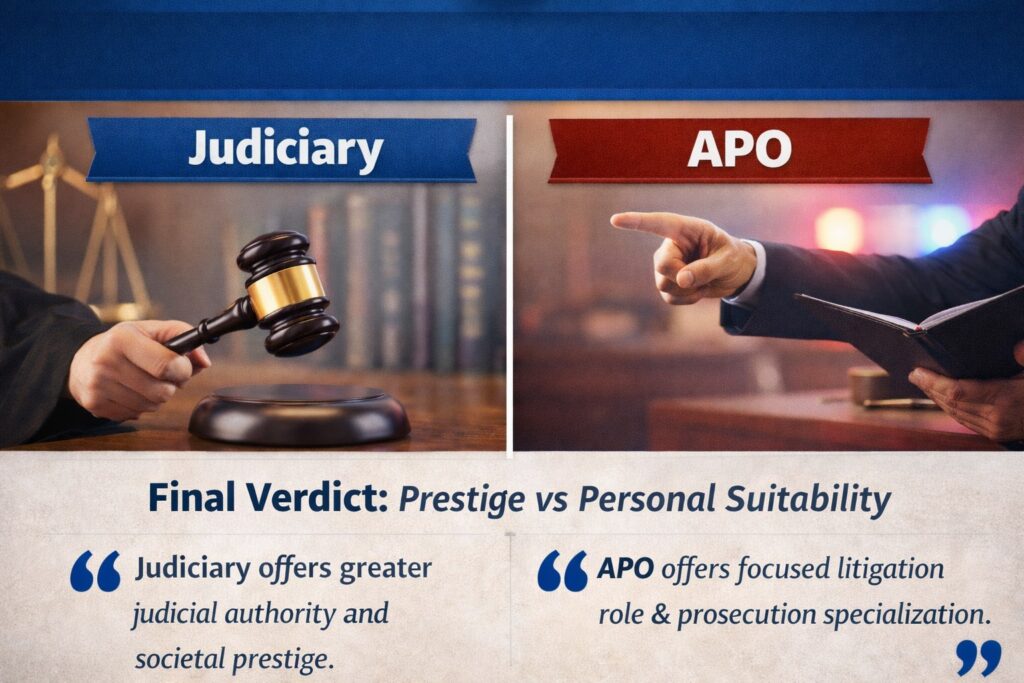
The Judiciary offers prestige and authority, while the APO role offers action and specialization. Neither is “better”—it’s about where you see yourself sitting: behind the wood of the Bench or at the podium of the Bar.
– Team Lawyer Talks