
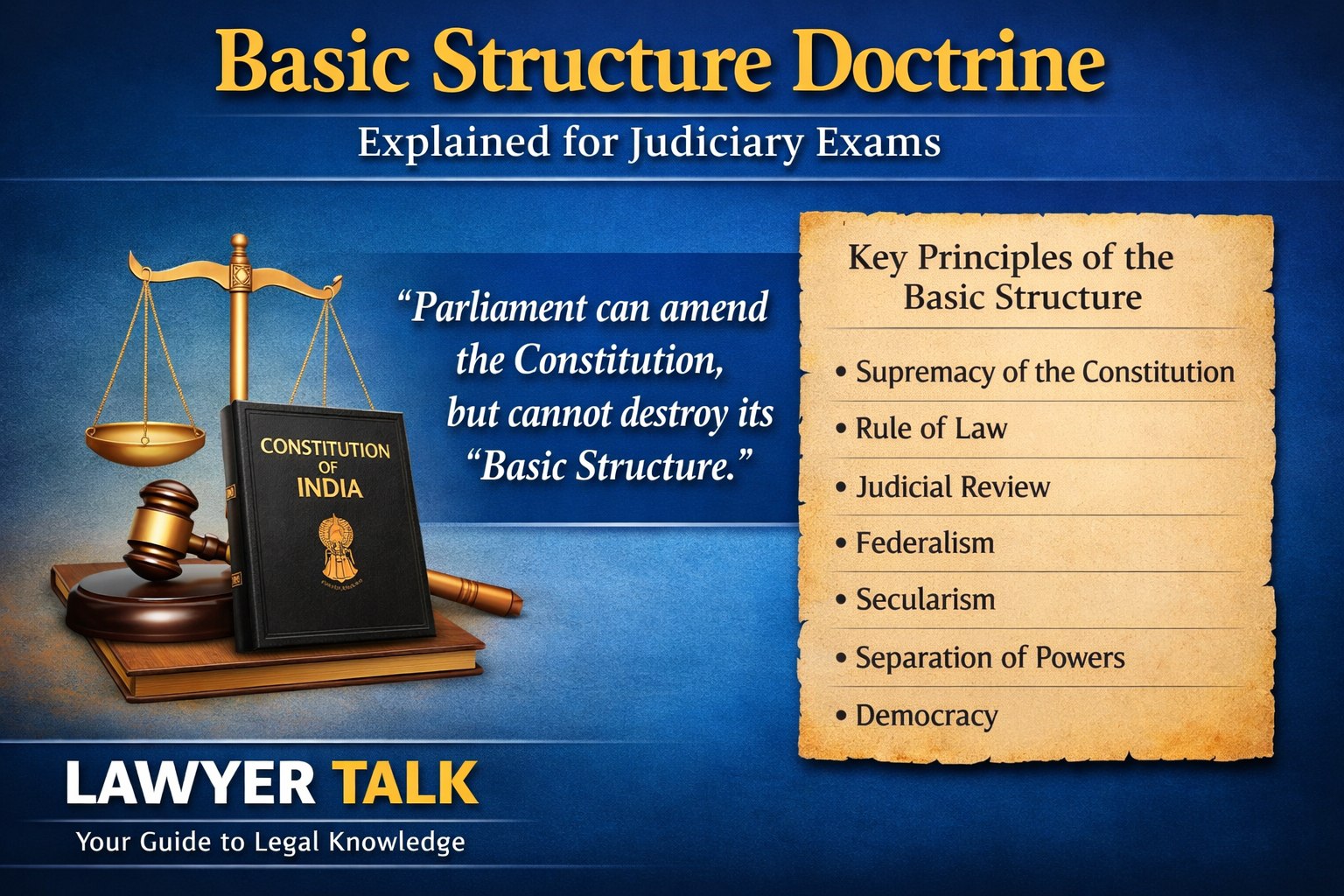
The Basic Structure Doctrine is a judicial innovation of paramount importance in Indian Constitutional Law. It serves as a substantive limitation on the constituent power of Parliament, ensuring that the essential identity and primordial spirit of the Constitution remain inviolable.
I. Conceptual Overview
While Article 368 grants Parliament the power to amend the Constitution, this power is not absolute. Through various landmark pronouncements, the Supreme Court has established that while the “form” of the Constitution may be altered, its “core” or Basic Structure cannot be abrogated or destroyed. This doctrine upholds the principle of Constitutionalism—the mandate that government power is limited by law and not subject to the arbitrary whims of a transient majority.
II. Judicial Evolution: From Literal to Teleological Interpretation
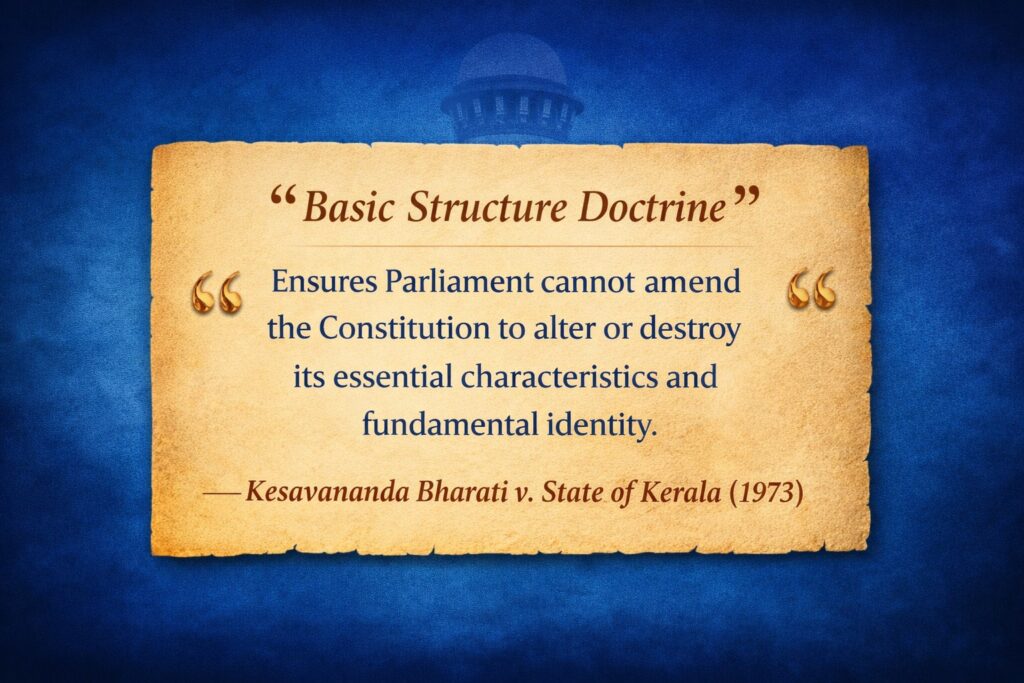
The evolution of this doctrine reflects a historic tug-of-war between Parliamentary Sovereignty and Judicial Supremacy.
1. Shankari Prasad v. Union of India (1951)
In the infancy of the Republic, the Court adopted a literal interpretation. It held that the power to amend under Article 368 was wide enough to include the power to abridge Fundamental Rights. At this stage, constitutional amendments were not considered “law” within the meaning of Article 13(2).
2. Golak Nath v. State of Punjab (1967) In a dramatic reversal, an 11-judge bench held that Fundamental Rights are transcendental and immutable. The Court ruled that Parliament possessed no power to curtail the rights enshrined in Part III, effectively shielding them from the reach of Article 368.
3. Kesavananda Bharati v. State of Kerala (1973)
This remains the most significant case in Indian legal history. A 13-judge bench (the largest ever constituted) overruled Golak Nath. It propounded that while Parliament can amend any part of the Constitution, it cannot alter its Basic Structure. This judgment shifted the focus from the “text” of the amendment to its “impact” on the constitutional fabric.
4. Minerva Mills v. Union of India (1980)
The Court further fortified the doctrine by striking down portions of the 42nd Amendment Act. It famously observed that “the Indian Constitution is founded on the bedrock of the balance between Parts III and IV,” and that the limited amending power of Parliament is itself a feature of the Basic Structure.
III. Salient Features of the Basic Structure
The Judiciary has intentionally avoided providing an exhaustive definition, allowing the doctrine to remain a “living” concept. However, the following elements have been judicially recognized:
- Supremacy of the Constitution: The Constitution remains the Grundnorm (ultimate legal authority).
- Separation of Powers: The functional distribution of powers between the Legislature, Executive, and Judiciary.
- Judicial Review: The inherent power of the High Courts and the Supreme Court to adjudicate the validity of legislative actions.
- Secularism and Democracy: The state’s religious neutrality and the republican nature of the polity.
- The Rule of Law: The principle that governance must be conducted according to established legal norms, ensuring protection against mala fide state action.
IV. Strategic Notes for Judiciary Aspirants
When addressing this topic in Mains examinations, keep these pointers in mind:
- Analytical Depth: Distinguish between “Constituent Power” (the power to frame/amend) and “Legislative Power” (the power to make ordinary laws).
- The Ambit of Article 13: Understand the debate on whether a Constitutional Amendment is a “law” that can be struck down if it violates Fundamental Rights.
- Recent Applications: Familiarize yourself with how the Basic Structure was invoked in the NJAC Case (2015) to protect the “Independence of the Judiciary.”
Conclusion
The Basic Structure Doctrine acts as the palladium of Indian Democracy. It prevents the “tyranny of the majority” and ensures that the Constitution remains a dynamic yet stable document. For a judicial aspirant, mastery of this doctrine is not merely an academic requirement but a prerequisite for understanding the soul of Indian Constitutional Jurisprudence.
– Team Lawyer Talks