

The First Information Report (FIR) is the cornerstone of the Indian criminal justice system. It serves as the primary mechanism through which information regarding a cognizable offense reaches the police, effectively triggering the investigative machinery.
For judiciary and law aspirants, mastering the nuances of the FIR is essential. Questions regarding its legal validity and evidentiary value are staples in judicial services examinations, CLAT PG, and various LL.B. assessments.
What is an FIR?
An FIR is the initial information provided to the police concerning the commission of a cognizable offense.
- Legal Basis: Historically recorded under Section 154 of the Code of Criminal Procedure (CrPC), it is now governed by Section 173 of the Bharatiya Nagarik Suraksha Sanhita (BNSS).
- Cognizable Offense: These are offenses where the police have the authority to arrest without a warrant and commence an investigation without prior judicial approval.
Essential Elements of a Valid FIR
To maintain legal sanctity, an FIR should generally fulfill the following criteria:
- Nature of Information: It must disclose the commission of a cognizable crime.
- Competent Authority: It must be given to the officer-in-charge of a police station.
- Form: If provided orally, the officer must reduce it to writing.
- Verification: The report must be read over to the informant to ensure accuracy.
- Authentication: The informant must sign the report.
- Documentation: The substance must be entered in the Station Diary (General Diary).
- Right to Copy: The informant is legally entitled to a free copy of the FIR immediately.
The Purpose of Filing an FIR
The FIR serves several critical functions in criminal jurisprudence:
- Initiation: It sets the criminal law machinery into motion.
- Chronology: It provides the earliest version of the incident before memories fade or stories are changed.
- Prevention: It minimizes the risk of later fabrication or “afterthought” improvements to the facts.
- Transparency: It maintains an official record of police action from the outset of the case.
Handling Delays in Filing an FIR
Courts do not automatically dismiss a case simply because there was a delay in lodging the FIR. Instead, they apply a test of reasonableness. Common justifications for delay that courts often accept include:
- Critical medical emergencies or the need for life-saving treatment.
- Severe physical or psychological trauma resulting from the crime.
- Significant distance or lack of access to a police station.
- Social stigma or the time required for family consultation, particularly in sensitive cases.
Key Legal Principle: If the delay is explained satisfactorily to the court, the FIR remains a valid and reliable starting point for the prosecution.
Who Can Lodge an FIR?
It is a common misconception that only the victim can file an FIR. In reality, an FIR can be lodged by:
- The victim of the crime.
- An eyewitness to the occurrence.
- A relative or friend of the victim.
- Any person who has credible knowledge that a cognizable offense has been committed.
- A police officer (acting suo motu).
The Evidentiary Value of an FIR
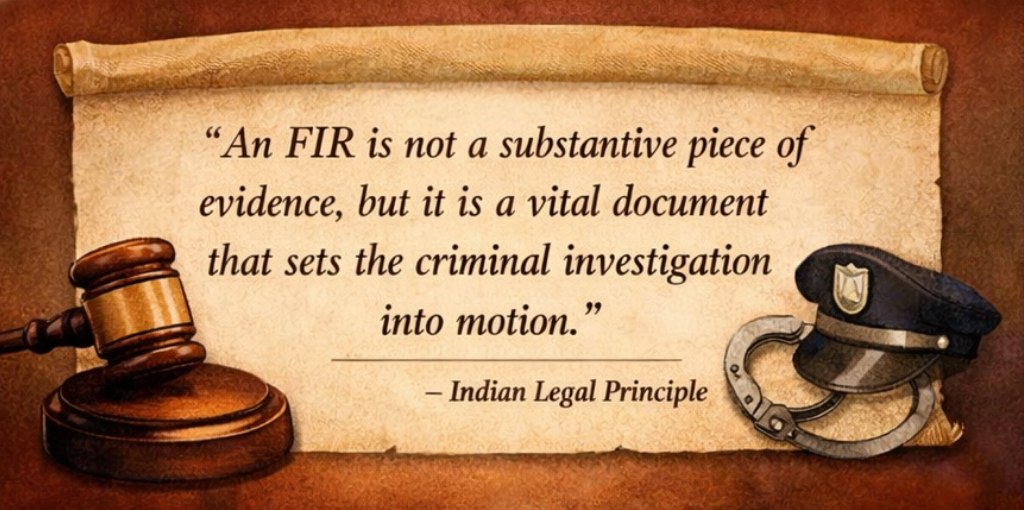
Is an FIR considered “substantive evidence”? No. An FIR cannot be used as the sole basis to prove the guilt of an accused person in court. However, it holds significant corroborative value under the law:
- Corroboration: It is used to support and strengthen the informant’s testimony during the trial.
- Contradiction: The defense may use the FIR to highlight inconsistencies if the witness changes their story in court.
- Dying Declaration: If the informant passes away before the trial, the FIR can, in specific circumstances, be treated as a dying declaration.
- Evidence of Conduct: It serves as evidence of the informant’s immediate reaction and conduct following the incident.
Judicial Observations
The Supreme Court of India has consistently held that “an FIR is not an encyclopedia.” It does not need to contain every minute detail of the crime; its primary job is to set the law in motion. Minor omissions do not necessarily make the entire case unreliable.
Special Concept: Zero FIR
A Zero FIR allows a victim to file a report at any police station, regardless of whether the crime took place within that station’s jurisdiction.
- It is marked with the serial number ‘0’ instead of a regular number.
- It is transferred to the police station that has the proper jurisdiction for investigation.
- This ensures that critical evidence is not lost and the investigation begins without jurisdictional delays.
Conclusion
The First Information Report is the foundation of the criminal trial. While it is not a substantive piece of evidence, its timely and accurate recording is vital for the delivery of justice. For any law student or judiciary aspirant, understanding the transition from the CrPC to the BNSS is now the most critical step in staying updated with the evolving legal landscape.
– Team Lawyer Talks