
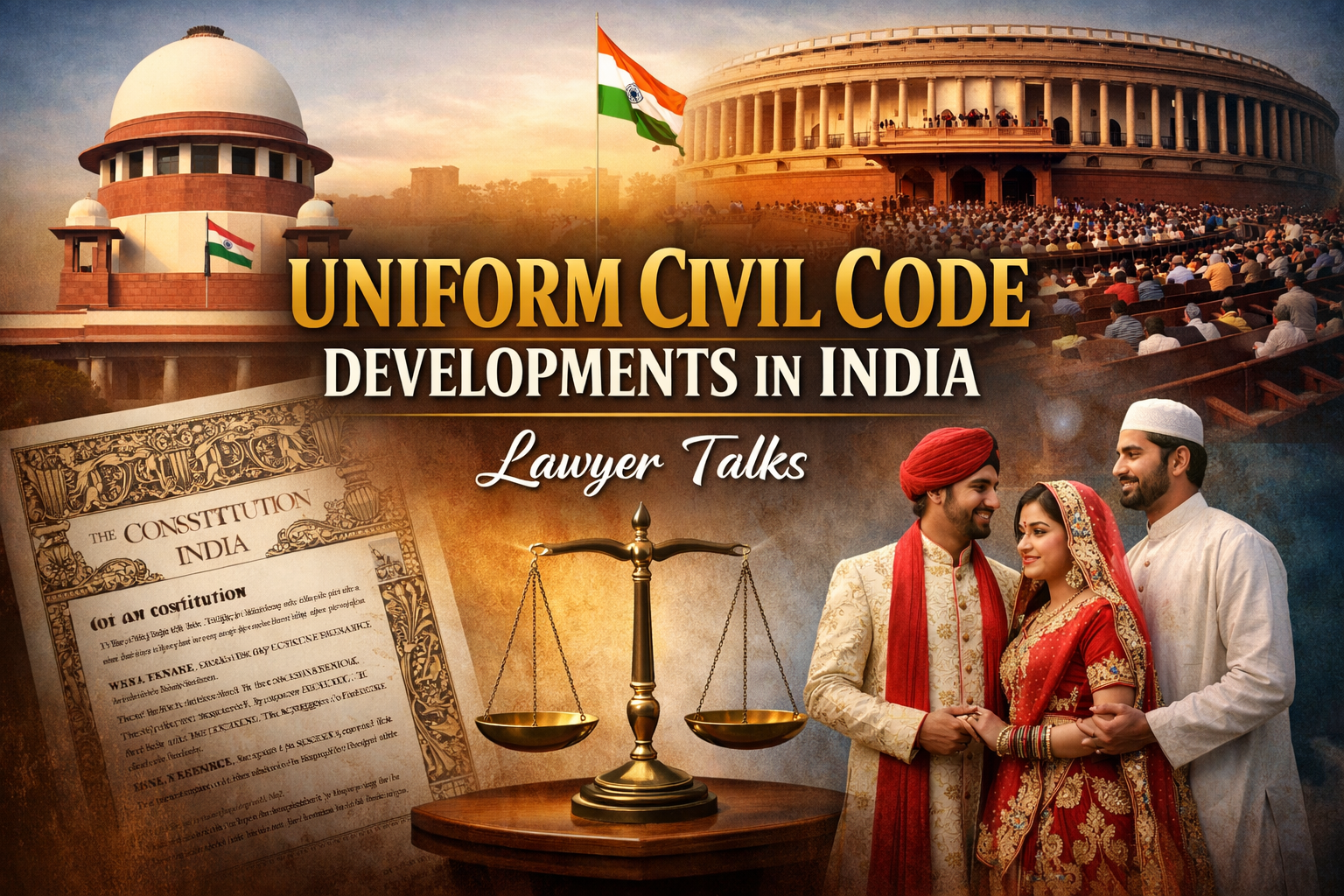
The concept of the Uniform Civil Code (UCC) has again assumed the limelight in India that has spawned intellectual debates within the realms of law, politics, and social sectors. Although the idea is not a recent one, the recent events turned it into the object of discussion.
We can simplify or make it easy to understand.
What is Uniform Civil Code?
A Uniform Civil Code is a general group of personal laws that would be applicable to the citizens of India despite the religion. Such legislations would encompass such aspects as:
- Marriage
- Divorce
- Adoption
- Inheritance
- Succession
At present, these issues are regulated by various individual provisions within various communities (Hindu, Muslim, Christian, etc.).
Constitutional Background
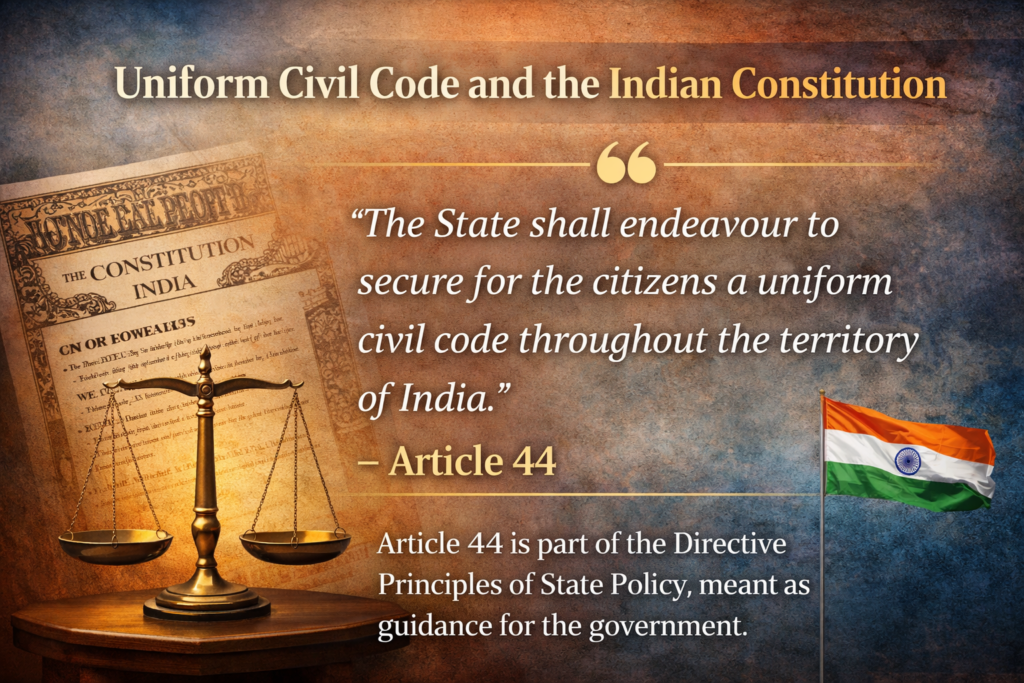
The very idea of UCC is referred to in the Article 44 of the Indian Constitution which says:
“The State shall endeavour to secure for the citizens a uniform civil code throughout the territory of India.”
But it belongs to here under the Directive Principles of State Policy (DPSP), which implies:
- Courts are not obliged to enforce it.
- However it forms the guide principle of the government.
Recent Developments
Unfortunately, over the past several years, the UCC drive is moving along:
– State-Level Initiatives:
Uttarakhand is another state that has been making progress in formulating and adopting a UCC framework.
– Law Commission Involvement:
The Law Commission has sought public views and it is evaluating the possibility and need of UCC in the current days.
– Political Debate:
UCC is one of the key political questions which are widely discussed by election parties and politicians in speeches.
– Judicial Observations:
Courts, such as the Supreme Court have sometimes shown that there is a necessity to have uniformity in personal laws so as to have equality.
Why is UCC Important?
Advocates of UCC propose that it is capable of:
- Assure Equality Before the law (Article 14)
- Advance gender justice particularly in individual legislation that concerns women.
- Enhance national integration.
- Streamline the legal system through elimination of complexity.
Concerns and Criticism
The UCC is true to criticize some crucial issues despite its possible benefits:
- Religious Freedom:
The opponents say that it can affect the right to religion as in Article 25.
- Cultural Diversity:
Personal laws are closely linked to traditions and customs since India is diverse.
- Implementation Challenges:
Formulating a legislation that will meet the requirements of all communities is a complicated exercise.
The Way Forward
The controversy on UCC is not merely legal, but it is highly social and emotional. A moderate position has to be taken:
- Wider public consultation
- Step by step and participatory reforms.
- Fundamental rights protection.
- Cultural diversity sensibility.
Conclusion
The Uniform Civil Code is yet another legal reform that is highly contested in India. As much as it is a good idea, equality and uniformity; the realization of this idea should be approached with caution, consultation and inclusiveness.
This is fundamentally a debate about how to reconcile unity and diversity, the law and realities in the lived world.
– Team Lawyer Talks