
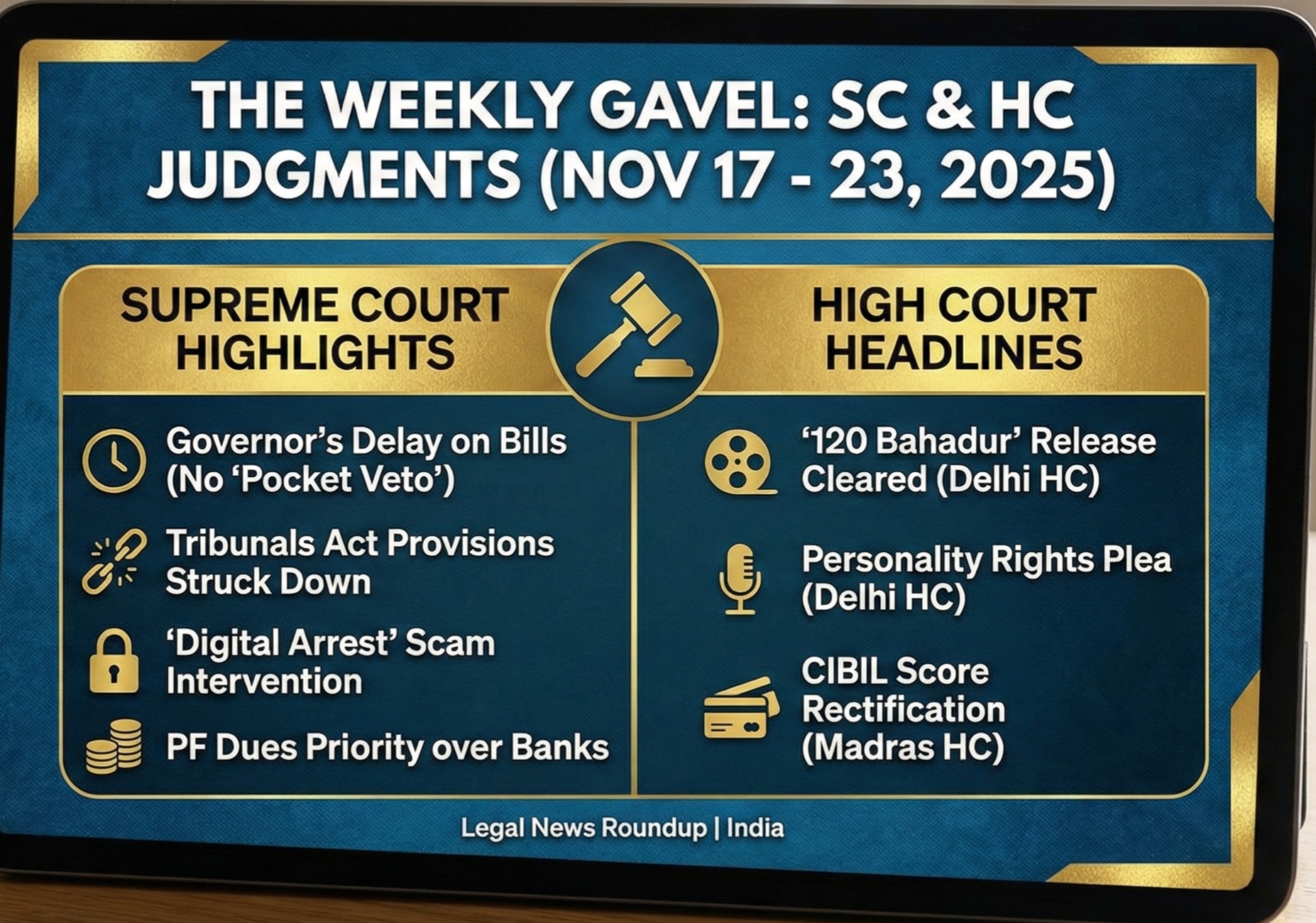
Welcome back to your weekly legal digest, November 17–23, 2025! This week was a blockbuster for Indian law, featuring landmark Supreme Court verdicts on federalism and tribunal independence, the long-awaited implementation of new labour codes, and critical interventions in cybercrime.
Supreme Court Highlights
1. Governors Cannot “Pocket Veto” Bills Indefinitely
In a massive win for federalism, the Supreme Court delivered its opinion on a Presidential Reference regarding the timeline for assent to bills.
- The Ruling: The Court held that it is “inappropriate” to judicially prescribe a fixed timeline for Governors or the President to give assent. However, it clarified that Governors cannot sit on bills indefinitely. If a Governor withholds assent, they must return the bill to the legislature “as soon as possible.”
- Significance: This judgment addresses the friction between state governments and Governors, emphasizing that constitutional authorities must not stall the legislative process.
2. Tribunal Reforms Act Provisions Struck Down
The apex court invalidated key sections of the Tribunals Reforms Act, 2021. The Bench ruled that these provisions undermined judicial independence. Furthermore, the Court directed the Centre to establish a National Tribunals Commission within four months to ensure these quasi-judicial bodies function autonomously and efficiently.
3. crackdown on “Digital Arrest” Scams
Acknowledging the rising menace of “Digital Arrest” cyber fraud—where scammers impersonate police or judges via video call to extort money—the Supreme Court signaled strong intervention. The Court observed that “unusual phenomena need unusual intervention” and indicated it would issue guidelines to protect citizens, directing the government to take immediate countermeasures.
4. Provident Fund Dues vs. Banks
In a crucial insolvency ruling involving the SARFAESI Act, the Supreme Court held that Provident Fund (PF) dues take precedence over the debts of secured creditors (like banks). This ensures that workers’ social security is prioritized during the liquidation of a company’s assets.
High Court Headlines
Delhi HC: “120 Bahadur” Release Cleared
The Delhi High Court allowed the theatrical release of the war film 120 Bahadur (starring Farhan Akhtar) on November 21. The court disposed of a plea claiming the film distorted history regarding the Battle of Rezang La, noting that the filmmakers had included a tribute to all 120 soldiers of the regiment.
Delhi HC: Personality Rights of Podcasters
In a developing story regarding the creator economy, the Delhi High Court heard a plea by podcaster and entrepreneur Raj Shamani seeking protection of his “personality rights” against unauthorized use of his voice and image. The Court is expected to pass a detailed order, which could set a precedent for content creators in India.
Madras HC: CIBIL Score & Duplicate PANs
The Madras High Court came to the rescue of a taxpayer whose CIBIL score was ruined because the Income Tax Department issued them a duplicate PAN card. The Court ordered the department to issue a fresh PAN and rectify the credit score issues, highlighting the state’s liability for administrative errors affecting citizens’ financial health.
- Top 25 Bihar Judiciary Previous Year Questions (MCQs) – PRELIMS PRACTICE SET
- Case Comment: INTERNET FREEDOM FOUNDATION v. UNION OF INDIA AND ORS. (AADHAAR CASE)

- When Foreign Divorce Meets Indian Law: Supreme Court Resolves an 18-Year Marital Dispute

- One Nation, One Election – Reform or Risk for Indian Democracy?
- Breach of Contract and Legal Remedies