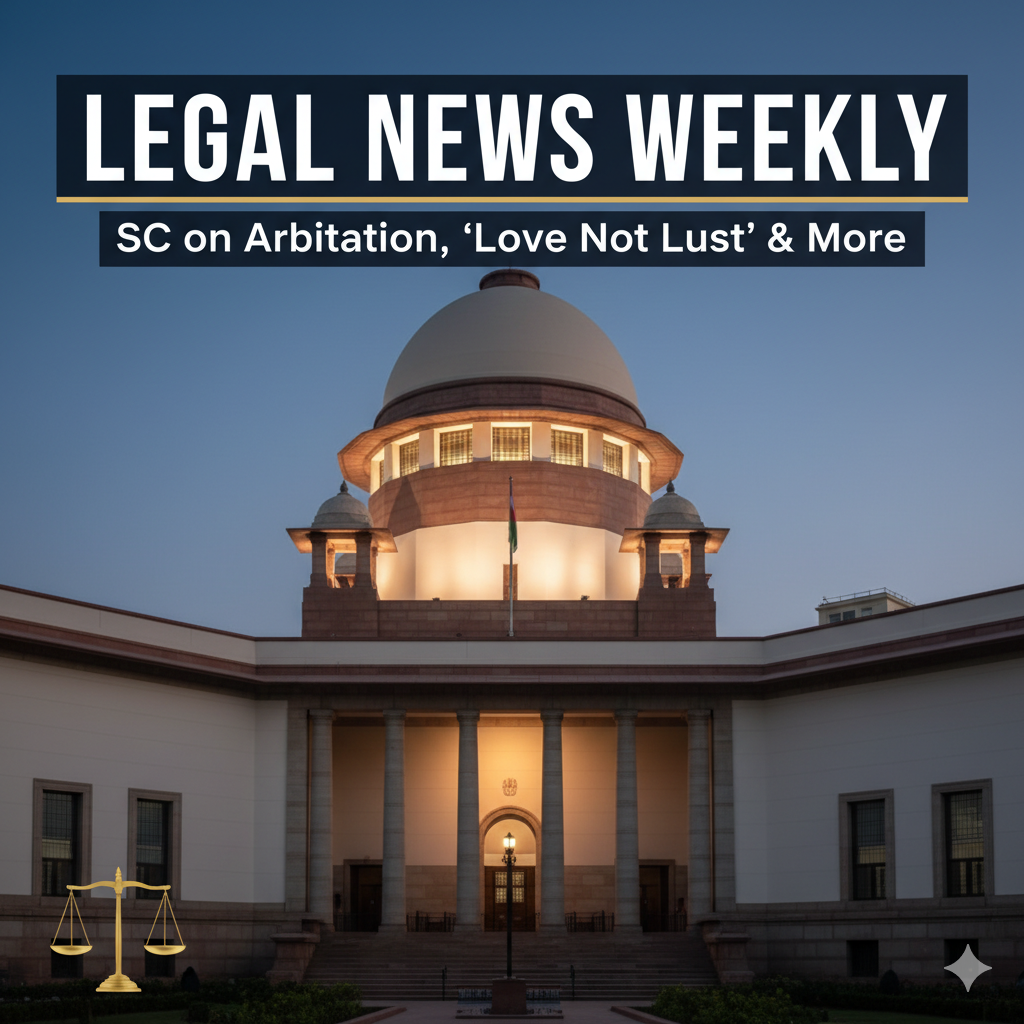
Welcome to your weekly legal roundup, where we dissect the most significant judgments, legislative changes, and legal developments from across India. This week, the Supreme Court delivered several landmark rulings on arbitration law, abetment of suicide, and the eligibility of judicial officers.
Here’s what you need to know from the week of October 26 to November 2, 2025.
⚖️ From the Supreme Court
1. Landmark Ruling: Courts Have Limited Power to Modify Arbitral Awards
In a major 4:1 majority decision, the Supreme Court settled a long-standing debate, ruling that courts do possess a limited power to “modify” arbitral awards under Sections 34 and 37 of the Arbitration and Conciliation Act, 1996.
- The Issue: Until now, courts were generally understood to only have the power to “set aside” a faulty award, not correct it. This often forced parties to restart the entire arbitration process.
- The Impact: This judgment grants courts the flexibility to correct errors and modify an award, which is expected to save significant time and resources for litigants. The Court clarified that this power is not unlimited and must be exercised sparingly, but it marks a significant, pro-enforcement shift in India’s arbitration jurisprudence.
2. ‘Mere Refusal to Marry’ Is Not Abetment of Suicide
The apex court made a crucial distinction in a case involving abetment of suicide charges. It held that a “mere refusal to marry” someone does not, by itself, constitute instigation under Section 107 of the Indian Penal Code. The Court quashed the charges against a man, observing that a simple refusal, even if it leads to a tragic outcome, does not meet the legal threshold for the offence of abetment.
3. SC on POCSO: ‘Act of Love, Not Lust’
In a sensitive case, the Supreme Court quashed POCSO charges against a man who had eloped with a minor girl. The Court took note of the fact that the couple was now happily married, had a child together, and the girl’s family supported the marriage. Terming the initial act one of “love, not lust,” the Court exercised its discretion to prioritize the family’s welfare and end the criminal proceedings.
4. Key Directives on Attorney-Client Privilege
Responding to concerns over police raids on lawyers’ offices, the Supreme Court issued a set of important directions to protect attorney-client privilege and curb indiscriminate seizures of digital devices. The Court laid down safeguards to ensure that privileged communication between a lawyer and their client is not compromised during an investigation, reinforcing the sanctity of this professional relationship.
5. Other Key SC Rulings:
- Vodafone Idea AGR Dues: The SC allowed the Central Government to reconsider the calculation of Adjusted Gross Revenue (AGR) dues for Vodafone Idea Ltd. The Court took this unusual step considering the government is now a major equity holder in the company and the interests of millions of consumers are at stake.
- District Judge Appointments: A Constitution Bench clarified the eligibility criteria for the direct appointment of District Judges, settling a dispute regarding the required years of practice for judicial officers.
- Delayed Arbitral Awards: In a separate arbitration matter, the SC held that an arbitral award passed after an “inordinately long delay” and which fails to resolve the core dispute violates public policy and can be set aside.
🏛️ From the High Courts
- Delhi HC on Tattoos in Armed Forces: The Delhi High Court has questioned the MHA guidelines that bar candidates with tattoos on their right (saluting) forearm from joining the Armed Forces. The court has asked the Centre to justify the “logic and rationale” behind this distinction.
- Bombay HC on Herbal Hookah: The Bombay High Court ruled that restaurants and bars in Mumbai can serve tobacco-free, herbal hookah without a license from the police, as they do not fall under the definition of “tobacco” products.
📰 Other Legal News
- CCPA Fines IAS Coaching Centres: The Central Consumer Protection Authority (CCPA) imposed heavy penalties of ₹8,00,000 each on Dikshant IAS and Abhimanu IAS coaching institutes. The action was taken for “misleading advertisements” and “unfair trade practices” related to testimonials from successful UPSC candidates.
- New Chief Justice of India: Justice Surya Kant is set to take charge as the 53rd Chief Justice of India in November, succeeding the current CJI.
Dearness Relief for Judges: The Department of Justice announced the grant of an additional instalment of Dearness Relief (DR) for retired Supreme Court and High Court judges, effective from July 1, 2025.
- Top 25 Bihar Judiciary Previous Year Questions (MCQs) – PRELIMS PRACTICE SET
- Case Comment: INTERNET FREEDOM FOUNDATION v. UNION OF INDIA AND ORS. (AADHAAR CASE)
- When Foreign Divorce Meets Indian Law: Supreme Court Resolves an 18-Year Marital Dispute
- One Nation, One Election – Reform or Risk for Indian Democracy?
- Breach of Contract and Legal Remedies

1 thought on “Weekly Legal Wrap: SC on Modifying Awards, “Refusal to Marry” & Attorney Privilege”
Sir,
This Lawyer talk’s very useful to our legal fraternity.