

The question of women’s representation in the judiciary is not merely about numbers; it is about equity, access to justice, and the strength of constitutional democracy. In a state like Bihar, where social structures are deeply rooted yet gradually evolving and the presence of women in the judiciary carries both symbolic and practical significance.
“Representation in the judiciary is not about filling seats; it is about fulfilling constitutional promises.”
As Bihar continues to produce successful Civil Judge aspirants, the conversation around gender diversity in the judicial system deserves serious and sustained attention.
Why Representation in the Judiciary Matters
The judiciary is the guardian of constitutional values. When courts reflect the diversity of society, public confidence in the justice delivery system naturally strengthens.
Women judges contribute:
- Diverse lived experiences
- Greater sensitivity in gender-based cases
- Broader perspectives in family, criminal, and constitutional matters
- Improved accessibility for women litigants
While justice must remain impartial and objective, representation enhances institutional inclusivity and public trust.
The Current Scenario: Women in Bihar Judiciary
In recent years, Bihar has witnessed a noticeable increase in women candidates clearing the Bihar Judicial Services Examination. Recruitment conducted by the Bihar Public Service Commission has shown encouraging participation from female aspirants.
At the level of the Subordinate Judiciary (Civil Judge – Junior Division), the proportion of women judges has gradually improved compared to previous decades. However, representation at the higher levels still reflects a visible gap.
The Patna High Court continues to have limited female representation on the bench relative to its sanctioned strength. This mirrors a broader national pattern also observed in the Supreme Court of India and several other High Courts across the country.
This indicates that while entry-level representation is improving, elevation to higher judicial positions remains an area requiring focused reform.
Structural and Social Challenges
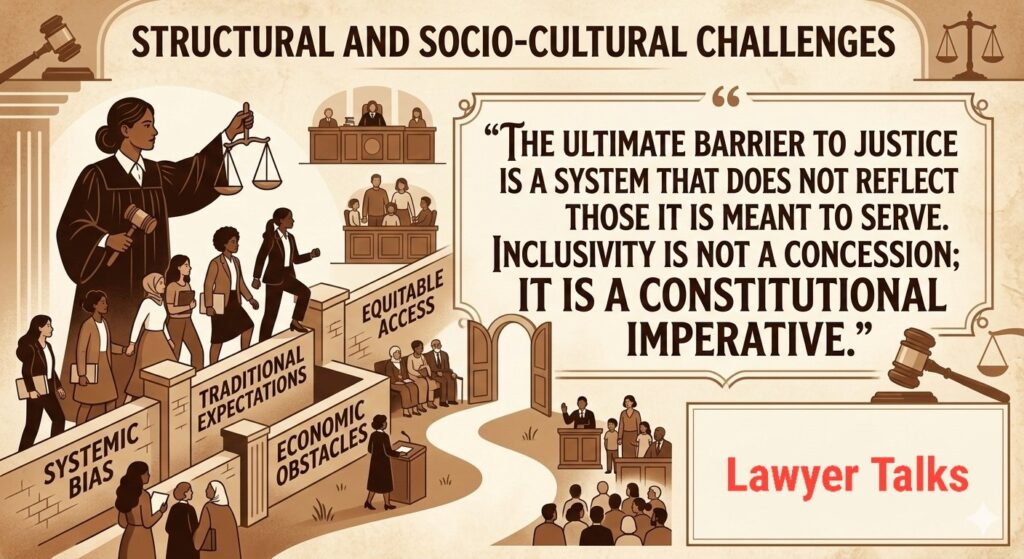
Despite increasing participation, women in Bihar’s judicial services face certain structural and societal challenges:
- Societal Expectations
Traditional expectations regarding marriage, relocation, and family responsibilities can influence long-term career continuity. - Posting and Transfers
Frequent transfers to remote districts may raise logistical and safety concerns. - Work-Life Balance
Balancing judicial workload with personal responsibilities remains a practical challenge. - Limited Mentorship at Senior Levels
Fewer women in senior judicial positions result in limited mentorship opportunities for aspiring female judges.
These are institutional concerns and not questions of merit or capability
Positive Developments
Despite challenges, there are clear and encouraging signs of progress:
- Increased female enrollment in law schools
- Rising success rates of women in judicial examinations
- Supportive recruitment policies and reservation frameworks
- Growing public discourse on gender diversity in courts
Bihar’s recent judiciary batches demonstrate that merit and diversity can coexist harmoniously.
Why This Topic Matters for Judiciary Aspirants
For Bihar Judiciary aspirants especially women candidates, representation sends a powerful message: the system is becoming more inclusive.
For male aspirants, understanding this issue is equally important. Gender representation is not a competitive concern; it is a reflection of the constitutional guarantee of equality under Articles 14 and 15 of the Indian Constitution.
Academically, this topic is highly relevant for:
- Essay papers
- Interview discussions
- General awareness sections
- Analytical answer writing
Understanding judicial diversity strengthens both preparation and perspective.
The Way Forward
To strengthen women’s representation in Bihar Judiciary, the following measures may be considered:
- Transparent elevation policies to higher judiciary
- Development of gender-sensitive infrastructure in district courts
- Creation of structured mentorship networks
- Institutional support for improved work-life balance
- Encouraging research and data transparency on judicial diversity
True representation is achieved not merely when women enter the judiciary, but when they thrive, lead, and shape judicial policy.
Conclusion
Women’s representation in Bihar Judiciary is a story of gradual but meaningful progress. While entry-level participation is improving, sustained institutional commitment is necessary to ensure balanced representation at higher judicial forums.
A judiciary that reflects the society it serves is stronger, more legitimate, and more responsive. Strengthening women’s presence on the bench is not simply a matter of gender parity, it is a reinforcement of constitutional morality and democratic integrity.
– Team Lawyer Talks