
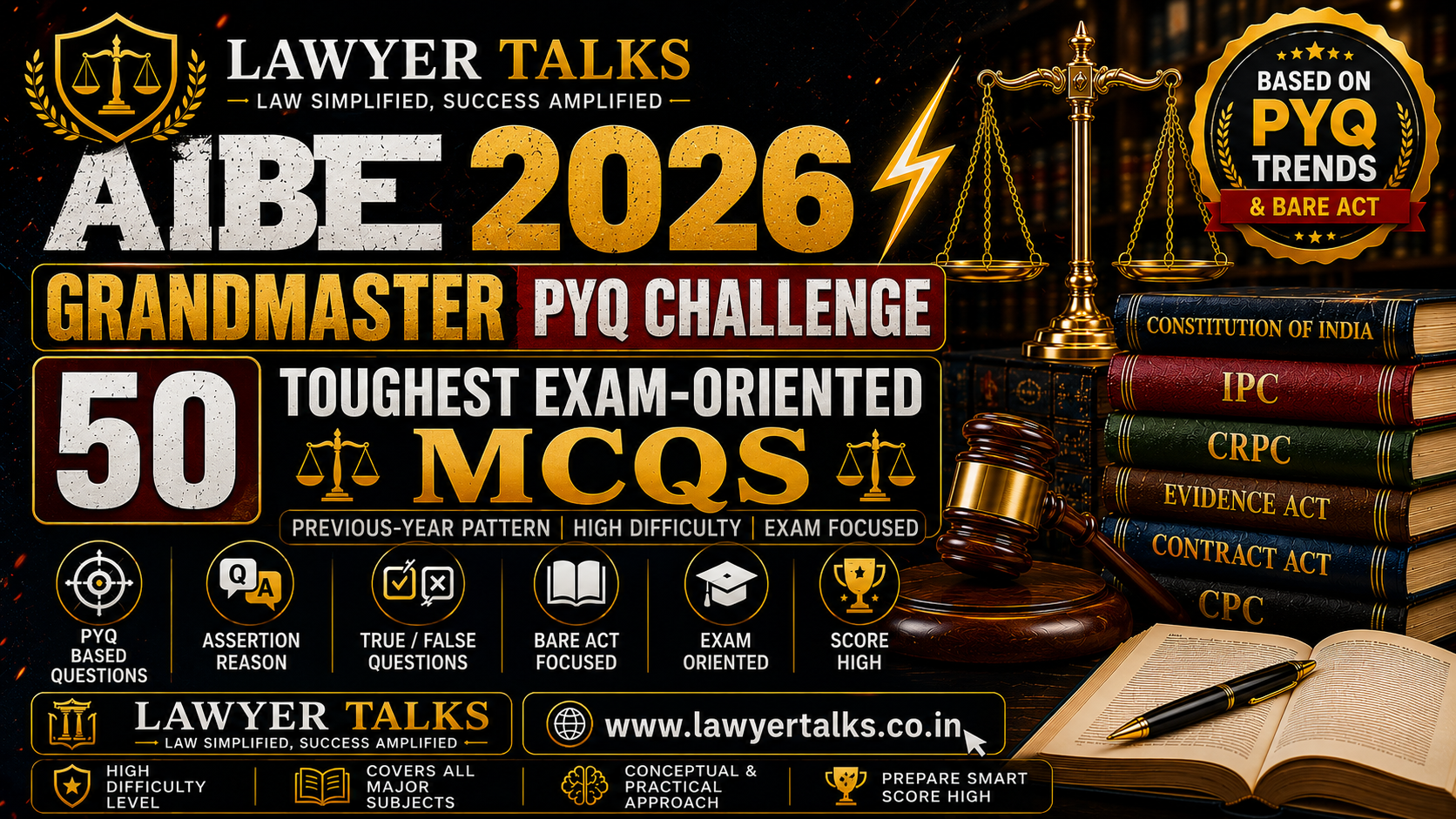
A fresh high-difficulty AIBE practice set inspired by previous-year trends, Bare Act interpretation, legal maxims, professional ethics, constitutional principles, criminal law, evidence, CPC, contract law, and practical legal reasoning. Designed to test real exam temperament and analytical skills.
1. Which Article protects a person from being prosecuted and punished more than once for the same offence?
A. Article 19
B. Article 20(2)
C. Article 21
D. Article 22
✅ Answer: B
2. True or False: Right to Privacy is recognized as a part of Article 21.
A. True
B. False
✅ Answer: A
3. Assertion (A): Article 14 permits reasonable classification.
Reason (R): Equal treatment of unequal persons may itself cause inequality.
A. Both true & R explains A
B. Both true but unrelated
C. A false
D. Both false
✅ Answer: A
4. Which writ is issued to command performance of a public duty?
A. Habeas Corpus
B. Mandamus
C. Certiorari
D. Prohibition
✅ Answer: B
5. Wrongful restraint is committed when a person:
A. Prevents movement in one direction
B. Confines completely
C. Causes hurt
D. Commits theft
✅ Answer: A
6. Extortion requires:
A. Dishonest taking
B. Fear of injury
C. Criminal force only
D. Possession only
✅ Answer: B
7. True or False: Every robbery is either theft or extortion.
A. True
B. False
✅ Answer: A
8. Which offence requires entrustment as an essential ingredient?
A. Theft
B. Criminal Breach of Trust
C. Robbery
D. Mischief
✅ Answer: B
9. A police officer investigating a cognizable offence generally does not require:
A. Magistrate’s order
B. FIR
C. Witnesses
D. Evidence
✅ Answer: A
10. Which of the following is a bailable offence characteristic?
A. Bail is matter of right
B. Bail depends entirely on court discretion
C. Bail never granted
D. Bail only by High Court
✅ Answer: A
11. Assertion (A): Arrest and detention are different concepts.
Reason (R): Every detention is not necessarily an arrest.
A. Both true & R explains A
B. Both true but unrelated
C. A false
D. Both false
✅ Answer: A
12. True or False: Cognizance is taken of an offence, not of an offender.
A. True
B. False
✅ Answer: A
13. Which evidence is considered direct evidence?
A. Eye-witness testimony
B. Presumption
C. Expert opinion
D. Secondary evidence
✅ Answer: A
14. Confession must be:
A. Voluntary
B. Registered
C. Written
D. Notarized
✅ Answer: A
15. Dying declaration is admissible because:
A. It is sworn testimony
B. Law treats it as exception to hearsay
C. It is documentary evidence
D. It is expert evidence
✅ Answer: B
16. True or False: Hearsay evidence is always inadmissible without exception.
A. True
B. False
✅ Answer: B
17. Which of the following is not an essential element of a valid contract?
A. Free consent
B. Competent parties
C. Lawful consideration
D. Registration in every case
✅ Answer: D
18. An agreement made under mistake of fact by both parties is generally:
A. Valid
B. Void
C. Voidable
D. Illegal
✅ Answer: B
19. Assertion (A): Consideration need not be adequate.
Reason (R): Courts generally do not assess adequacy if consideration is lawful.
A. Both true & R explains A
B. Both true but unrelated
C. A false
D. Both false
✅ Answer: A
20. Contract of guarantee involves:
A. Two parties
B. Three parties
C. Four parties
D. One party
✅ Answer: B
21. Res sub judice aims to:
A. Avoid conflicting decisions
B. Increase litigation
C. Prevent appeals
D. Enforce decrees
✅ Answer: A
22. Temporary injunction is granted to:
A. Decide final rights
B. Preserve status quo
C. Dismiss suit
D. Prevent appeal
✅ Answer: B
23. True or False: Review is an appeal in disguise.
A. True
B. False
✅ Answer: B
24. Second Appeal under CPC generally lies on:
A. Facts only
B. Substantial Question of Law
C. Evidence only
D. Witness credibility only
✅ Answer: B
25. Defamation protects:
A. Possession
B. Reputation
C. Property
D. Contractual rights
✅ Answer: B
26. Which tort involves unlawful interference with possession of land?
A. Nuisance
B. Defamation
C. Trespass
D. Negligence
✅ Answer: C
27. Assertion (A): Negligence requires damage.
Reason (R): Mere carelessness without legal damage is insufficient.
A. Both true & R explains A
B. Both true but unrelated
C. A false
D. Both false
✅ Answer: A
28. Volenti non fit injuria is based upon:
A. Fraud
B. Consent
C. Defamation
D. Negligence
✅ Answer: B
29. Separate legal entity principle was firmly established in:
A. Donoghue v Stevenson
B. Salomon v Salomon
C. Rylands v Fletcher
D. Carlill v Carbolic
✅ Answer: B
30. True or False: Company can sue and be sued in its own name.
A. True
B. False
✅ Answer: A
31. Holder in due course is associated with:
A. Transfer of Property Act
B. NI Act
C. Companies Act
D. CPC
✅ Answer: B
32. A cheque is always:
A. Promissory Note
B. Bill of Exchange drawn on banker
C. Decree
D. Contract
✅ Answer: B
33. An advocate’s first duty is towards:
A. Client’s profit
B. Court and justice system
C. Media
D. Police
✅ Answer: B
34. Professional misconduct may lead to:
A. Suspension
B. Reprimand
C. Removal from rolls
D. All of these
✅ Answer: D
35. Assertion (A): Legal profession is service-oriented.
Reason (R): Advocacy is not treated merely as a commercial activity.
A. Both true & R explains A
B. Both true but unrelated
C. A false
D. Both false
✅ Answer: A
36. “Actus non facit reum nisi mens sit rea” means:
A. Guilty act alone is enough
B. Guilty mind generally required with guilty act
C. Motive equals intention
D. Ignorance is no excuse
✅ Answer: B
37. “Nemo judex in causa sua” relates to:
A. Bias rule
B. Burden of proof
C. Negligence
D. Defamation
✅ Answer: A
38. True or False: Basic Structure Doctrine allows complete destruction of Constitution.
A. True
B. False
✅ Answer: B
39. Which case is famously associated with Right to Privacy?
A. Kesavananda Bharati
B. Puttaswamy
C. Golaknath
D. Minerva Mills
✅ Answer: B
40. PIL can generally be filed by:
A. Only aggrieved person
B. Public spirited individual in suitable cases
C. Government only
D. Advocate General only
✅ Answer: B
41. Arbitration primarily aims at:
A. Criminal punishment
B. Alternative dispute resolution
C. Constitutional review
D. Tax assessment
✅ Answer: B
42. True or False: Conciliation is less formal than arbitration.
A. True
B. False
✅ Answer: A
43. “Res judicata” means:
A. Matter already adjudicated
B. Hear the other side
C. Buyer beware
D. No legal injury
✅ Answer: A
44. “Caveat emptor” means:
A. Seller beware
B. Buyer beware
C. Court beware
D. Witness beware
✅ Answer: B
45. Lok Adalat functions under:
A. Legal Services Authorities Act
B. CPC
C. CrPC
D. Evidence Act
✅ Answer: A
46. True or False: Lok Adalat award is treated as a decree of court.
A. True
B. False
✅ Answer: A
47. AIBE certificate is required for:
A. Enrolment as law student
B. Practice as advocate after enrolment
C. Judicial service exam
D. LLM admission
✅ Answer: B
48. AIBE focuses mainly on:
A. Practical application of law
B. Pure theoretical jurisprudence
C. Mathematics
D. Economics
✅ Answer: A
49. The most frequently tested AIBE area is:
A. Bare Acts and core legal concepts
B. Science
C. International relations
D. Engineering
✅ Answer: A
50. The smartest AIBE exam strategy is:
A. Memorize answers only
B. Revise Bare Acts, Ethics, PYQs and Mock Tests
C. Read summaries only
D. Skip difficult subjects
✅ Answer: B
– Team Lawyer Talks