
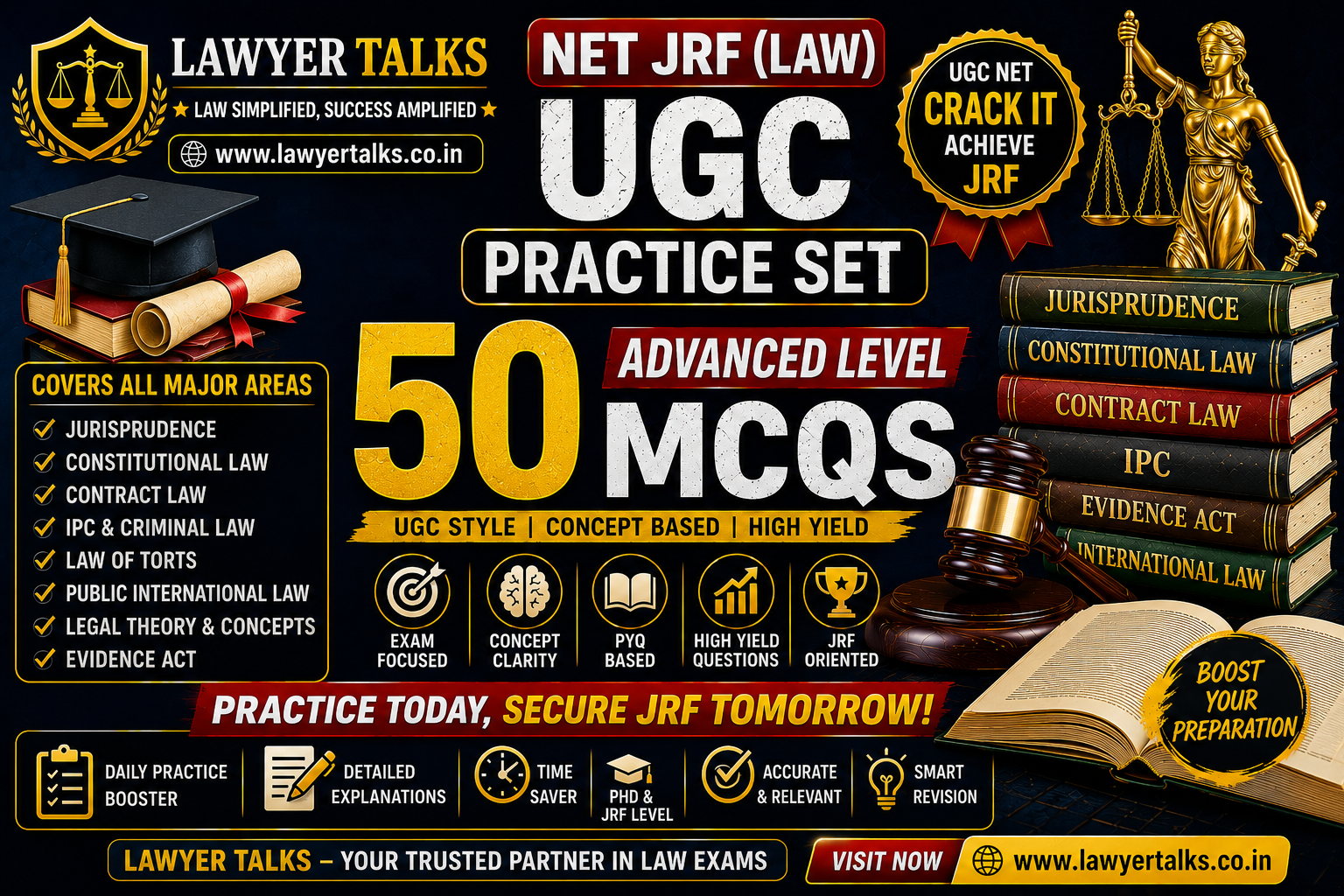
This set is designed for UGC NET JRF Law aspirants, covering Constitutional Law, Jurisprudence, IPC basics, Evidence Act, Contract Law, Public International Law, and Legal Theory with conceptual + assertion–reason + PYQ-style MCQs.
1. Who is known as the father of Legal Positivism?
A. Austin
B. Savigny
C. Hart
D. Kelsen
2. Sovereignty theory is associated with:
A. Austin
B. Bentham
C. Kant
D. Hegel
3. True/False: Law and morality are always identical.
A. True
B. False
4. Basic structure doctrine was propounded in:
A. Kesavananda Bharati case
B. Golaknath case
C. Minerva Mills case
D. Maneka Gandhi case
5. Article 32 is called:
A. Heart and soul of Constitution
B. Directive principle
C. Emergency provision
D. Federal provision
6. Habeas Corpus means:
A. Produce body
B. Command order
C. Remove authority
D. Appeal
7. Which writ is issued against unlawful detention?
A. Habeas Corpus
B. Mandamus
C. Certiorari
D. Quo Warranto
8. True/False: Jurisprudence is the science of law.
A. True
B. False
9. Salmond defined law as:
A. Set of rules enforced by courts
B. Moral code
C. Religious order
D. Political theory
10. Austin defines law as:
A. Command of sovereign
B. Custom
C. Justice
D. Ethics
11. Consideration is defined in:
A. Section 2(d) Contract Act
B. IPC
C. CrPC
D. CPC
12. Free consent excludes:
A. Coercion
B. Offer
C. Acceptance
D. Proposal
13. True/False: All agreements are contracts.
A. True
B. False
14. Bailment involves:
A. Delivery of goods
B. Transfer of ownership
C. Sale
D. Lease of land
15. Nemo dat quod non habet means:
A. No one gives better title than he has
B. Contract is valid
C. Law is equal
D. Justice delayed
16. IPC was enacted in:
A. 1860
B. 1872
C. 1908
D. 1950
17. Mens rea refers to:
A. Guilty mind
B. Physical act
C. Evidence
D. Judgment
18. Actus reus refers to:
A. Physical act
B. Intent
C. Motive
D. Punishment
19. True/False: Attempt is always punishable.
A. True
B. False
20. Criminal conspiracy is under:
A. Section 120A IPC
B. Section 34 IPC
C. Section 149 IPC
D. Section 378 IPC
21. Evidence Act was enacted in:
A. 1872
B. 1860
C. 1908
D. 1956
22. Dying declaration is under:
A. Section 32 Evidence Act
B. Section 45
C. Section 60
D. Section 154
23. Burden of proof generally lies on:
A. Prosecution
B. Accused
C. Judge
D. Witness
24. Confession to police is:
A. Inadmissible
B. Admissible
C. Mandatory
D. Binding
25. Primary evidence means:
A. Original document
B. Copy
C. Oral statement
D. Opinion
26. CPC stands for:
A. Civil Procedure Code
B. Criminal Procedure Code
C. Constitutional Procedure Code
D. Contract Procedure Code
27. Res judicata is under:
A. Section 11 CPC
B. Section 154 CrPC
C. Section 32 IPC
D. Article 21
28. Injunction is:
A. Preventive relief
B. Punishment
C. Arrest order
D. Appeal
29. True/False: Every decree is appealable.
A. True
B. False
30. Jurisdiction of Supreme Court under writs:
A. Article 32
B. Article 226
C. Article 141
D. Article 136
31. Jurisdiction of High Court under writs:
A. Article 226
B. Article 32
C. Article 19
D. Article 21
32. PIL stands for:
A. Public Interest Litigation
B. Private Interest Law
C. Police Investigation Law
D. Public International Law
33. Public International Law deals with:
A. States
B. Individuals only
C. Companies only
D. Criminal law
34. Sources of international law include:
A. Treaties
B. Customs
C. General principles
D. All of these
35. True/False: Custom is a source of law.
A. True
B. False
36. Hart is associated with:
A. Rule of recognition
B. Sovereign command
C. Natural law
D. Divine theory
37. Kelsen is known for:
A. Pure theory of law
B. Natural law
C. Sociological theory
D. Historical theory
38. Salmond belonged to:
A. Analytical school
B. Historical school
C. Sociological school
D. Realist school
39. True/False: Law is static in nature.
A. True
B. False
40. Constitution of India came into force in:
A. 1950
B. 1947
C. 1952
D. 1949
41. Article 14 deals with:
A. Equality before law
B. Freedom of speech
C. Religion
D. Property
42. Article 19 deals with:
A. Freedom of rights
B. Arrest
C. Trial
D. Judiciary
43. Fundamental Rights are in:
A. Part III
B. Part IV
C. Part II
D. Part I
44. DPSP are in:
A. Part IV
B. Part III
C. Part II
D. Part V
45. Directive Principles are:
A. Non-justiciable
B. Enforceable
C. Criminal
D. Procedural
46. Judicial review is part of:
A. Basic structure
B. Emergency
C. Ordinance
D. Schedule
47. Article 21 includes:
A. Right to life
B. Right to property
C. Right to vote
D. Right to contract
48. Legal right means:
A. Enforceable right
B. Moral duty
C. Religious duty
D. Social custom
49. Ratio decidendi means:
A. Reason for decision
B. Obiter dictum
C. Appeal
D. Judgment
50. Obiter dicta means:
A. Incidental remarks
B. Binding rule
C. Statute
D. Code
📌 ANSWER KEY
1-A, 2-A, 3-B, 4-A, 5-A, 6-A, 7-A, 8-A, 9-A, 10-A
11-A, 12-A, 13-B, 14-A, 15-A, 16-A, 17-A, 18-A, 19-B, 20-A
21-A, 22-A, 23-A, 24-A, 25-A, 26-A, 27-A, 28-A, 29-B, 30-A
31-A, 32-A, 33-A, 34-A, 35-A, 36-A, 37-A, 38-A, 39-B, 40-A
41-A, 42-A, 43-A, 44-A, 45-A, 46-A, 47-A, 48-A, 49-A, 50-A
– Team Lawyer Talks