
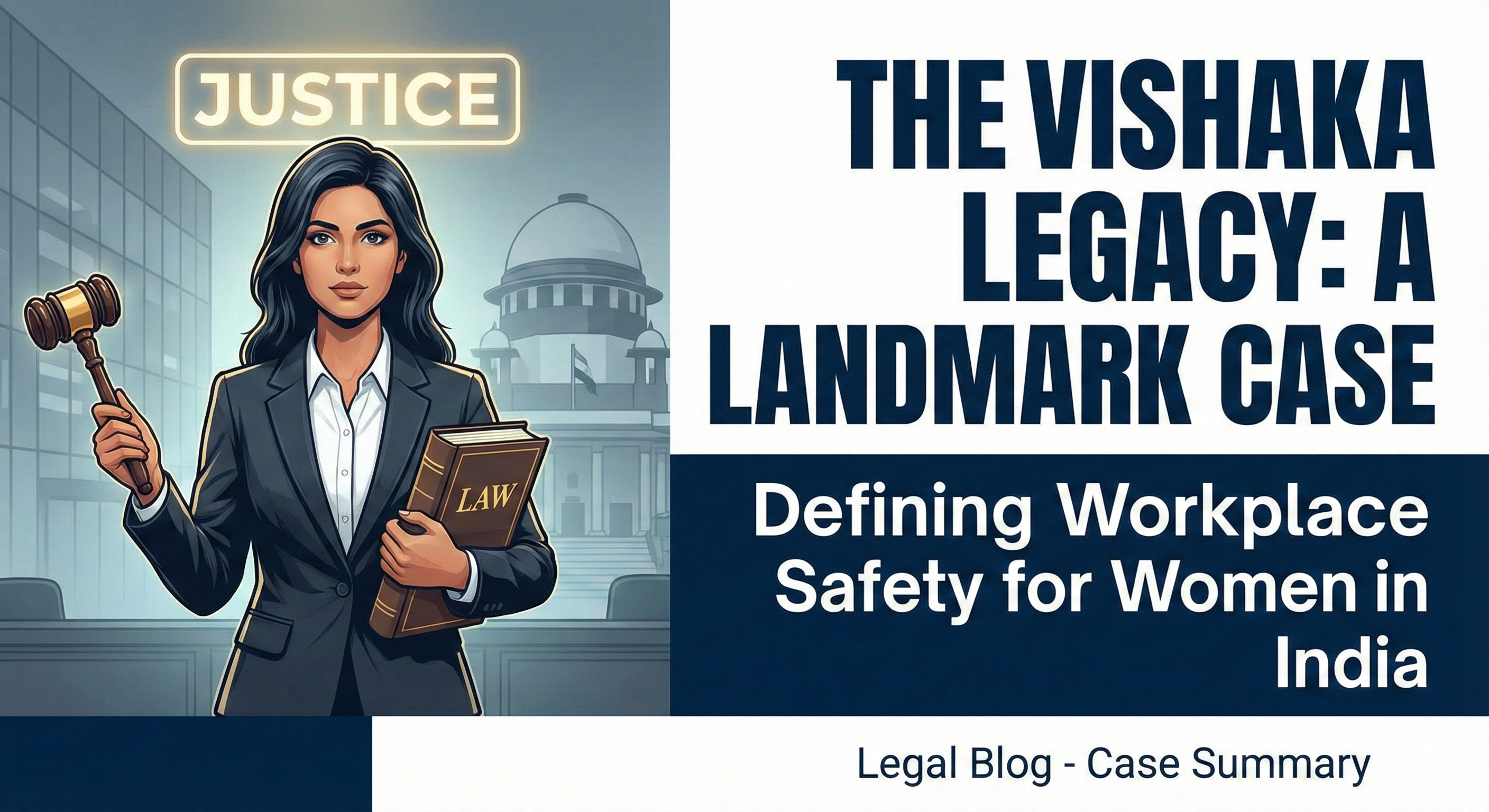
Case: Vishaka & Ors. vs. State of Rajasthan & Ors.
Citation: AIR 1997 SC 3011
Bench: J.S. Verma (CJI), Sujata V. Manohar, B.N. Kirpal
Today, the term “Internal Complaints Committee” (ICC) is a standard part of corporate and institutional life. But before 1997, India had no specific law to deal with sexual harassment at the workplace. The legal “void” was filled by the Supreme Court in this one landmark judgment, delivered by a bench headed by Justice J.S. Verma.
1. Facts of the Case
The case wasn’t filed by a single person but was a Public Interest Litigation (PIL) brought by a collective of NGOs and social activists under the banner ‘Vishaka’.
The trigger for this PIL was the horrific brutal gang-rape of Bhanwari Devi, a social worker (Saathin) in rural Rajasthan. As part of her job with the state-sponsored Women’s Development Programme, she actively campaigned against the practice of child marriage.
In 1992, as retaliation for her efforts to prevent a child marriage in an upper-caste family, she was assaulted and gang-raped.
What followed was systemic failure. The police were apathetic, her medical examination was delayed and botched, and the trial court ultimately acquitted the accused, citing a lack of evidence and implausible reasoning (such as upper-caste men being unlikely to rape a lower-caste woman).
This shocking injustice exposed the extreme vulnerability of working women and the complete absence of any legal mechanism to protect them or provide redressal. The PIL was filed to seek enforcement of the fundamental rights of working women.
2. Issues Before the Court
The Supreme Court had to answer two primary questions:
- Is sexual harassment at the workplace a violation of the fundamental rights guaranteed by the Constitution (specifically Articles 14, 15, 19, and 21)?
- In the complete absence of any domestic legislation to address this issue (a “legislative vacuum”), can the Supreme Court lay down binding guidelines to fill that void?
3. Arguments by the Parties
Petitioners (Vishaka & Ors.):
- Violation of Fundamental Rights: The petitioners argued that the act of sexual harassment is a gross violation of a woman’s fundamental right to equality (Article 14), right against discrimination (Article 15), and, most importantly, the right to life and personal liberty (Article 21), which includes the right to live with dignity.
- Right to Work: They contended that a “safe” working environment is a necessary component of the right to practice any profession or carry on any occupation (Article 19(1)(g)). A workplace where a woman is subject to harassment is not a safe environment and thus infringes this right.
- International Law: The petitioners pointed out that India was a signatory to international conventions like the Convention on the Elimination of All Forms of Discrimination Against Women (CEDAW). They argued that in the absence of a domestic law, the principles of these international conventions should be read into Indian law and used to define the state’s obligation.
Respondents (State of Rajasthan & Union of India):
- This case was unique in that the respondents (represented by the Solicitor General) did not strongly oppose the petition. They acknowledged the “legislative vacuum” and the severity of the problem.
- The government’s side largely assisted the Court in formulating a solution, agreeing that guidelines were necessary to tackle this societal aberration.
4. The Judgment: The Birth of the Vishaka Guidelines
The Supreme Court, in a powerful judgment authored by Chief Justice J.S. Verma, ruled decisively in favor of the petitioners.
On Violation of Rights:
The Court held that sexual harassment at the workplace is unequivocally a violation of:
- Article 14 (Equality): It is a form of gender-based discrimination.
- Article 19(1)(g) (Right to Profession): It creates a hostile, intimidating, or offensive work environment that prevents a woman from exercising her right to work.
- Article 21 (Right to Life): The right to life includes the right to live with dignity. Sexual harassment is a profound affront to a person’s dignity.
On Filling the “Void”:
This was the most “activist” part of the judgment. The Court stated that in the absence of a specific law, it was its constitutional duty to provide a solution. Citing India’s obligations under international law (like CEDAW), the Court laid down legally binding guidelines.
These became famously known as the “Vishaka Guidelines.”
Key provisions of the guidelines included:
- Definition: The Court provided the first legal definition of sexual harassment, including unwelcome sexually determined behavior, physical contact, demands for sexual favors, showing pornography, or any other unwelcome physical, verbal, or non-verbal conduct of a sexual nature.
- Employer’s Duty: It placed a clear duty on employers (in both public and private sectors) to prevent sexual harassment.
- Complaints Committee: It mandated the creation of an Internal Complaints Committee (ICC) in every organization.
- Committee Composition: The committee had to be headed by a woman, have at least 50% female members, and include a third-party member from an NGO to ensure fairness and prevent undue pressure.
- Awareness: Employers were obligated to actively spread awareness about what constitutes harassment and the mechanisms for redressal.
These guidelines were to be treated as binding law across India until Parliament enacted a formal statute. They remained the law of the land for 16 years, finally forming the basis for The Sexual Harassment of Women at Workplace (Prevention, Prohibition and Redressal) Act in 2013.
- Honor Killing After Independence
- Navtej Singh Johar v. Union of India : Landmark case that decriminalised Homosexuality in India
- Kerala High Court : Mandatory Injunction Claim Does Not Bar Arbitration

- AI-Hallucinated Case Citations: Landmark NCLAT Review in Pooja Ramesh Singh v. Jammu and Kashmir Bank
- Juvenile Justice (Care and Protection of Children) Act, 2015