
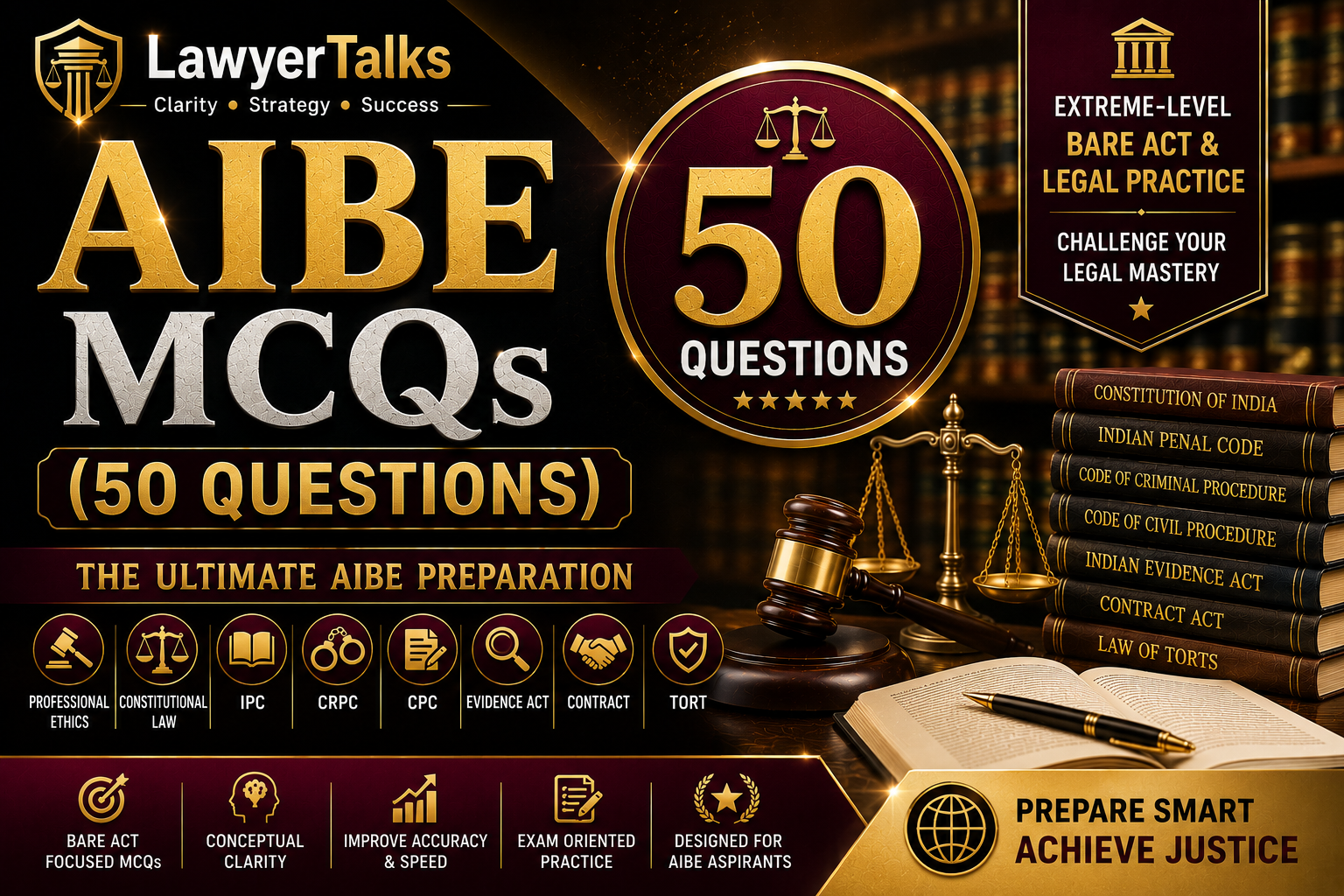
Master your AIBE preparation with this extreme-level set of 50 MCQs crafted for advanced legal understanding and Bare Act precision. Covering Professional Ethics, IPC, CrPC, CPC, Evidence, Constitution, Contract, Tort, and practical legal application, this set is designed to sharpen analytical ability and exam-oriented legal reasoning.
1. The Bar Council of India is constituted under:
A. Section 3 Advocates Act
B. Section 4 Advocates Act
C. Section 5 Advocates Act
D. Section 7 Advocates Act
Answer: B
2. True or False: Right to practice law is an absolute right under Advocates Act.
Answer: False
3. Professional misconduct proceedings against advocate are conducted by:
A. Supreme Court
B. State Government
C. Disciplinary Committee of Bar Council
D. District Judge
Answer: C
4. An advocate is prohibited from:
A. Accepting vakalatnama
B. Advertising professional services directly
C. Appearing before court
D. Giving legal opinion
Answer: B
5. Contingency fee agreement between advocate and client is:
A. Valid
B. Illegal
C. Enforceable conditionally
D. Mandatory
Answer: B
6. True or False: An advocate may appear in matter where he is likely to become witness.
Answer: False
7. Res judicata is governed under:
A. Section 9 CPC
B. Section 10 CPC
C. Section 11 CPC
D. Section 80 CPC
Answer: C
8. Res sub judice is contained under:
A. Section 9 CPC
B. Section 10 CPC
C. Section 11 CPC
D. Section 151 CPC
Answer: B
9. Caveat is filed under:
A. Section 144 CPC
B. Section 148A CPC
C. Section 151 CPC
D. Section 80 CPC
Answer: B
10. True or False: CPC is substantive law.
Answer: False
11. Review petition generally lies before:
A. Appellate court
B. Same court
C. Supreme Court only
D. Executive authority
Answer: B
12. Appeal is considered a:
A. Natural right
B. Fundamental right
C. Statutory right
D. Human right
Answer: C
13. FIR is registered under:
A. Section 154 CrPC
B. Section 156 CrPC
C. Section 161 CrPC
D. Section 173 CrPC
Answer: A
14. Anticipatory bail is granted under:
A. Section 436 CrPC
B. Section 437 CrPC
C. Section 438 CrPC
D. Section 439 CrPC
Answer: C
15. True or False: FIR is substantive evidence.
Answer: False
16. Cognizance of offence is taken under:
A. Section 154 CrPC
B. Section 156 CrPC
C. Section 190 CrPC
D. Section 200 CrPC
Answer: C
17. Police report under CrPC is filed under:
A. Section 161 CrPC
B. Section 164 CrPC
C. Section 173 CrPC
D. Section 190 CrPC
Answer: C
18. Double jeopardy protection is guaranteed under:
A. Article 19
B. Article 20(2)
C. Article 21
D. Article 22
Answer: B
19. True or False: Sessions Court ordinarily cannot directly take cognizance without committal.
Answer: True
20. Confession before police officer is generally:
A. Admissible
B. Inadmissible
C. Conclusive proof
D. Mandatory evidence
Answer: B
21. Section 27 Evidence Act partially validates:
A. Entire confession
B. Discovery portion of information
C. Police diary
D. Character evidence
Answer: B
22. Dying declaration is admissible under:
A. Section 24 Evidence Act
B. Section 32 Evidence Act
C. Section 45 Evidence Act
D. Section 65 Evidence Act
Answer: B
23. True or False: Hearsay evidence is generally inadmissible.
Answer: True
24. “Res gestae” is embodied under:
A. Section 5 Evidence Act
B. Section 6 Evidence Act
C. Section 24 Evidence Act
D. Section 32 Evidence Act
Answer: B
25. Expert opinion becomes relevant under:
A. Section 32 Evidence Act
B. Section 45 Evidence Act
C. Section 73 Evidence Act
D. Section 114 Evidence Act
Answer: B
26. Accomplice evidence is:
A. Inadmissible
B. Substantive evidence
C. Illegal evidence
D. Secondary evidence
Answer: B
27. True or False: Corroboration of accomplice evidence is rule of prudence.
Answer: True
28. Under IPC, “dishonestly” is defined under:
A. Section 23 IPC
B. Section 24 IPC
C. Section 25 IPC
D. Section 52 IPC
Answer: B
29. Theft is defined under:
A. Section 378 IPC
B. Section 390 IPC
C. Section 405 IPC
D. Section 415 IPC
Answer: A
30. “Mens rea” generally means:
A. Guilty act
B. Guilty intention
C. Wrongful restraint
D. Strict liability
Answer: B
31. True or False: Every culpable homicide amounts to murder.
Answer: False
32. Common intention is embodied under:
A. Section 34 IPC
B. Section 149 IPC
C. Section 120A IPC
D. Section 511 IPC
Answer: A
33. Criminal conspiracy is defined under:
A. Section 107 IPC
B. Section 120A IPC
C. Section 149 IPC
D. Section 503 IPC
Answer: B
34. Right of private defence causing death is available under:
A. Section 96 IPC
B. Section 97 IPC
C. Section 100 IPC
D. Section 101 IPC
Answer: C
35. True or False: Mistake of law is valid defence under IPC.
Answer: False
36. Consideration under Indian Contract Act may move from:
A. Promisee only
B. Promisor only
C. Third party
D. Court
Answer: C
37. Minor’s agreement is:
A. Voidable
B. Illegal
C. Void ab initio
D. Enforceable
Answer: C
38. “Consensus ad idem” means:
A. Compensation
B. Meeting of minds
C. Legal injury
D. Estoppel
Answer: B
39. Quantum meruit claim is based on:
A. Equity
B. Crime
C. Tort
D. Constitutional law
Answer: A
40. True or False: Every agreement is enforceable contract.
Answer: False
41. “Volenti non fit injuria” is defence in:
A. Contract
B. Tort
C. Evidence
D. Crime
Answer: B
42. Rylands v. Fletcher established doctrine of:
A. Negligence
B. Absolute liability
C. Strict liability
D. Constitutional tort
Answer: C
43. Absolute liability principle in India evolved through:
A. Kesavananda Bharati
B. MC Mehta
C. Golaknath
D. Maneka Gandhi
Answer: B
44. True or False: Negligence requires duty of care.
Answer: True
45. Article 14 guarantees:
A. Freedom of speech
B. Equality before law
C. Freedom of religion
D. Constitutional remedies
Answer: B
46. Doctrine of eclipse applies to:
A. Post-constitutional laws
B. Pre-constitutional laws violating Fundamental Rights
C. Emergency laws only
D. Tax laws only
Answer: B
47. True or False: Article 32 itself is a Fundamental Right.
Answer: True
48. “Audi alteram partem” means:
A. Hear the other side
B. No one should judge own cause
C. Equity follows law
D. Law is supreme
Answer: A
49. Standard of proof in criminal cases is:
A. Preponderance of probabilities
B. Beyond reasonable doubt
C. Suspicion
D. Prima facie proof
Answer: B
50. Standard of proof in civil cases is generally:
A. Beyond reasonable doubt
B. Mathematical certainty
C. Preponderance of probabilities
D. Absolute proof
Answer: C
– Team Lawyer Talks