
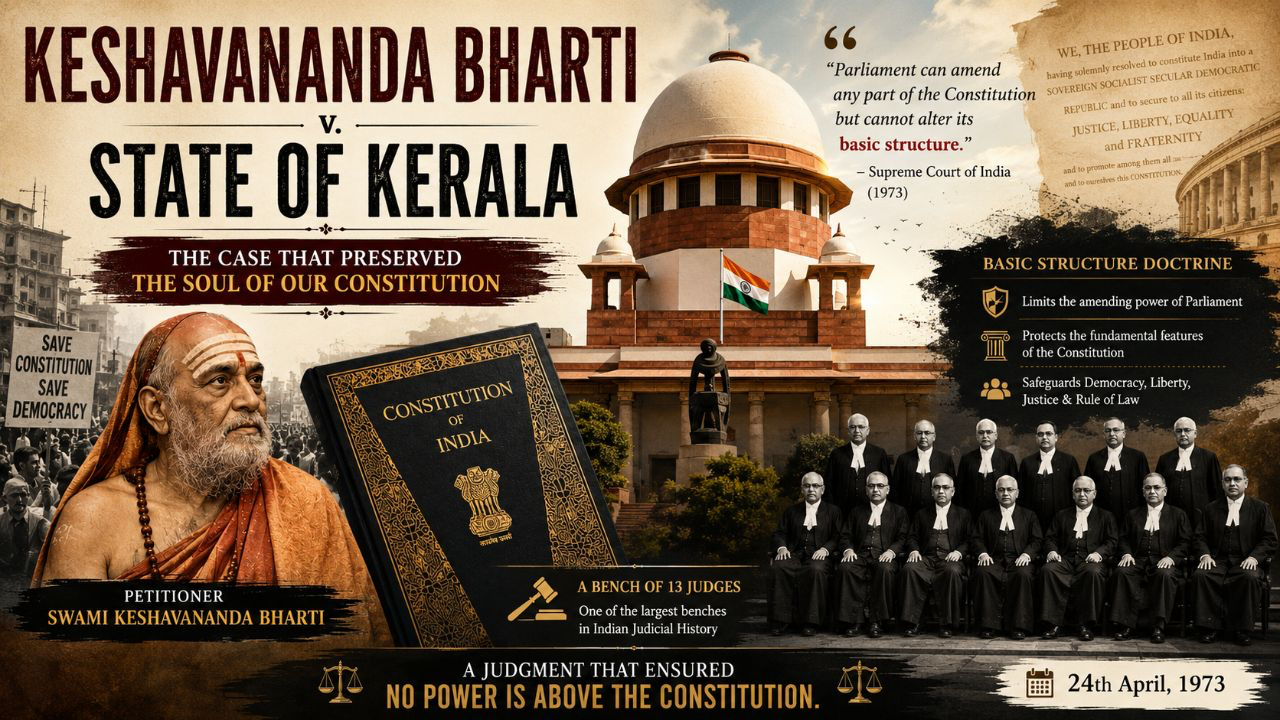
Keshavnanda Bharti Sripadagalvaru v. State of Kerala
CITATION: AIR 1973 SUPREME COURT 1961, 1973, 4 SSC 225
Case no:- Writ Petition (civil) 135 of 1970
PETITIONER: Keshavnanda Bharti Sripadagalvaru and Ors.
RESPONDENT: State of Kerala and Ors.
DATE OF JUDGEMENT: 24/04/1973
BENCH: Y.V. Chandrachud, A.N. Grover, S.M. Sikri, A.N. Ray, D.J. Palekar, H.R. Khanna, J.M Shelat, K.K. Mathew, K.S Hegde, M.H. Beg, P. Jaganmohan Reddy and S.N. Dwivedi.
Table of Contents
ToggleINTRODUCTION
Kesavananda Bharti v State of Kerala is a landmark case which established Doctrine of Basic Structure. It deals with amending power of parliament and protection of individual’s fundamental right and maintain a balance between both. To bypass the judgement of Golaknath v. State of Punjab, Parliament passed a series of amendments which were then challenged by Kesavananda Bharti.
BACKGROUND
Kesavananda Bharti was head of a religious sect named Edneer Mutt in Kasaragod district of Kerala. the State government of Kerala introduced LAND REFORMS AMENDMENT ACT, 1969 which authorizes state government to acquire any property of Kerala, resultant State government acquire some property of Edneer Mutt.
On 21st Kesavananda move to Supreme Court under Article 32 enforcing its right guaranteed under
- Violation of Article 26, Right to manage their religious affair,
- Violation of Article 25 Right to Practice and propogate their religion.
- Violation of Article 19(1)(f) Right to acquire property.
- Article 14, Right to Equality
- Article 31, Compulsory acquisition of property.
After landmark case Golaknath v State of Punjab, the parliament passed various amendments;
In 1971, 24th amendements
In 1972, 25th amendement and 29th amendement
24th Amendment: It restored Parliament power to amend fundamental right and inserted clause 4 in Article 13 stating that nothing in Article 13 shall apply to amendments made under Article 368 ensuring that amendments made y parliament cannot be said as violation of Fundamental Right. Kesavananda Bharti challenge the following amendments in Supreme Court:
Amendment made to Article 368: parliament empowered to make any amendments to constitution including Fundamental Right as well President has to give assent to amendment bill if it has passed through both of the houses.
25th Amendment: To ensure that state government don’t need to pay adequate compensation for the land acquired by state government according to market value, it replace the word “compensation” to “amount”.
Article 31 (c) inserted by amendment provided that any law made to implement Article 39(b) and Article 39(c), cannot bring in court for violation of Article 14, 19 and 31.
ISSUES
- Whether 24th constitutional (Amendment) is constitutionally valid or not ??
- Whether 25th constitutional (Amendment) is constitutionally valid or not?
- Whether 29th constitutional (Amendment) is constitutionally valid or not?
- What is the extent of Parliament amending power of constitution?
CONTENTION OF PETITIONER
It is contended by petitioner that Parliament cannot amend fundamental Right, it have limited power to amend the constitution. As propounder by Justice Mudhokar in Sajjan Singh v State of Rajasthan, constitution has basic structure which can’t be amended.
Petitioner plead for protection of Right to Property as mentioned in Article 19(1)(f) and constitutionality of 24, 25, 26 Amendment. Fundamental Right are provided to citizens of India constitution and if it amended by Parliament the core value of constitution will destroy.
CONTENTION OF RESPONDENT
Respondent was State, it states that supermacy of Parliament is basic of Indian legal system. To achieve socio-economic nation as mentioned in Preamble parliament should grant with power to amend constitution. Since, state has to managed equal distribution of property to whole citizens, Parliament should grant with unlimited power to amend constitution.
JUDGEMENT
In Keshavnanda Bharti Case 13 bench of judge adjudicate the matter and judgement provided on 24th of April. It was held by the bench with majority of 7:6 that Parliament has power to amend the constitution to fulfill its socio-economic obligation to an extent of not violating Basic Structure of Constitution. The majority decision delievered by S.M. Sikari, P. Jagmohan Reddy J.J. , Khanna J, B.K. Mukherjee, J.M Sheelat, A.N. Grover, K.S. Hedge and minority opinion given byK.K. Mathew, A.N. Ray, D.J. Palekar, S.N. Dviwedi, Y.V. Chandrachudji and M.H. Beg.
The 24th constitutional Amendment Act upheld entirely but part 1 and 2 of 25th Constitutional Amendment found ultra vires and intra vires. The Doctrine of Basic Structure laid down by bench in this case, the question that left unanswered in Golaknath v. State of Rajasthan finally answered in Keshavnanda Bharti v. State of Kerala, the extent of amending power of Parliament barred to protect the value and integrity of constitution.
CONCLUSION
Bench wanted to maintain the integrity of constitution as before Independence around 30 Amendment have already made and after independence 150 amendments have been done whereas in U.S. in 230 years only 27 amendments made. Even though after so many Amendments in Indian Constitution the integrity and spirit of Constitution still maintained. The Keshavnanda Bharti case protects the spirit of constitution through its judgement.