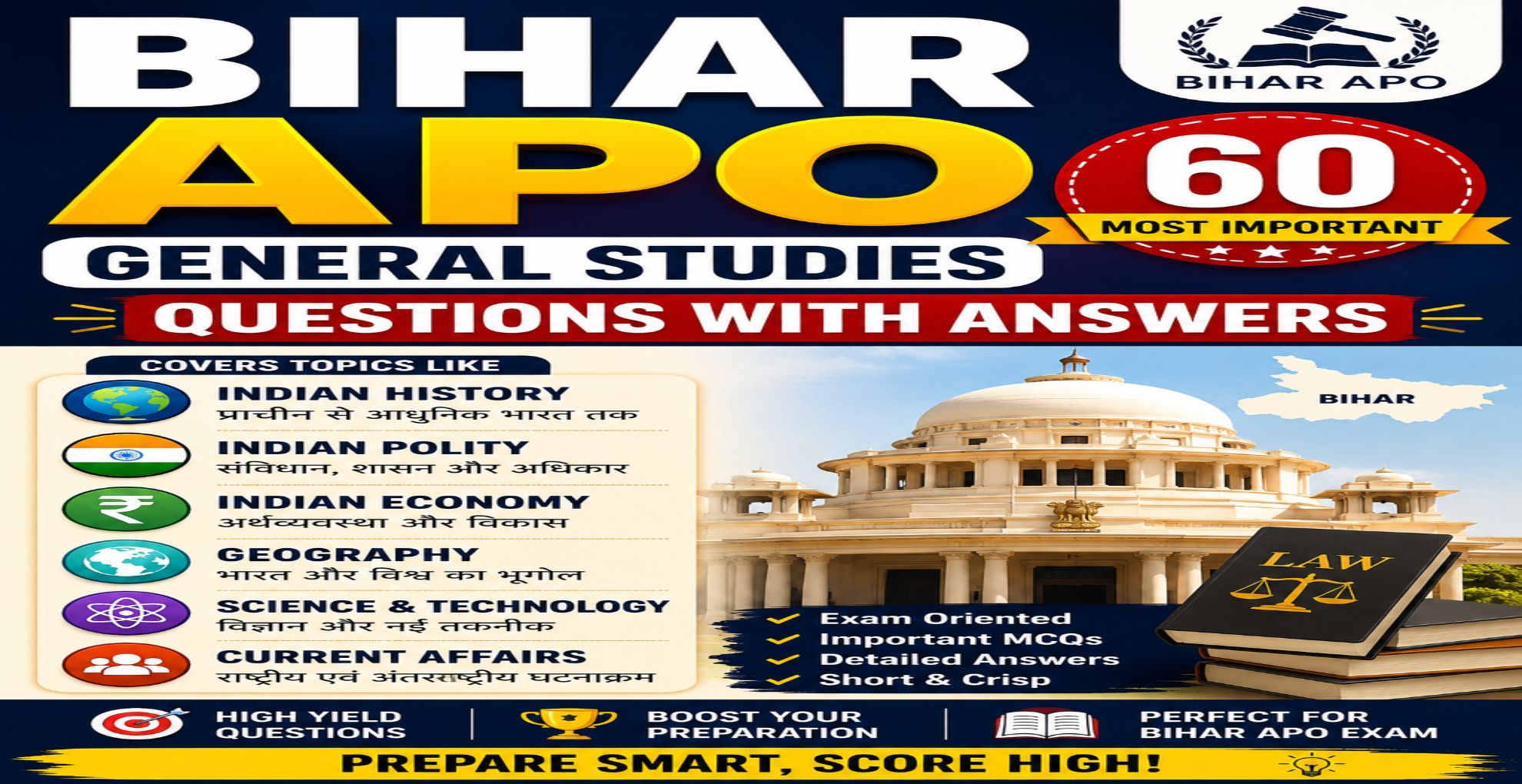
Prepare effectively with the 60 most important Bihar APO General Studies questions and answers covering Bihar GK, history, polity, geography, economy, and science.
Table of Contents
ToggleBihar APO 60 Most Important General Studies Questions with Answers
General Studies is one of the most important scoring areas in the Bihar APO examination. A smart preparation strategy should focus on Bihar-specific facts, Indian polity, history, geography, economy, and basic science. Bihar is especially important from the perspective of the Ganga river system, Nalanda, Bodh Gaya, Champaran, literacy statistics, and agriculture-based identity such as litchi and makhana production. Britannica Nalanda University UNESCO World Heritage Centre UNESCO World Heritage Centre MoSPI MoFPI
Bihar Special General Studies Questions
1. What is the capital of Bihar?
Patna.
2. Which river divides Bihar into two natural regions?
The Ganga River.
3. From which Sanskrit word is the name Bihar derived?
Vihara.
4. Which place in Bihar is associated with Buddha’s enlightenment?
Bodh Gaya.
5. Why is the Mahabodhi Temple Complex important?
It is the place where Gautama Buddha attained enlightenment.
6. Who founded ancient Nalanda University?
Emperor Kumaragupta I.
7. Which ancient university of Bihar was founded by Dharmapala?
Vikramshila University.
8. What was the ancient name of Patna?
Pataliputra.
9. Which river is called the Sorrow of Bihar?
Kosi.
10. Which famous festival of Bihar is dedicated to the Sun God?
Chhath Puja.
11. When was Bihar formed as a separate province?
22 March 1912.
12. Who from Bihar became the first President of India?
Dr. Rajendra Prasad.
13. In which year was Champaran Satyagraha launched?
1917.
14. How many agro-climatic zones are there in Bihar?
Three.
15. What were Bihar’s male and female literacy rates in Census 2011?
Male: 71.2%; Female: 51.5%.
Bihar is officially and historically significant as the land of ancient monastic learning, Buddhist heritage, and fertile Gangetic plains. References also highlight Bihar’s strong agriculture base, its role as India’s largest litchi producer, and its dominance in makhana production. Britannica MoSPI MoFPI
Indian History Questions
16. In which year was the Battle of Buxar fought?
1764.
17. Who founded the Maurya Empire?
Chandragupta Maurya.
18. Which ruler made Pataliputra a major imperial capital?
Ashoka.
19. Which event led to the Swadeshi Movement?
Partition of Bengal in 1905.
20. When was the Non-Cooperation Movement launched?
1920.
21. When was the Quit India Movement launched?
1942.
22. Who gave the slogan “Do or Die”?
Mahatma Gandhi.
23. What was the immediate cause of the Revolt of 1857?
Greased cartridges of the Enfield rifle.
24. In which year was the Permanent Settlement introduced?
1793.
25. Why was the Simon Commission opposed?
Because it had no Indian member.
Indian Polity Questions
26. What is the supreme law of India?
The Constitution of India.
27. When was the Constitution adopted?
26 November 1949.
28. When did the Constitution come into force?
26 January 1950.
29. Which Article guarantees equality before law?
Article 14.
30. Which Article protects life and personal liberty?
Article 21.
31. Which Article is called the Right to Constitutional Remedies?
Article 32.
32. Which courts can issue writs under Article 226?
High Courts.
33. Who appoints the Governor of a state?
The President of India.
34. In which House can a Money Bill be introduced?
Lok Sabha.
35. Who is the ex-officio Chairman of Rajya Sabha?
The Vice-President of India.
36. Who is the constitutional head of the Union?
The President.
37. Who is the real executive head of a state?
The Chief Minister.
38. In which part of the Constitution are Directive Principles mentioned?
Part IV.
39. In which part are Fundamental Duties mentioned?
Part IVA.
40. Which Schedule deals with anti-defection?
Tenth Schedule.
Geography and Environment Questions
41. Which river system is most important for Bihar?
The Ganga river system.
42. Name major rivers of North Bihar.
Kosi, Gandak, Bagmati, Ghaghara, and Mahananda.
43. Which soil is most common in Bihar plains?
Alluvial soil.
44. Which biosphere reserve is located in Bihar?
Valmiki Biosphere Reserve.
45. Which monsoon brings most rainfall to India?
Southwest Monsoon.
46. In which atmospheric layer is the ozone layer found?
Stratosphere.
47. Which delta is formed by the Ganga-Brahmaputra system?
Sundarbans Delta.
48. Does the Tropic of Cancer pass through Bihar?
No.
49. What is the highest peak in India?
Kangchenjunga.
50. Which disaster frequently affects North Bihar?
Floods.
Economy, Science, and Miscellaneous Questions
51. In which year was the RBI established?
1935.
52. Which body replaced the Planning Commission?
NITI Aayog.
53. What is a deficit budget?
A budget in which expenditure exceeds revenue.
54. Who is called the father of the Green Revolution in India?
Dr. M. S. Swaminathan.
55. In which cell organelle does photosynthesis occur?
Chloroplast.
56. Deficiency of which vitamin causes rickets?
Vitamin D.
57. What is the SI unit of electric current?
Ampere.
58. What is the full form of DNA?
Deoxyribonucleic Acid.
59. Which is the largest planet in the solar system?
Jupiter.
60. Where is the Satish Dhawan Space Centre located?
Sriharikota, Andhra Pradesh.
Final Note
For Bihar APO, your General Studies preparation should strongly focus on Bihar heritage, rivers, agriculture, literacy, polity basics, and modern Indian history. Bihar’s importance as the seat of ancient Nalanda, the location of Bodh Gaya, and a major agrarian state makes state-specific GS especially important. Nalanda University UNESCO World Heritage Centre UNESCO World Heritage Centre MoFPI
2. MCQ Practice Set with Options
Bihar APO GS MCQ Practice Set
1. What is the capital of Bihar?
A. Gaya
B. Patna
C. Bhagalpur
D. Muzaffarpur
Answer: B
2. Which river divides Bihar into two natural regions?
A. Yamuna
B. Son
C. Ganga
D. Damodar
Answer: C
3. The name Bihar is derived from which word?
A. Vihara
B. Bihari
C. Veda
D. Vidya
Answer: A
4. Bodh Gaya is associated with:
A. Birth of Mahavira
B. Enlightenment of Buddha
C. First Buddhist Council
D. Death of Ashoka
Answer: B
5. Ancient Nalanda University was founded by:
A. Harshavardhana
B. Chandragupta Maurya
C. Kumaragupta I
D. Kanishka
Answer: C
6. Vikramshila University was founded by:
A. Ashoka
B. Dharmapala
C. Samudragupta
D. Bimbisara
Answer: B
7. The ancient name of Patna was:
A. Vaishali
B. Rajgir
C. Pataliputra
D. Mithila
Answer: C
8. Which river is called the Sorrow of Bihar?
A. Gandak
B. Kosi
C. Son
D. Falgu
Answer: B
9. Chhath Puja is dedicated to:
A. Lord Shiva
B. Lord Vishnu
C. Sun God
D. Lord Ganesha
Answer: C
10. Bihar became a separate province in:
A. 1905
B. 1912
C. 1920
D. 1935
Answer: B
11. The first President of India from Bihar was:
A. Anugrah Narayan Sinha
B. Sri Krishna Sinha
C. Dr. Rajendra Prasad
D. Jayaprakash Narayan
Answer: C
12. Champaran Satyagraha was launched in:
A. 1915
B. 1916
C. 1917
D. 1919
Answer: C
13. Bihar has how many agro-climatic zones?
A. 2
B. 3
C. 4
D. 5
Answer: B
14. According to Census 2011, Bihar’s female literacy rate was:
A. 51.5%
B. 61.5%
C. 71.2%
D. 48.2%
Answer: A
15. The Battle of Buxar was fought in:
A. 1757
B. 1764
C. 1773
D. 1781
Answer: B
16. The founder of the Maurya Empire was:
A. Ashoka
B. Bimbisara
C. Chandragupta Maurya
D. Bindusara
Answer: C
17. Swadeshi Movement began after:
A. Jallianwala Bagh
B. Simon Commission
C. Partition of Bengal
D. Cripps Mission
Answer: C
18. Non-Cooperation Movement was launched in:
A. 1919
B. 1920
C. 1922
D. 1930
Answer: B
19. Quit India Movement was launched in:
A. 1939
B. 1940
C. 1942
D. 1945
Answer: C
20. “Do or Die” slogan was given by:
A. Subhas Chandra Bose
B. Jawaharlal Nehru
C. Sardar Patel
D. Mahatma Gandhi
Answer: D
21. The immediate cause of the Revolt of 1857 was:
A. Doctrine of Lapse
B. Heavy taxation
C. Greased cartridges
D. Ilbert Bill
Answer: C
22. Permanent Settlement was introduced in:
A. 1765
B. 1793
C. 1813
D. 1833
Answer: B
23. Simon Commission was opposed because:
A. It supported partition
B. It increased taxes
C. It had no Indian member
D. It abolished councils
Answer: C
24. The supreme law of India is:
A. Parliament
B. Supreme Court
C. Constitution
D. President’s Order
Answer: C
25. The Constitution of India was adopted on:
A. 15 August 1947
B. 26 November 1949
C. 26 January 1950
D. 2 October 1950
Answer: B
26. The Constitution came into force on:
A. 26 January 1950
B. 26 November 1949
C. 15 August 1947
D. 1 January 1950
Answer: A
27. Article 14 deals with:
A. Freedom of speech
B. Equality before law
C. Protection from arrest
D. Education
Answer: B
28. Article 21 deals with:
A. Religious freedom
B. Cultural rights
C. Life and personal liberty
D. Minority rights
Answer: C
29. Article 32 is known as:
A. Right to Equality
B. Right to Freedom
C. Right to Constitutional Remedies
D. Right to Education
Answer: C
30. Writ jurisdiction under Article 226 belongs to:
A. Lok Sabha
B. High Courts
C. Rajya Sabha
D. Finance Commission
Answer: B
31. The Governor is appointed by:
A. Prime Minister
B. Chief Minister
C. President
D. Parliament
Answer: C
32. Money Bill can be introduced only in:
A. Rajya Sabha
B. Supreme Court
C. Lok Sabha
D. State Assembly
Answer: C
33. Ex-officio Chairman of Rajya Sabha is the:
A. President
B. Prime Minister
C. Speaker
D. Vice-President
Answer: D
34. The real executive head of a state is:
A. Governor
B. Chief Minister
C. Chief Secretary
D. Advocate General
Answer: B
35. Directive Principles are in:
A. Part III
B. Part IV
C. Part IVA
D. Part V
Answer: B
36. Fundamental Duties are in:
A. Part II
B. Part III
C. Part IVA
D. Part VI
Answer: C
37. Anti-defection provisions are in:
A. Seventh Schedule
B. Eighth Schedule
C. Ninth Schedule
D. Tenth Schedule
Answer: D
38. Bihar’s most important river system is:
A. Narmada
B. Godavari
C. Ganga
D. Tapi
Answer: C
39. Which of the following is a major river of North Bihar?
A. Kosi
B. Cauvery
C. Krishna
D. Sabarmati
Answer: A
40. The most common soil in Bihar plains is:
A. Black soil
B. Red soil
C. Alluvial soil
D. Laterite soil
Answer: C
41. The biosphere reserve located in Bihar is:
A. Simlipal
B. Valmiki
C. Nilgiri
D. Sundarbans
Answer: B
42. Most rainfall in India is brought by:
A. Northeast monsoon
B. Local winds
C. Southwest monsoon
D. Western disturbances
Answer: C
43. The ozone layer is found in the:
A. Troposphere
B. Stratosphere
C. Mesosphere
D. Thermosphere
Answer: B
44. Ganga-Brahmaputra forms the:
A. Kutch Delta
B. Krishna Delta
C. Sundarbans Delta
D. Mahanadi Delta
Answer: C
45. Tropic of Cancer passes through Bihar:
A. Yes
B. No
Answer: B
46. The highest peak in India is:
A. Nanda Devi
B. Kangchenjunga
C. K2
D. Anamudi
Answer: B
47. North Bihar is frequently affected by:
A. Cyclones
B. Floods
C. Tsunami
D. Volcanoes
Answer: B
48. RBI was established in:
A. 1935
B. 1947
C. 1950
D. 1969
Answer: A
49. Planning Commission was replaced by:
A. UPSC
B. Finance Commission
C. NITI Aayog
D. Election Commission
Answer: C
50. A deficit budget means:
A. Income exceeds expenditure
B. Expenditure exceeds revenue
C. Imports exceed exports only
D. Savings exceed investment
Answer: B
51. Father of Green Revolution in India is:
A. Verghese Kurien
B. M. S. Swaminathan
C. Homi Bhabha
D. Vikram Sarabhai
Answer: B
52. Photosynthesis takes place in:
A. Nucleus
B. Mitochondria
C. Chloroplast
D. Ribosome
Answer: C
53. Rickets is caused by deficiency of:
A. Vitamin A
B. Vitamin B12
C. Vitamin C
D. Vitamin D
Answer: D
54. SI unit of electric current is:
A. Volt
B. Ohm
C. Ampere
D. Watt
Answer: C
55. Full form of DNA is:
A. Deoxyribonucleic Acid
B. Dioxyribose Nucleic Acid
C. Dynamic Nuclear Acid
D. Double Nucleic Atom
Answer: A
56. Largest planet in the solar system is:
A. Earth
B. Mars
C. Jupiter
D. Saturn
Answer: C
57. Satish Dhawan Space Centre is located at:
A. Bengaluru
B. Sriharikota
C. Hyderabad
D. Thiruvananthapuram
Answer: B
58. Bihar is the largest producer in India of:
A. Tea
B. Litchi
C. Coffee
D. Rubber
Answer: B
59. Bihar accounts for more than 85% of India’s production of:
A. Cotton
B. Jute
C. Makhana
D. Tea
Answer: C
60. The Mahabodhi Temple Complex is located in:
A. Rajgir
B. Nalanda
C. Bodh Gaya
D. Vaishali
Answer: C