
Table of Contents
ToggleIntroduction
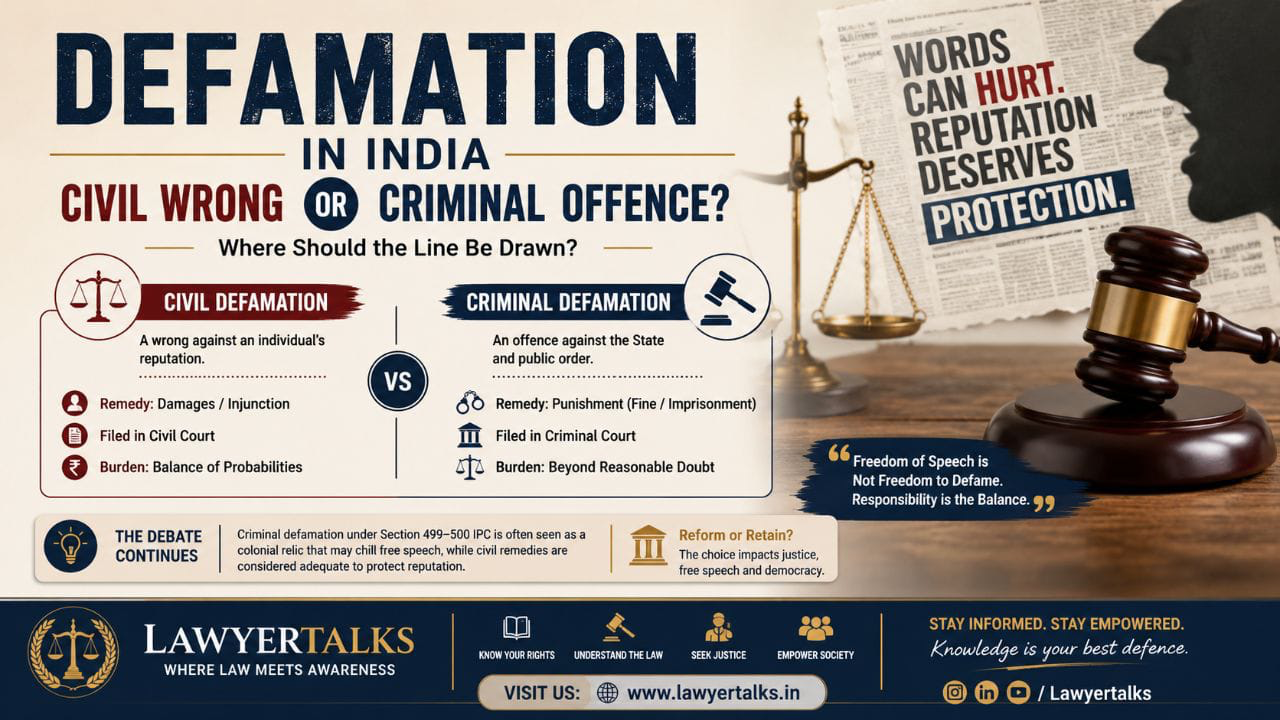
The law of defamation has a special place in the Indian legal system. It deals with protecting a person’s reputation while also making sure people can speak freely, as guaranteed by the Constitution. Unlike some other countries, India considers defamation both as civil issue and a criminal one. If someone feels their reputation has been harmed, they can sue for damages in a civil case. At the same time, they can also report the case to the police, which could result in fines or jail time. The two- side approach raises an important question: Is criminal defamation is necessary, or is it enough to rely on civil options for protecting reputation?
In today’s world, with social media, online news, and AI changing how information spreads, the issue has become even more important. While reputation damage can spread quickly across too much. This Article looks at whether India’s current system of handling defamation still makes sense or if it needs to be changed.
The Dual Nature of Defamation Law in India
In India, defamation has two separate parts:-
The Civil side deals with private cases where people can seek compensation for harm to their repuation. courts often award money, stop further harm or ask the person who made the false statement to aplogize. The goal is to help the victim and stop further damage.
The Criminal part, on the other hand, is covered under the Bhartiya Nyaya Sanhita, 2023. It involves punishment like jail time or fines if someone makes false statement that harm another person’s reputation. This law allows for criminal consequences, reflecting the idea protecting reputation is not just a personal matter but also a way to keep society running smoothly.
The dual sysytem is different from some other democratic countries that either don’t have criminal defamation laws or have made them much weaker.
Constitutional Balance Between Reputation and Free Speech
The Indian Constitution protects Free Speech and Right to a Good Reputation. Article 19(1)(a) says people have the right to express themselves freely, but Article 19(2) allows reasonable limits, including on defamation. Additional, the Supreme Court has said that the right to Good Reputation is part of the Right to Life and Personal Freedom under Article 21.
The balance means that courts have the weigh the need to protect free speech against the need to protect personal dignity. However, some experts say that using criminal punishment for defamation can be too harsh on free speech. It can make people afraid to criticize, report the truth, or speak up about important social issue.
In the case Subramanian Swamy v. Union of Indian (2026), the Supreme Court ruled that criminal defamation, saying that reputation is important for personal liberty. However, critics say the ruling didn’t fully address how criminal penalties can discourage people from speaking in a democracy.
Is Dual Liability Still Justified?
People who support criminal defamation say that civil cases aren’t enough. They argue that money compensation might not help if the person who harmed the reputation doesn’t have much money, or if they want to damage someone socially. Criminal punishment, they say can serve as a strong warning against intentional harm. But this argument is being questioned more and more.
Criminal defamation cases are ofteh started by powerful people like politicians, big companies, or influential groups against journalist, academics, activists and media. These cases are sometimes called Strategic Lawsuits Against Public Participation (SLAPPs), where the goal isn’t to get a conviction but to stop people from speaking up in the future. Even if someone is found guilty, the process can be punishing. Going through court, dealing with legal costs, and facing negative public reactions can all have a big effect on free speech.
Comparative International Perspective
Around the world, there is a growing trend to rely more on civil ways to handle defamation. In the United Kingdom, the law of criminal libel was removed in 2009. In the United States, the New York Times Co. v. Sullivan case set a high standard for criticizing public officials, making it harder to use criminal penalities against honest criticism.
International Human Rights Groups, like the United Nations, also suggest that jail time for defamation while keeping freedom of Speech safe. Even though legal system is different, theses trends show a global shift toward treating defamation as a private issue rather than a criminal one.
Defamation in the Digital Era
The rise of technology has made defamation easier and faster. Social media lets false claims and altered images spread widely in seconds. AI can create fale videos, and online accounts can be anonymous. This makes it hard for traditional legal methods to keep up. Through these criminal punishments is the answer. India needs new tools like fast civil courts, rules for online platform to remove harmful content quickly, and ways to deal with fake news. These solutions can help without hurting free Speech.
Conclusion
India’s current system of treating defamation as both civil and criminal issue reflects a long-standing effort to balance free speech and need to protect reputation. While making sure people’s dignity is protected is important, it’s also time to rethink whether criminal laws are necessary.