
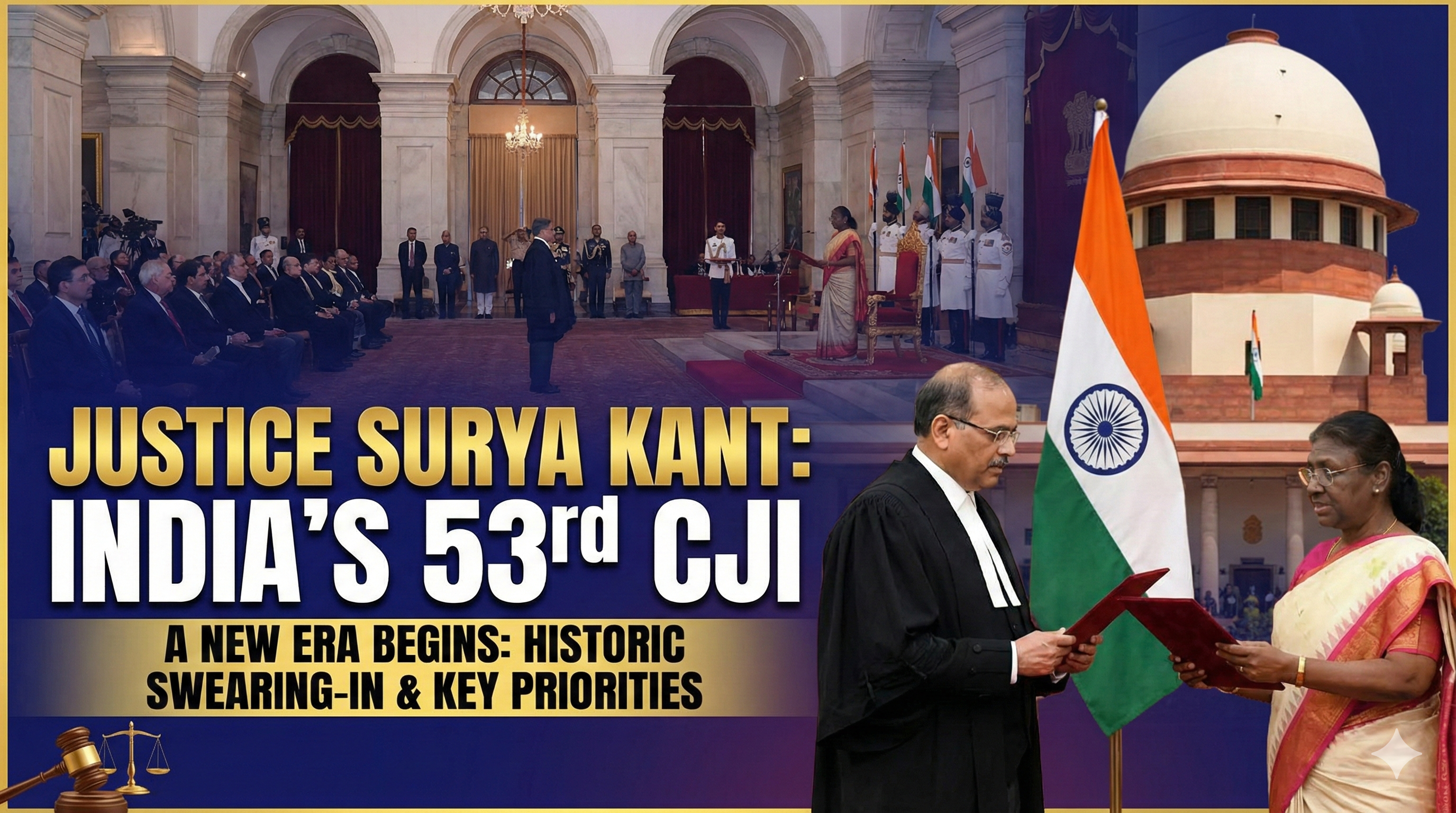
In a historic ceremony held today at the Rashtrapati Bhavan, Justice Surya Kant was sworn in as the 53rd Chief Justice of India (CJI). Administered by President Droupadi Murmu, the oath-taking ceremony marked the beginning of a significant tenure that is expected to bring stability and long-term reforms to the apex court.
If you have been following the rapid leadership changes in the Supreme Court over the last year, today’s appointment is particularly noteworthy. Unlike his immediate predecessors who had shorter stints, CJI Surya Kant is set to lead the judiciary for nearly 15 months, providing a crucial window for institutional consistency.
Here is everything you need to know about the new Chief Justice, his journey, and what to expect from his tenure.
1. The Swearing-In: A Historic First
The ceremony today was distinct for a special reason. For the first time in the history of the Indian judiciary, the swearing-in of a Chief Justice was attended by a high-level delegation of foreign judges and Chief Justices.
- Dignitaries Present: Chief Justices and judges from Sri Lanka, Bhutan, Mauritius, Nepal, Kenya, and Malaysia were in attendance.
- Domestic Leaders: The event was graced by Vice President C.P. Radhakrishnan, Prime Minister Narendra Modi, and other senior cabinet ministers.
- Oath: Justice Kant took the oath in Hindi, invoking the name of God, and sought blessings from his elders immediately after—a gesture that highlighted his humble roots.
2. The Succession Timeline: Clearing the Confusion
For law students and legal observers, the timeline of CJIs in 2024–2025 has been fast-moving. Here is the quick succession context:
- Justice D.Y. Chandrachud (50th CJI): Retired Nov 10, 2024.
- Justice Sanjiv Khanna (51st CJI): Served from Nov 11, 2024, to May 13, 2025.
- Justice B.R. Gavai (52nd CJI): Served a brief 6-month tenure from May 14, 2025, to Nov 23, 2025.
- **Justice Surya Kant (53rd CJI): Assumed office today, Nov 24, 2025, and will serve until Feb 9, 2027.
3. From Hisar to the Supreme Court: A Profile
CJI Surya Kant’s journey is an inspiration for first-generation lawyers.
- Roots: Born in Hisar, Haryana (1962), to a middle-class family.
- Early Career: He did not start in the elite corridors of Delhi. He began his practice at the District Court, Hisar in 1984, before moving to the Punjab and Haryana High Court.
- Rise to Prominence: He became the youngest Advocate General of Haryana in 2000.
- Judicial Career: Elevated to the Supreme Court in May 2019, after serving as the Chief Justice of the Himachal Pradesh High Court.
4. Key Judgments & Judicial Philosophy
Justice Kant is known for a pragmatic approach to law. Some of his most significant contributions include:
- Abrogation of Article 370: He was part of the 5-judge Constitution Bench that upheld the Centre’s decision to abrogate Article 370.
- Pegasus Spyware Case: He was part of the bench that ordered an independent probe into the alleged use of Pegasus spyware, emphasizing that “national security cannot be the bugbear” to deny judicial review.
- Sedition Law: He was on the bench that effectively put the colonial-era Sedition law (Sec 124A IPC) on hold, directing no new FIRs be filed under it.
- Governor’s Powers: In a crucial federalism verdict, he ruled that Governors cannot sit on Bills passed by State Assemblies indefinitely.
5. The Road Ahead: Priorities for 2025-2027
In his interactions with the media just before taking the oath, CJI Surya Kant outlined two massive “game-changer” goals:
- Tackling the Backlog: With over 5 crore cases pending across Indian courts, he has flagged this as his primary challenge.
- Promoting Mediation: He is a strong proponent of mediation as an alternative dispute resolution mechanism to declog the courts.
Why This Matters for You
For legal aspirants and citizens alike, CJI Surya Kant’s tenure is significant because it offers stability. After two short-term Chief Justices, a 15-month tenure allows for the implementation of administrative reforms that take time to bear fruit, such as listing reforms and filling judicial vacancies.
Final Thought:
As Justice Surya Kant takes the helm, the Indian judiciary looks toward a period of consolidation. His journey from a district court lawyer to the highest judicial office serves as a powerful reminder that merit and perseverance remain the bedrock of the legal profession.
- Top 25 Bihar Judiciary Previous Year Questions (MCQs) – PRELIMS PRACTICE SET
- Case Comment: INTERNET FREEDOM FOUNDATION v. UNION OF INDIA AND ORS. (AADHAAR CASE)

- When Foreign Divorce Meets Indian Law: Supreme Court Resolves an 18-Year Marital Dispute

- One Nation, One Election – Reform or Risk for Indian Democracy?
- Breach of Contract and Legal Remedies