
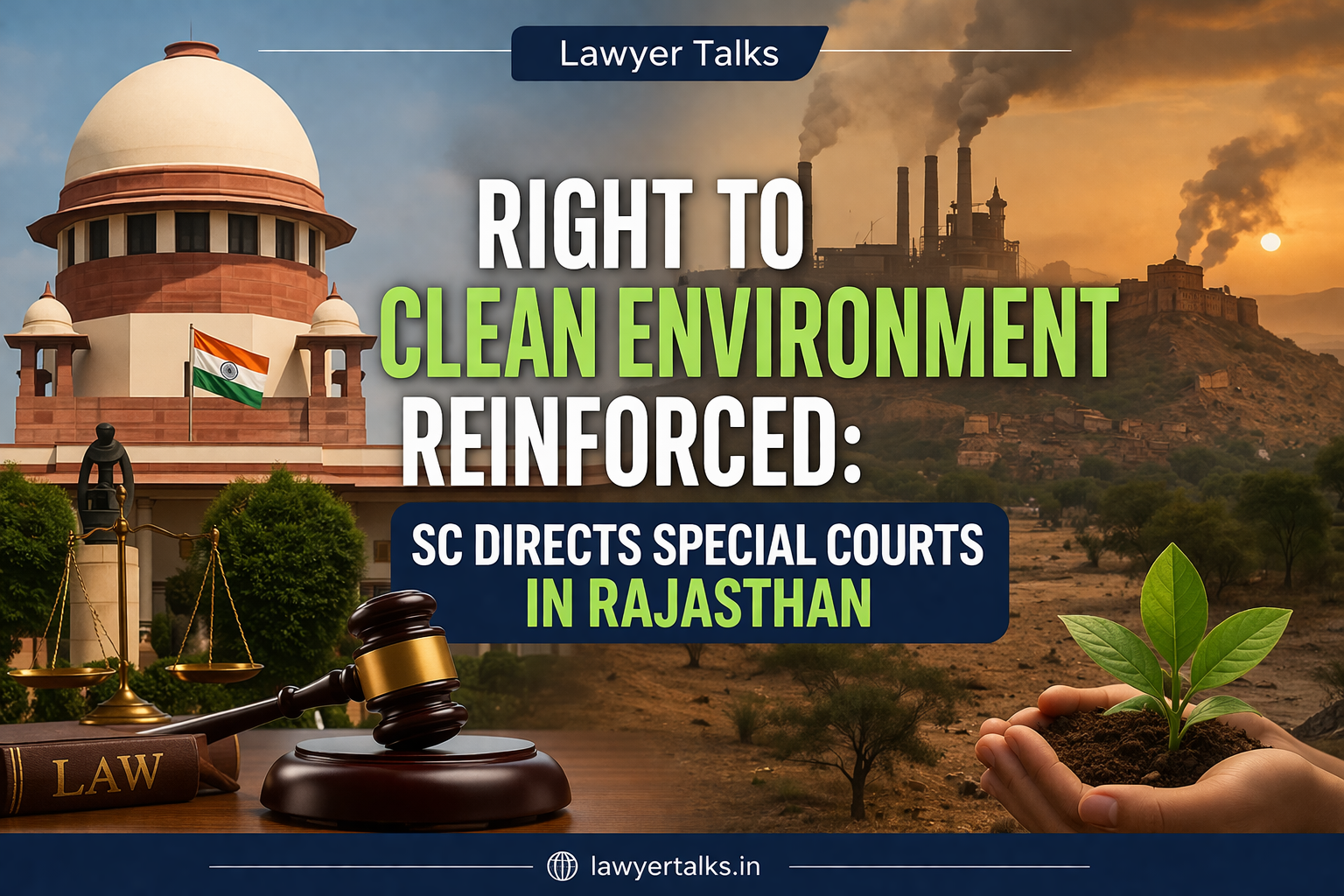
In a major 2026 action the Supreme Court has once again affirmed the right to a clean environment. Aware of the increasing environmental issues in Rajasthan, the Court has ordered the creation of special environmental courts to provide quicker and more efficient way of solving environmental disputes.
Background of the Issue
Rajasthan is a culturally rich and expansive state, which is experiencing a growing environmental stress over the years. Issues such as:
- Industrial pollution
- Illegal mining
- Water scarcity
- Air quality deterioration
have contributed to the increase in environmental litigation.
Nevertheless, adjudication delays tend to undermine enforcement and diminish the effectiveness of the remedies of law.
Supreme Court’s Intervention
Considering these issues, the Supreme Court pointed out that environmental protection is not only a policy issue but a basic right as stated in Article 21 of the Constitution that provides the right to life.
The Court directed:
- Setting up of dedicated environmental courts in Rajasthan
- Hiring of special judges and professionals
- Guaranteeing disposal of environmental cases in time
This will be done to enhance the institutional mechanism in order to handle complex environmental issues effectively.
Reason behind Special environmental courts
Cases in the environment usually entail scientific data, technical reports, and ecological considerations in the long term. Such complexities can present a challenge to regular courts which have their own caseload.
- Special courts will:
- Provide expert-driven adjudication
- Reduce case backlog
- Enhance the implementation of environmental laws
- Provide faster response to the communities that are affected
Legal Significance
The ruling is based on the history of the Supreme Court to hold the view that a clean and healthy environment is part of the right to life. Judgments made in the past have already identified:
- Right to pollution-free air and water
- Sustainable development principles
- Precautionary and polluter pays principles
Through the commissioning of specialized courts, the judiciary is shifting towards the recognition of rights as it is being implemented effectively.
Impact on Rajasthan and Beyond
Environmental courts should be introduced in Rajasthan that may be used as the template of other states with the same problems. It portends a transition to:
- Stronger environmental governance
- Increased responsibility of industries and powers
- Increased access to environmental justice
To citizens, this implies that the basic rights of the citizens are better safeguarded and the judicial system is more responsive.
Conclusion
The course of action by the Supreme Court is a significant move towards closing the divide between the provisions of environmental rights and their application. The judiciary has reiterated the fact that the right to clean environment is not an aspiration but a binding right through the institution of specialized courts.
This is a progressive trend whereby legal systems change in order to satisfy new environmental demands whereby justice is not postponed in the name of safeguarding the environment and human life.
– Team Lawyer Talks