
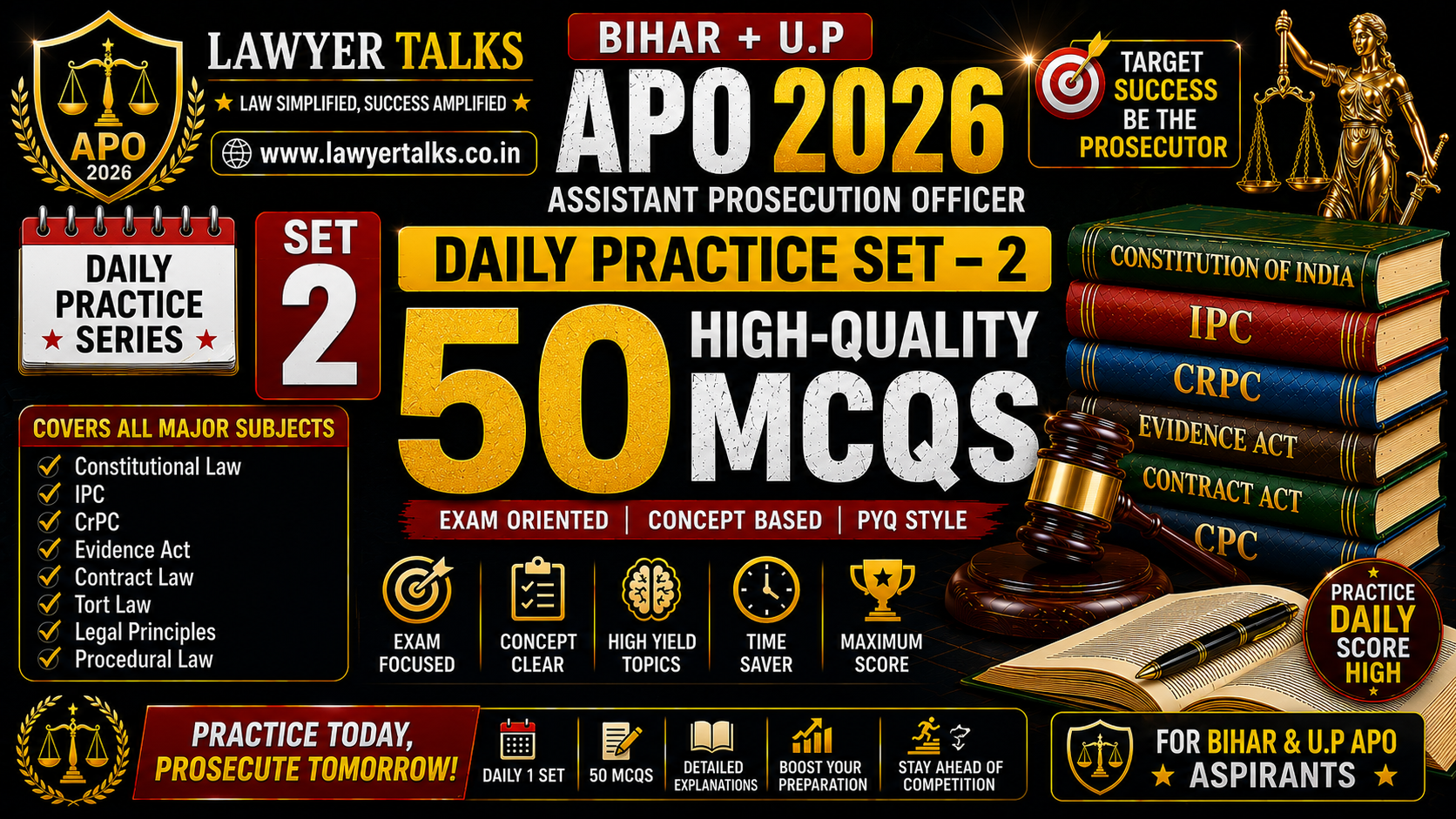
This is APO Daily Set-2 designed for Bihar & U.P Assistant Prosecution Officer exam. Covers IPC, CrPC, Evidence Act, Constitution and procedural law with PYQ-based, conceptual and assertion-style MCQs for strong revision.
1. Which Article empowers Supreme Court to issue writs?
A. 32
B. 226
C. 136
D. 142
2. True/False: Article 21 includes right to livelihood.
A. True
B. False
3. Cognizable offences allow:
A. Arrest without warrant
B. Only FIR
C. Only bail
D. Civil suit
4. FIR is filed under:
A. Section 154 CrPC
B. Section 161 CrPC
C. Section 173 CrPC
D. Section 200 CrPC
5. Section 302 IPC deals with:
A. Murder
B. Theft
C. Cheating
D. Assault
6. Section 34 IPC relates to:
A. Common intention
B. Common object
C. Negligence
D. Attempt
7. True/False: Preparation is always punishable.
A. True
B. False
8. Criminal conspiracy is defined under:
A. Section 120A IPC
B. Section 34 IPC
C. Section 149 IPC
D. Section 378 IPC
9. Section 120B IPC deals with:
A. Punishment for conspiracy
B. Murder
C. Theft
D. Fraud
10. Dying declaration is admissible under:
A. Section 32 Evidence Act
B. Section 45
C. Section 60
D. Section 154
11. Burden of proof generally lies on:
A. Prosecution
B. Accused
C. Judge
D. Police
12. Confession to police is:
A. Not admissible
B. Admissible
C. Mandatory
D. Binding
13. Primary evidence means:
A. Original document
B. Copy
C. Oral statement
D. Secondary witness
14. Section 161 CrPC deals with:
A. Examination of witnesses
B. FIR
C. Trial
D. Appeal
15. Section 313 CrPC is for:
A. Examination of accused
B. FIR
C. Bail
D. Charge sheet
16. Bail in bailable offence is:
A. Right
B. Discretion
C. Punishment
D. Appeal
17. Habeas Corpus means:
A. Produce body
B. Command authority
C. Appeal
D. Quash order
18. Mandamus is issued to:
A. Public authority
B. Private person always
C. Court only
D. Police only
19. True/False: Article 14 allows reasonable classification.
A. True
B. False
20. Article 19 deals with:
A. Freedom rights
B. Criminal law
C. Arrest
D. Trial
21. Mens rea means:
A. Guilty mind
B. Physical act
C. Punishment
D. Judgment
22. Actus reus means:
A. Physical act
B. Intent
C. Motive
D. Crime result
23. Theft requires:
A. Dishonest intention
B. Consent
C. Violence
D. Contract
24. Robbery is aggr
avated form of:
A. Theft
B. Cheating
C. Fraud
D. Assault
25. Cheating is defined under:
A. Section 415 IPC
B. Section 302 IPC
C. Section 34 IPC
D. Section 120B IPC
26. Res judicata means:
A. Matter already decided
B. Fresh trial
C. Appeal
D. Review
27. CPC deals with:
A. Civil procedure
B. Criminal procedure
C. Evidence
D. Constitution
28. Injunction is:
A. Preventive relief
B. Punishment
C. Arrest order
D. Appeal
29. True/False: Every decree is appealable.
A. True
B. False
30. Evidence Act was enacted in:
A. 1872
B. 1860
C. 1908
D. 1950
31. Admission is:
A. Relevant evidence
B. Irrelevant
C. Always binding
D. Illegal
32. Confession means:
A. Admission of guilt
B. Witness statement
C. FIR
D. Judgment
33. Cross-examination is done by:
A. Opposite party
B. Judge
C. Police
D. Accused
34. Examination-in-chief is by:
A. Party calling witness
B. Opposite party
C. Judge
D. Police
35. True/False: All statements are evidence.
A. True
B. False
36. Company is:
A. Separate legal entity
B. Natural person
C. Minor
D. State
37. Consideration may move from:
A. Third party
B. Only promisor
C. Only promisee
D. Court
38. Free consent excludes:
A. Coercion
B. Offer
C. Acceptance
D. Agreement
39. Agreement without consideration is:
A. Void
B. Valid
C. Binding
D. Enforceable
40. Tort law deals with:
A. Civil wrongs
B. Crimes
C. Constitution
D. Contract only
41. Defamation protects:
A. Reputation
B. Property
C. Contract
D. Arrest
42. Strict liability case:
A. Rylands v Fletcher
B. Donoghue v Stevenson
C. Carlill v Carbolic
D. Salomon case
43. ADR stands for:
A. Alternative Dispute Resolution
B. Automatic Dispute Rule
C. Appeal Dispute Rule
D. All legal rights
44. Arbitration is based on:
A. Agreement
B. Court order only
C. Police action
D. FIR
45. Lok Adalat award is:
A. Binding
B. Optional
C. Appealable
D. Invalid
46. Doctrine of precedent is based on:
A. Stare decisis
B. Res judicata
C. Mens rea
D. Ratio
47. Ratio decidendi means:
A. Reason for decision
B. Obiter dicta
C. Appeal
D. Statute
48. Obiter dicta are:
A. Incidental remarks
B. Binding rule
C. Law
D. Statute
49. Fundamental Rights are in:
A. Part III
B. Part IV
C. Part II
D. Part I
50. DPSP are in:
A. Part IV
B. Part III
C. Part II
D. Part I
📌 ANSWER KEY
1-A, 2-A, 3-A, 4-A, 5-A, 6-A, 7-B, 8-A, 9-A, 10-A
11-A, 12-A, 13-A, 14-A, 15-A, 16-A, 17-A, 18-A, 19-A, 20-A
21-A, 22-A, 23-A, 24-A, 25-A, 26-A, 27-A, 28-A, 29-B, 30-A
31-A, 32-A, 33-A, 34-A, 35-B, 36-A, 37-A, 38-A, 39-A, 40-A
41-A, 42-A, 43-A, 44-A, 45-A, 46-A, 47-A, 48-A, 49-A, 50-A
– Team Lawyer Talks