
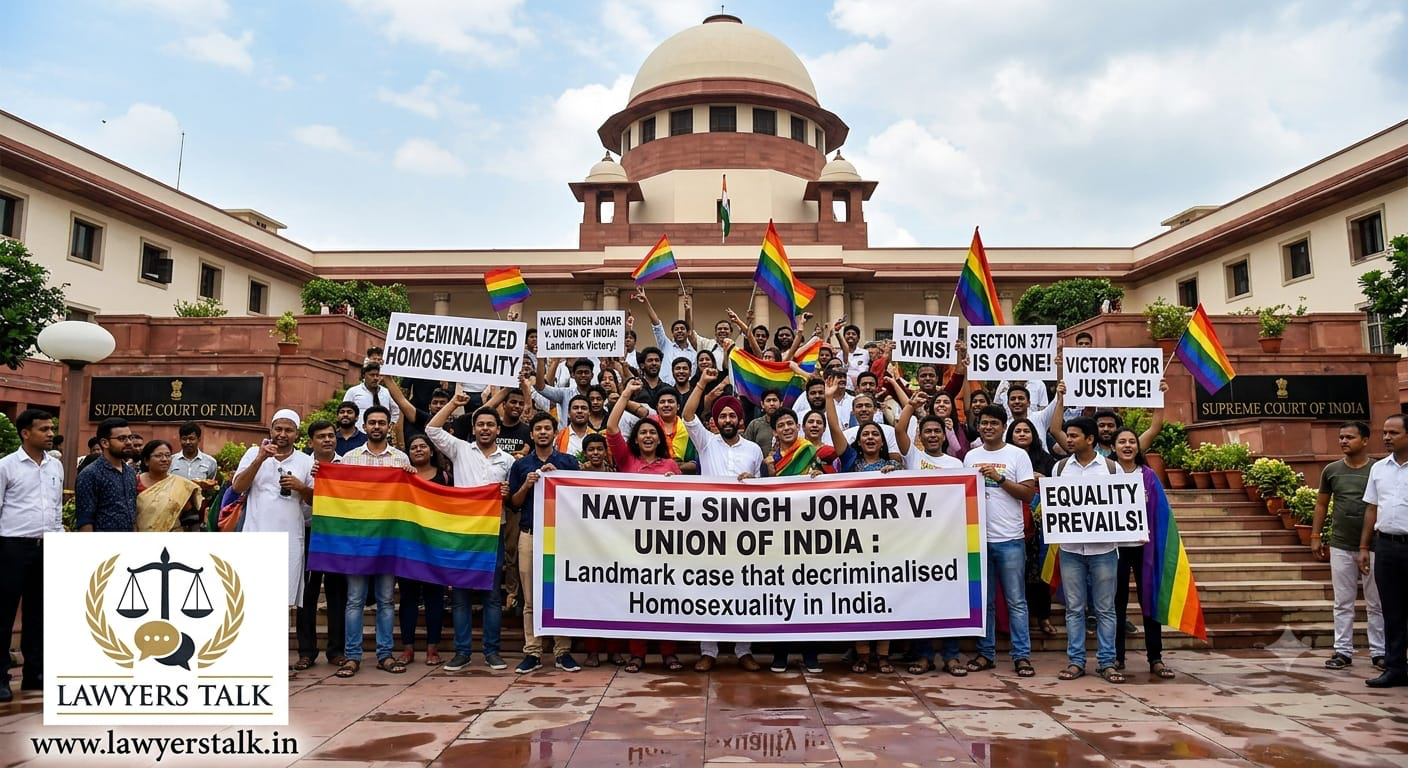
On 6th September 2018, Supreme Court delivered a landmark judgement in nation’s history. In Navtej Singh Johar v. Union of India, a constitutional bench declared that Section 377 of Indian Penal Code (IPC), 1860 which prohibit consensual sex of same sex, decriminalise by SC’s judgement. The verdict marked a constitutional morality, equality, dignity and individual liberty ensuring the right of millions LGBTQ+ who had lived under the shadow of criminalisation for over 150 years. The bench reaffirms that constitutional right of LGBTQ+ cannot be denied only on the ground of person’s identity and presence of this community in very less number.
BACKGROUND OF THE CASE
Section 377 of IPC which was introduced during British Rule 180 which criminalise “carnal intercourse against the order of nature” and prescribed life punishment whoever infringes this section. Although the section applied broadly but mainly it target LGBTQ+ community exposing them to harrasment, discrimination and social stigma. It was legally challenge inmthe case Naz Foundation v. Government of NCT of Delhi (2009), held that section 377 criminalising same sex relation is against fundamental right of individual. This decision was overruled by Suresh Kumar Koushal v. Naz Foundation (2013), which upheld the validity of section 377 on the ground that it is ‘minuscule minority.’
Supreme Court recognise the right to Privacy in K.S. Puttaswamy V. Union of India (2017) and recognition of transgender right in National Legal Service Authority (NALSA) v. Union of India (2014) Navtej Singh Johar an activist with other petitioners approached Supreme Court seeking reconsideration of Kousal Judgement.
ISSUE BEFORE THE COURT
- Whether the section 377 was unconstituional as it criminalise consensual sex between two adults of same sex in private??
- Whether the section violated Article 14, 15, 19, and 21 of the constitution?
- Whether the early judgement in case Suresh Kumar Koushal required reconsideration?
PETITONER ARGUMENT
Petitioner argued that homosexuality is not a crime or a disease, people are born with it they can not control their sex. They submitted that criminalising same sex violate the Fundamental right, autonomy and freedom of expression. Sexual orientation is a part of individual liberty and it cannot be separated from that and every person has right to chose their life partner and express their sexuality without any fear of criminal prosecution. Section 377, perpetuated discrimination, encourage harrasment and infringe of fundamental right guaranteed under Article 14, 15, 19 and 21.
SUPREME COURT ANALYSIS
The five judge Constitution Bench comprising of Chief Justice Dipak Mishra, Justice A.M. Khanwilkar, Justice Rohinton F. Nariman, Justice D.Y. Chandrchud and Justice Indu Mahotra held the section 3777 unconstitutional to the extent that criminalise consensual sexual conduct between adults in private. The Court emphasise that constitutional morality must prevail social morality, fundamental right cannot depend upon approval of majority nor denied because the victim party is in minority.
Right to Equality (Article 14)
The court observed that section 377 arbitraly denied the Right to equality to have sex inprivate as normal people do. Criminalising same-sex relationship infringe Article 14 of individual that is guarantee by constitution of india and it is also a part of basic structure as judgement in Keshavnanda Bharti v. Union of India.
Freedom of Expression (Article 19)
The court recognised that expressing one’s sexual identity comes under freedom of Expression. Criminalising LGBTQ+ consensual sex creating a chilling effect on constitutional freedom.
Significance of Judgement
This case fundamentally transformed India’s constitutional jurisprudence. it reaffirms the dignity and fundamental right of individual, The judgment overruled the previous judgement of Suresh Kumar Kousal, rejecting minuscule minority affirming that judgment do not depend on the numeric number of people.
The judgement decriminalise the same sex relationship between two consensual adult, finally it gave legal recognition to same sex relationship but still Indian system has not aware of same sex marriage and adoption of a child by same sex couple.
CONCLUSION
The decision inn Navtej Singh Johar v. Union of India stand as one of the most important judgement to redefine and shaped the India judicial system and LGBTQ+ community. By decriminalise section 377, Supreme Court reaffirmed the equal dignity of individual and identified individual needs. This was win-win for LGBTQ+, the law which has been practicing since British time held unconstitutional by Supreme Court.