
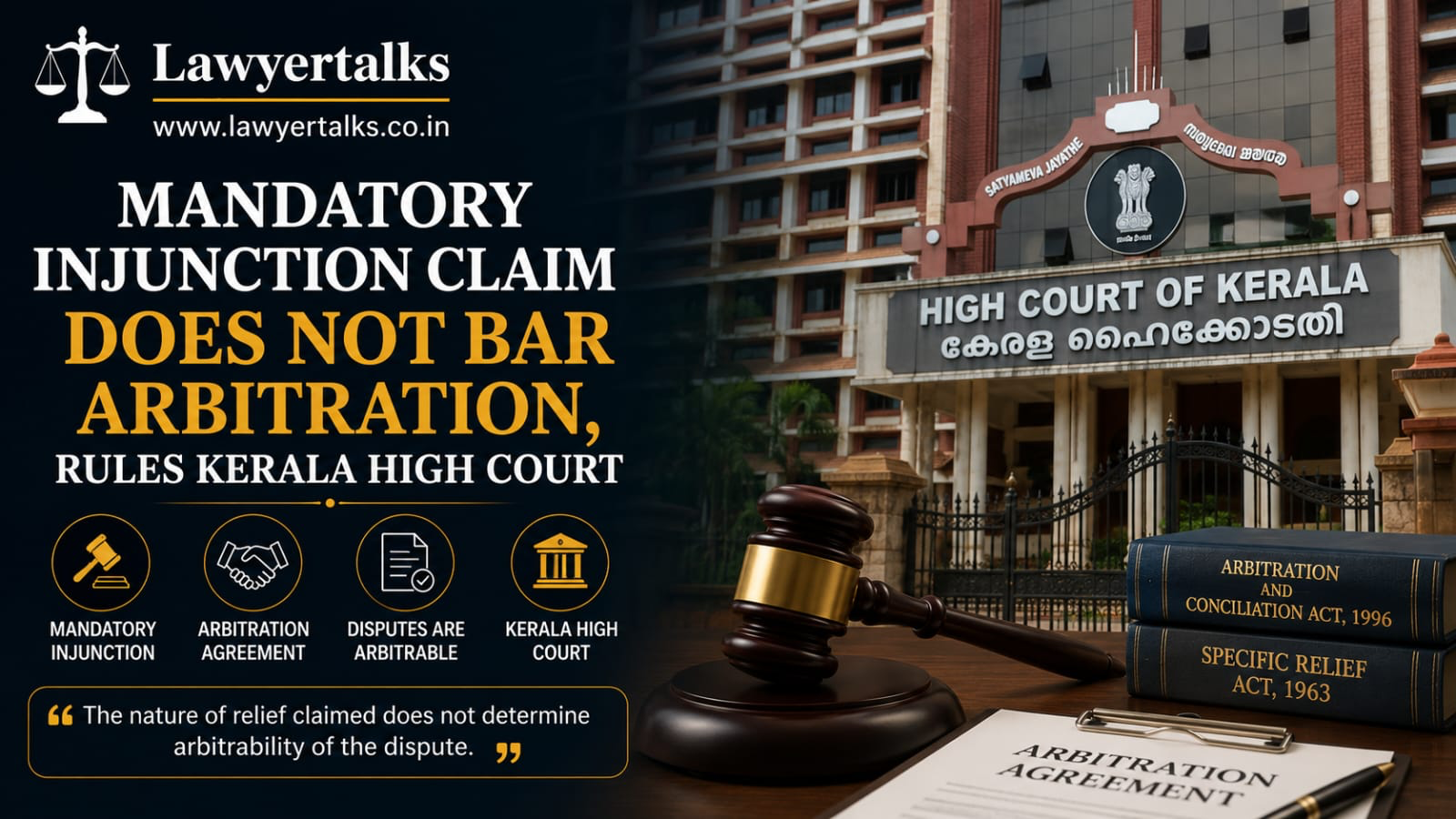
Kerela High Court held that in a dispute of return of original title deeds between two companies Saradhu Lines and Indians Hotels Company Limited (IHCL) remain arbitrable, even after claimant sough permanent injunction in the case by the Court. Court clarifies that prayer for permanent injunction from Court does not make the case non-arbitrable, the nature of the case decide whether an arbitral tribunal has jurisdiction instead of the type of relief sought. Court comfrims that principles that contractual disputes involving private disputes should be resolve by arbitration where parties have agreed to an arbitration clause.
BACKGROUND
The dispute arose from a commercial arrangement between Saradhi lines and Indian Hotels Compnay Limited (IHCL). The original deeds of an immovable property came into the possession of one company, a dispute arise between both the parties of the ownership of the immovable properties. Saradhi Lines asked for the return of deeds but IHCL refuse, it also sough of permanent injunction compeling Indian Hotels to hand over the document. Respondent argued that since injunction claimed by petitioner under Special Releif Act, dispute could be adjudicated by civil court while the petitioner mentioned that since contractual obligation governed by arbitration agreement and was therefore fully arbitrable.
ISSUE BEFORE COURT
The principal questions before the Kerala High Court:
Does inclusion of prayer of of mandatory injunction for the return of title deeds make contractual dispute as non-arbitrable?
The court examined this case whether the dispute fall in Right to rem which particularly saved for civil courts or Right to personam, which decided through arbitration.
COURT FINDING
The High Court decided the case in favour of Arbitration. Court observed that Arbitration usually distinguish between Right to Rem and Right in Personam. Right in rem affect public at large and usually need adjudication by court or statutory authorities. On the other hand Right to personam involve private right concerning with private individual and can be resolve by arbitration. Court observed that the present case was fundamentally contractual, controversy does not involve transfer of ownership property ownership but involve transfer alleged contractual obligation to return the original document. court emphasized that a case having the label of relief cannot determine arbitrability, just because party seeks mandatory injunction does not make the case fall out of jurisdiction of Arbitration on this ground.
Strengthening India’s Pro Arbitration Jurisprudence
The judgement is consistent with supreme Court’s policy to encourage Arbitration and reducing judicial interference in commercial dispute to save the time of court and provide speedy justice to parties, to ensure the growth of economy too. Indian Court always argued that arbitration should recognise as liberal interpretation and doubt of a case whether arbitration can be apply or not, should be decided in the favour of arbitration unless it has been specifically provided in the law to trial the matter through court proceedings.
TIMELINE OF CASE
- Commercial Relationship :- Saradhi Line and Indian Hotels entered into a contractual agreement involving title documents.
- Dispute Arises :- Dispute arises for the retention of title deeds.
- Releif claimed :- Saradi Lines sought return of document along with mandatory injunction.
- Legal Objective :- Indian Hotels believe that relief can only granted by Civil Court as it contain mandatory injunction.
- Kerala High Court Judgement :- Court decided that dispute remains arbitrable instead of mandatory injunction.
CONCLUSION
Kerala High Court marks a important step in strengthening India’s arbitration system by holding that merely inclusion of a prayer of mandatory injunction seeking the return of deeds does not exclude arbitration. Court affirmed on importance of respecting arbitration agreement and focusing on true nature of commercial dispute. For commercial disputes arbitration provides a better judgement, as it is an efficient mechanism for resolving commercial dispute.